12.7mm vs 25.4mm Printheads: Print Window, Line Ceiling, India Price Bands
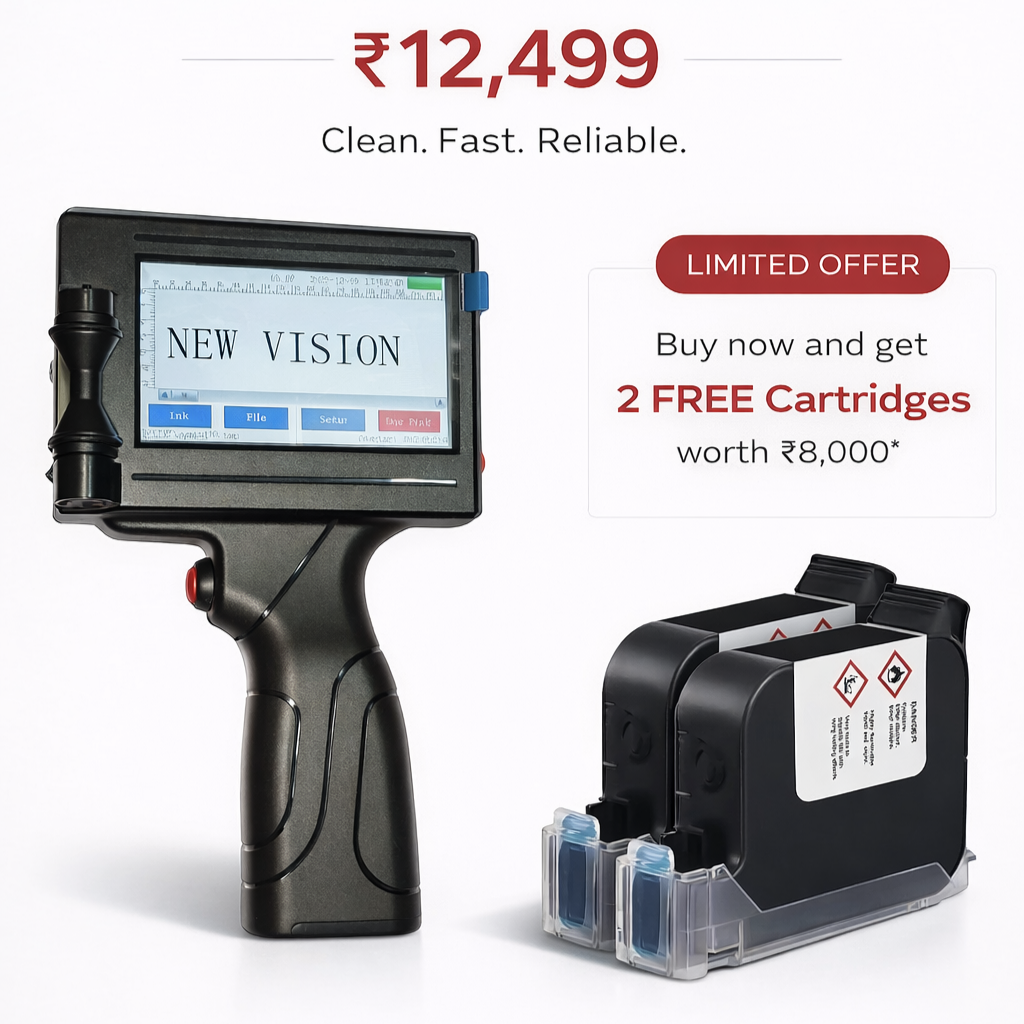
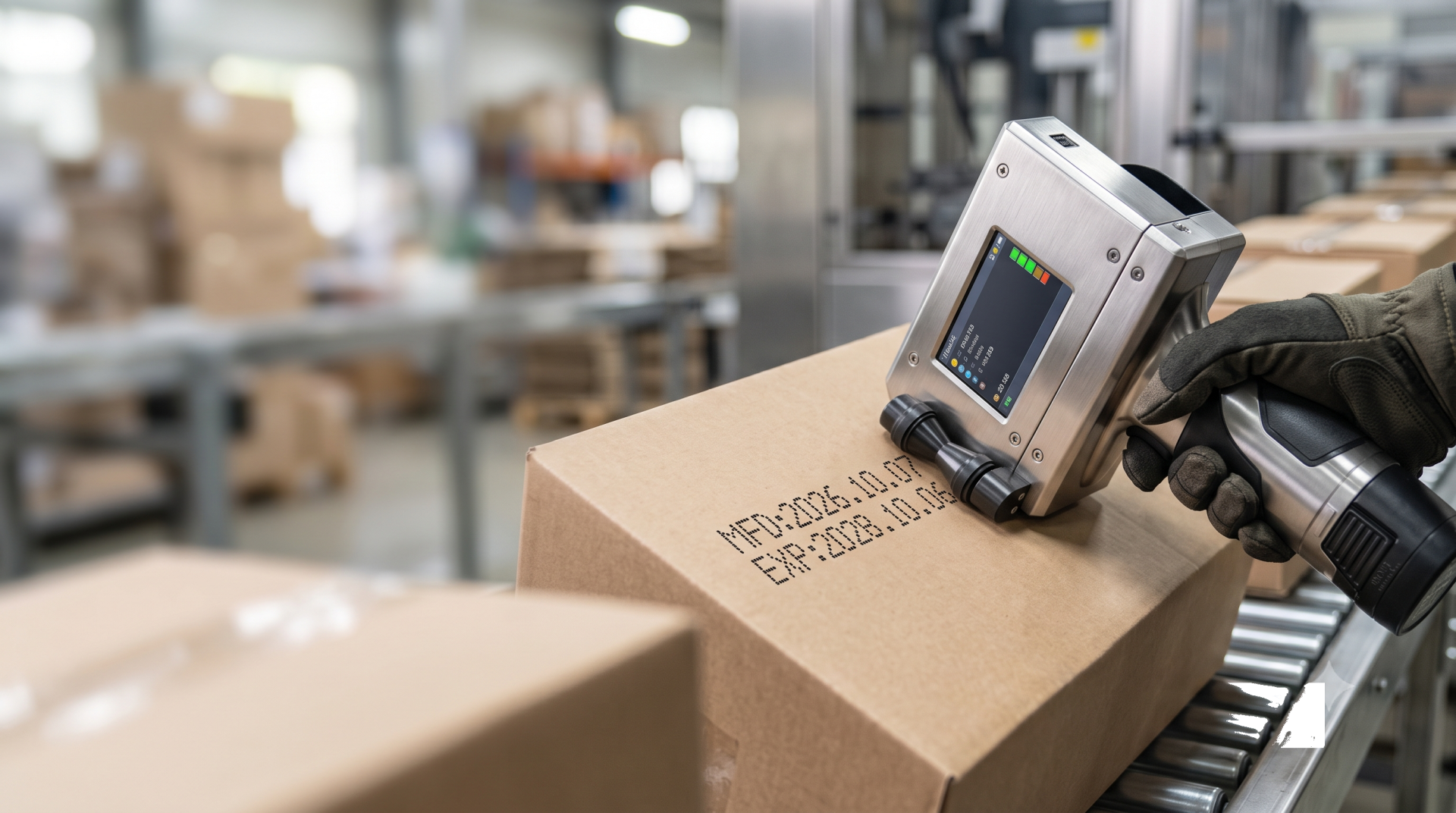
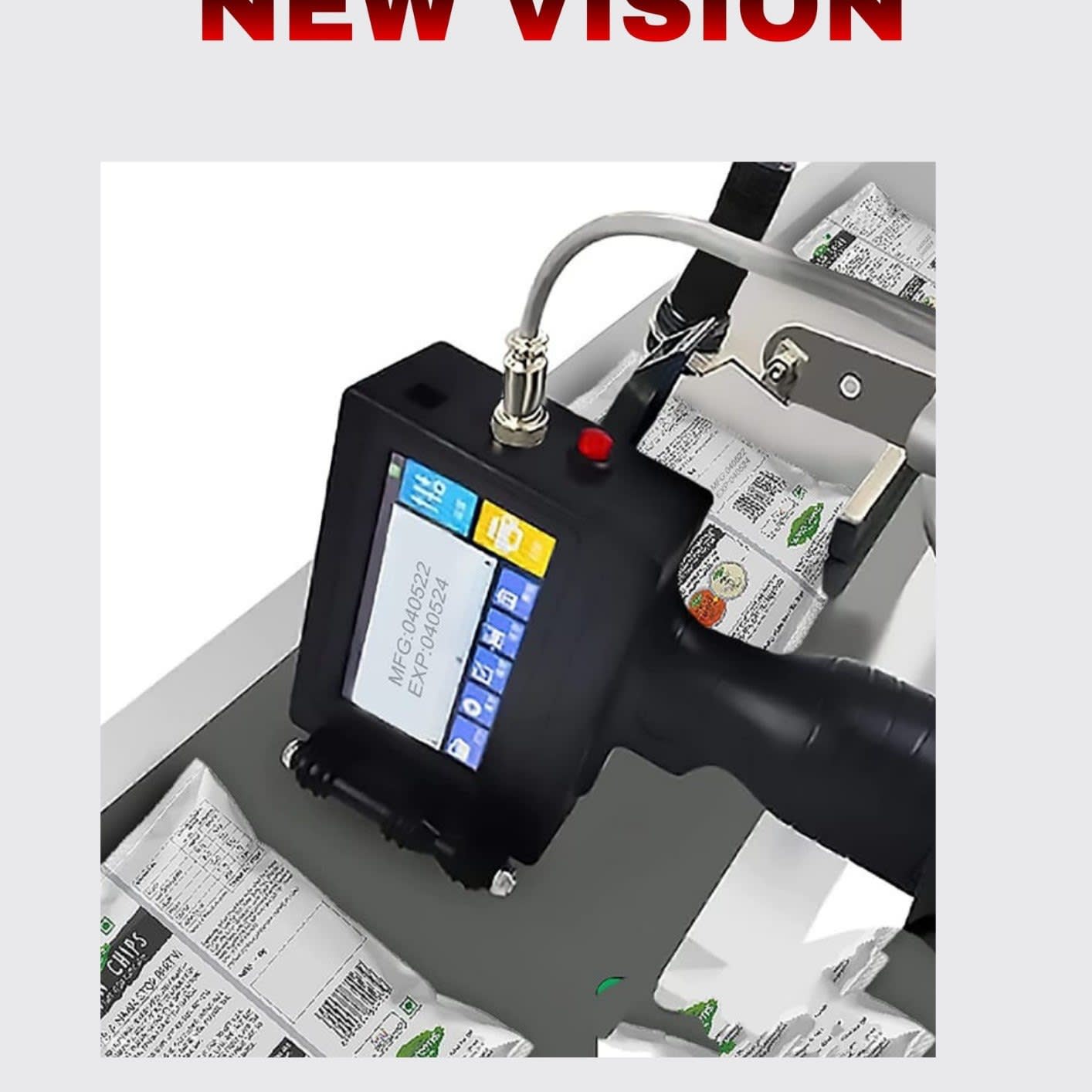
Picking between a 12.7mm vs 25.4mm TIJ printer comes down to one measurement: the total vertical height of your statutory print block in a single pass. A 12.7 mm handheld thermal inkjet printer gives you a 12.7mm (0.5-inch) vertical print swath. That covers standard 1-to-3-line batch, date, and MRP coding on pouches, bottles, and cartons. Step up to a 25.4 mm handheld inkjet printer and the vertical print window doubles to 25.4mm (1 inch)—enough room for taller characters, additional stacked statutory lines, or a larger 2D barcode in one sweep. New Vision Machines (Indore, India) lists its 12.7mm handheld thermal inkjet printer at Rs 12,499 starting-from (ex-works Indore, GST extra) and its 2-inch (50mm) portable TIJ printer at Rs 35,593 starting-from (ex-works Indore, GST extra). Although 25.4mm (1-inch) TIJ printheads exist as a distinct machine class across the industry, New Vision Machines does not currently list a 1-inch unit.
Why does vertical nozzle height matter more right now? Statutory text per pack is expanding in key Indian food segments. On 6 June 2026, India's Department of Consumer Affairs amended the Legal Metrology standard pack-size rules for edible oils to require dual volume and weight declarations, with enforcement starting around 6 September 2026 (reported in June 2026 by Moneycontrol, The Hindu BusinessLine, News18, Times Now, and Akashvani News). If a packing line prints net quantity dynamically in the same block as MRP, unit sale price, batch code, and manufacturing or expiry dates, that extra text forces you to either stack another line or shrink character height.
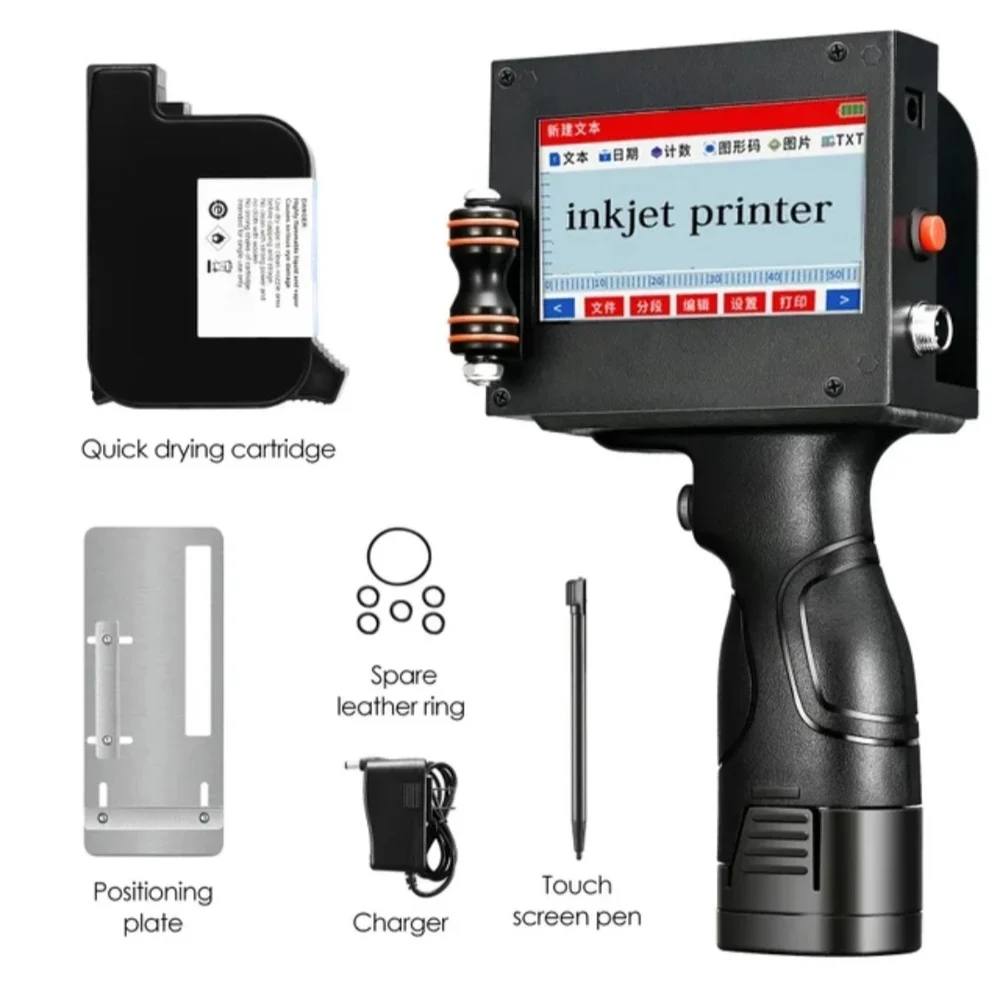
Hardware across the thermal inkjet (TIJ) category shares class-typical specifications: a thermal foaming nozzle architecture firing at up to 600 DPI, a 2–5mm throw distance, and ~42ml cartridges that print alphanumeric text, batch strings, linear barcodes, and QR codes. Buyers researching the 1 inch handheld inkjet printer price in India will find the 25.4mm machine class positioned between 12.7mm entry coders (starting from Rs 12,499 ex-works Indore, GST extra at New Vision Machines) and 2-inch (50mm) wide-swath portable TIJ units (starting from Rs 35,593 ex-works Indore, GST extra at New Vision Machines). You can compare broader hardware tiers in our MRP printing machine price in India buyer's guide.
Legal Metrology Font-Height Math: When 12.7mm Stops Being Enough
Buyers evaluating a TIJ printer for MRP printing India usually ask one question first: how many lines can a 12.7mm printer print without running foul of Legal Metrology font size rules? Touch-screen controllers may let you type five or six lines into a template, but nozzle geometry sets the physical ceiling. Every stacked line of text—plus the blank gap separating each line—has to fit inside the fixed height of the nozzle bank.
To calculate the total vertical print height (H_required) for N stacked lines of uniform character height (h_char) separated by an inter-line gap (g_line), use:
H_required = (N × h_char) + ((N − 1) × g_line)
Rearrange that formula to find the tallest character height (h_char) that fits inside a fixed printhead window (H_window):
h_char = (H_window − ((N − 1) × g_line)) ÷ N
Run the numbers side by side for a 12.7mm window and a 25.4mm window to see how quickly stacked statutory fields shrink your font height:
- 2-Line Print Block (e.g., Batch + MRP) with 1.5mm inter-line gap: 12.7mm printhead: (12.7 − 1.5) ÷ 2 = 5.60mm maximum character height per line. 25.4mm printhead class: (25.4 − 1.5) ÷ 2 = 11.95mm maximum character height per line.
- 4-Line Print Block (e.g., Batch, Mfg/Exp Date, MRP, Unit Sale Price) with 1.0mm inter-line gaps: 12.7mm printhead: (12.7 − 3.0) ÷ 4 = 2.425mm maximum character height per line. 25.4mm printhead class: (25.4 − 3.0) ÷ 4 = 5.60mm maximum character height per line.
- 5-Line Print Block (adding dual net-quantity lines) with 1.0mm inter-line gaps: 12.7mm printhead: (12.7 − 4.0) ÷ 5 = 1.74mm maximum character height per line. 25.4mm printhead class: (25.4 − 4.0) ÷ 5 = 4.28mm maximum character height per line.
Look at what happens at four and five lines. On a 12.7mm head, five lines with 1.0mm gaps squeeze each character down to 1.74mm tall. That math hits edible oil packers directly following the 6 June 2026 Department of Consumer Affairs amendment to the Legal Metrology standard pack-size rules (enforced from roughly 6 September 2026, reported by Moneycontrol, The Hindu BusinessLine, News18, Times Now, and Akashvani News in June 2026). Because edible oil packs must display both volume and weight declarations, lines that dynamically print net quantity alongside MRP, unit sale price, batch number, and date codes either pack more characters onto each line or add another stacked row. Once your required statutory numeral height multiplied by line count crosses 12.7mm, a half-inch printhead forces operators to make two manual passes—or you move up to a wider printhead window (the 25.4mm class, or the 50mm unit available from New Vision Machines).
The QR Code Trap on Pouches: Module Size vs Scanners
Growing search interest around CPCB EPR QR code printing and batch-level 2D traceability has led many plants to print QR codes directly onto flexible laminate pouches with handheld TIJ coders. Class-typical TIJ printheads fire at up to 600 DPI and support QR code and barcode generation out of the box. On the shop floor, however, two physical limits decide whether those printed codes actually scan:
Vertical Swath Allocation and Module Size: A 2D QR code is a grid of black and white square modules surrounded by a mandatory blank margin (quiet zone). On a 12.7mm printhead, the entire height of the QR code plus its top and bottom quiet zones cannot exceed 12.7mm. Stack a human-readable line above or below the code in the same pass, and the QR matrix height drops to 8mm–10mm. Packing a long alphanumeric URL or traceability string into a high-density QR grid inside that tiny footprint makes each individual square module microscopic.
Throw Distance Sensitivity on Flexible Pouches (2–5mm Class-Typical): Class-typical thermal foaming nozzle printheads maintain focus across a 2–5mm throw distance. Filled pillow pouches and stand-up pouches rarely sit flat. When the printhead rollers ride over a pouch seam, wrinkle, or curved fill bulge—pushing the nozzle plate past the 2–5mm throw window—ink droplets fan out in flight and land slightly off-grid. On a small, dense QR code crammed into a 12.7mm window, slight dot placement drift or ink spread across neighboring modules causes optical scanners and phone cameras to fail decoding.
Printing a high-character-count QR code alongside human-readable batch and MRP text in one pass is where a 25.4mm printhead class (or a 2-inch / 50mm portable TIJ printer starting at Rs 35,593 ex-works Indore, GST extra at New Vision Machines) earns its keep. Doubling the overall height of the QR matrix doubles the width of each individual module, giving you far more margin against flexible-film distortion inside the 2–5mm throw window. For substrate preparation and guide-plate positioning on non-porous films and rigid containers, see our guide to printing expiry dates on plastic and metal.
Ink Cost Per Print: What Actually Drives TIJ Running Cost
Brochure claims quoting an arbitrary paise-per-print figure tell you nothing unless they state the font height, character count, DPI setting, and cartridge price behind the math. Calculate running cost yourself using a transparent formula where both inputs are explicitly stated and verified:
Cost per Print (Rs) = Stated Cartridge Price (Rs) ÷ Stated Impression Yield per Cartridge
Class-typical TIJ printers run ~42ml cartridges firing through thermal foaming nozzles at up to 600 DPI. How many impressions you actually get out of one ~42ml cartridge depends on four physical factors:
- Total Printed Area (12.7mm vs 25.4mm Window Utilization): Ink consumption tracks the total number of drops fired per trigger pull, not the physical width of the printhead housing. Print an identical 2-line, 3mm-tall batch and MRP string at the same DPI, and a 25.4mm head consumes the exact same ink volume as a 12.7mm head. Cartridge yield per pack only drops when a plant uses a 25.4mm (or 50mm) head to print taller characters, 5-to-6-line statutory blocks, or large 2D codes that fire more drops per impression.
- Operating Resolution (Up to 600 DPI Class-Typical): Running at the full 600 DPI ceiling puts down four times the droplet density across a 2D area compared to a 300 × 300 DPI setting. Dense QR codes often need higher DPI to keep module edges crisp, whereas plain alphanumeric batch codes can run at lower drop densities to stretch ink life.
- 2D Barcode Fill Ratio: A solid-square QR code covers a much larger share of its bounding box with ink than single-stroke dot-matrix or sans-serif text.
- Nozzle Maintenance and Purging: Thermal foaming nozzles need periodic wiping and spitting before production shifts to clear dried ink from the nozzle plate, which trims the net usable volume of a ~42ml cartridge on low-volume intermittent lines.
Ask your supplier for the exact cartridge price (ex-works, GST extra) and the measured impression yield for your exact character string, font height in millimeters, and DPI setting before locking in consumable budgets.
Which Printhead for Your Pack: A Decision Rule
Match your package layout to the right printhead width across our industrial inkjet printers lineup and the wider TIJ market:
Select a 12.7mm Handheld Thermal Inkjet Printer (Rs 12,499 starting-from, ex-works Indore, GST extra at New Vision Machines) if:
- Your entire single-pass print block (all lines plus inter-line gaps) fits within 12.7mm of vertical height.
- You print 1 to 4 lines of compact statutory data (batch number, manufacturing date, expiry date, MRP, and unit sale price) on pouches, labels, bottles, or mono-cartons where the required numeral height fits inside a 0.5-inch window.
- Your operator or conveyor guide holds the class-typical 2–5mm throw distance across the pack surface.
Evaluate the 25.4mm (1-Inch) TIJ Printhead Class (not currently listed by New Vision Machines) if:
- Your statutory text block or combined QR-plus-text layout needs between 12.8mm and 25.4mm of vertical height in a single pass.
- Multi-line declarations—such as edible oil packaging carrying dual volume and weight declarations under the 6 June 2026 Department of Consumer Affairs amendment (enforced from ~6 September 2026)—push total block height past 12.7mm at your required numeral height.
Select a 2-Inch (50mm) Portable TIJ Printer (Rs 35,593 starting-from, ex-works Indore, GST extra at New Vision Machines) if:
- Your single-pass vertical print block exceeds 12.7mm (or exceeds 25.4mm) and you want a stocked New Vision Machines unit that prints up to a 50mm vertical swath in one pass.
- You print tall outer-case markings, multi-line statutory panels, and large scannable QR codes or barcodes simultaneously without making multiple manual passes.
Swipe or scroll horizontally to view all columns
| Printhead class | Print window | 4 lines at 1 mm gap: tallest character | NVM offering (Oct 2026) | Best for |
|---|---|---|---|---|
| 12.7 mm TIJ | 12.7 mm (0.5 in) | 2.43 mm | Handheld TIJ — Rs 12,499 starting-from, ex-works | 1–4 line batch, date, MRP coding |
| 25.4 mm TIJ | 25.4 mm (1 in) | 5.60 mm | Not listed — discussed as a machine class | 5+ stacked lines, taller numerals, larger QR codes |
| 50 mm TIJ | 50 mm (2 in) | 11.75 mm | Portable TIJ — Rs 35,593 starting-from, ex-works | Outer-case marks, big QR plus text blocks |
Frequently Asked Questions
How many lines can a 12.7mm printer print in a single pass?
A 12.7mm handheld thermal inkjet printer has a fixed 12.7mm (0.5-inch) vertical print window. The exact line count depends on character height and inter-line spacing: with 1.0mm gaps between lines, a 12.7mm window fits 2 lines at up to 5.85mm character height, 4 lines at up to 2.425mm character height, or 5 lines at up to 1.74mm character height.
Does New Vision Machines sell a 25.4mm (1-inch) handheld TIJ printer?
No. While 25.4mm (1-inch) TIJ printheads exist as a machine class, New Vision Machines (Indore) does not currently list a 1-inch unit. New Vision Machines lists a 12.7mm handheld thermal inkjet printer starting from Rs 12,499 (ex-works Indore, GST extra) and a 2-inch (50mm) portable TIJ printer starting from Rs 35,593 (ex-works Indore, GST extra).
Can a 12.7mm TIJ printer print QR codes on pouches?
Yes, class-typical 12.7mm TIJ printers operate at up to 600 DPI and support QR code printing, provided total QR height (including quiet zones) stays at or below 12.7mm and the operator holds the class-typical 2–5mm throw distance on a flat pouch surface. If the QR code holds a long data string or needs to be taller than 12.7mm for reliable scanning on curved flexible films, use a 25.4mm printhead class or a 50mm (2-inch) portable TIJ printer.
How does the June 2026 Legal Metrology edible oil amendment affect TIJ printer selection?
On 6 June 2026, India's Department of Consumer Affairs amended the Legal Metrology standard pack-size rules for edible oils to mandate dual volume and weight declarations, with enforcement beginning around 6 September 2026 (reported by Moneycontrol, The Hindu BusinessLine, News18, Times Now, and Akashvani News in June 2026). If a packager prints net quantity dynamically alongside MRP, unit sale price, batch, and date codes, those extra characters require either a wider print window (such as 25.4mm or 50mm) or smaller per-line character height if constrained to 12.7mm.
Limits and Assumptions
- Ex-Works Pricing Scope: Stated New Vision Machines prices — Rs 12,499 starting-from for the 12.7mm handheld thermal inkjet printer and Rs 35,593 starting-from for the 2-inch (50mm) portable TIJ printer — are ex-works Indore, Madhya Pradesh, with GST, freight, and optional accessories extra. Prices are subject to revision.
- Class-Typical TIJ Specifications: Figures for thermal foaming nozzle architecture, up to 600 DPI resolution, 2–5mm throw distance, and ~42ml cartridge volume represent class-typical TIJ benchmarks. Exact nozzle counts, firmware line limits, and throw tolerances depend on the specific controller and cartridge selected.
- Geometric Line Calculations: The font-height equations in this guide model purely geometric vertical allocation inside a 12.7mm or 25.4mm window and assume uniform line heights and flat substrate contact within the 2–5mm throw distance.