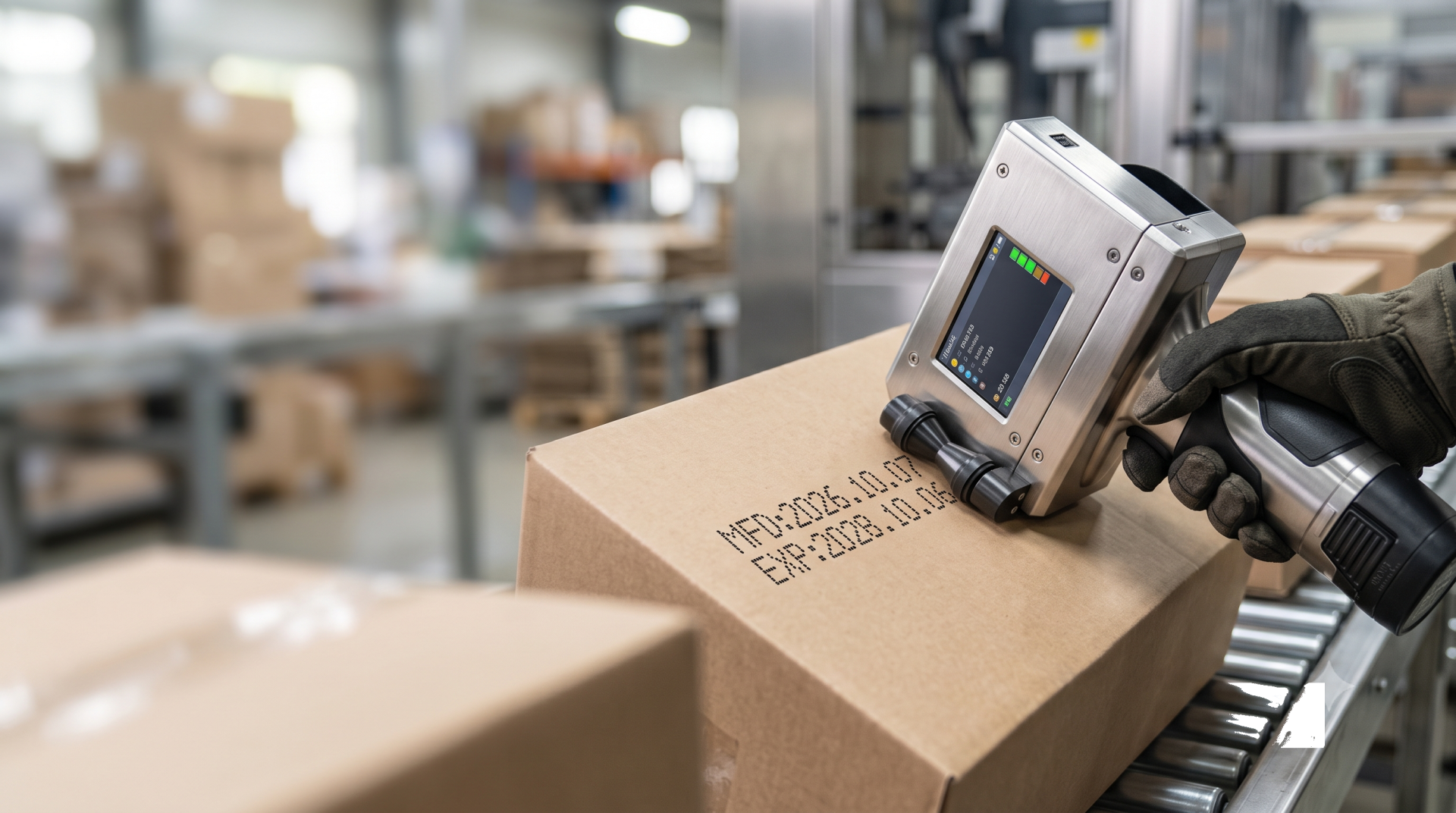
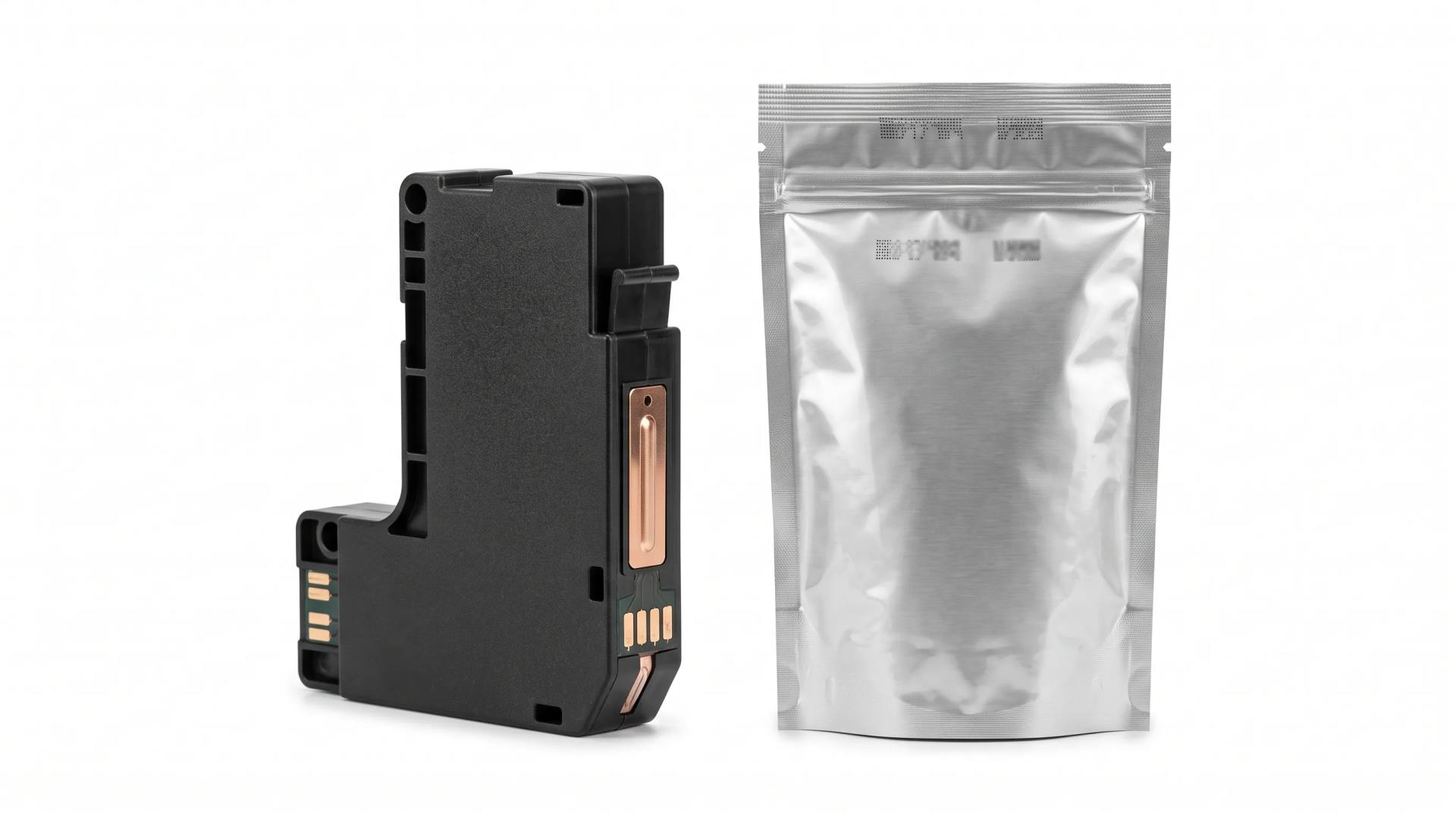
A tij batch coding machine for pouches uses a 12.7mm head for 2-to-4-line batch data, but requires a 1-inch (25.4mm) head when declarations and QR codes demand 5 or more lines.
- 12.7mm printheads deliver a 12.7 mm vertical window, sufficient for 1 to 4 lines of 2.5mm alphanumeric text.
- 25.4mm (1-inch) printheads provide a 25.4 mm print window, fitting 5+ lines alongside a crisp 12mm QR code.
- Non-porous pouch laminates (PET, BOPP, aluminum foil) require fast-drying solvent ink with a 1 to 3 second dry time.
- Replacement TIJ cartridges cost ₹4,000 + GST each, and New Vision Machines supplies two free with every printer.
Thermal inkjet printing has largely pushed hot-foil stamping and wet-ink contact coders off flexible packaging lines. Digital inkjet printers eliminate messy ribbon changes, hot-type block wear, and mechanical stamp puncturing on thin laminate films. For Indian spice millers, snack manufacturers, and chemical packers running pre-formed pouches, selecting the right printhead width directly dictates packaging compliance, line speed, and ongoing consumable expenses.
12.7mm vs 1 Inch TIJ Printer: How Do Printheads Compare on Pouches?
A 12.7mm printhead spans a single 12.7 mm (0.5-inch) vertical swath for 1 to 4 lines of 2.5mm text, while a 1-inch (25.4mm) printhead provides a continuous 25.4 mm swath capable of printing up to 8 lines or combining text with high-resolution 2D barcodes.
When evaluating a 12.7mm vs 1 inch tij printer for pre-formed bags, physical cartridge aperture determines how much variable data fits in a single pass without mechanical stitching.
Swipe or scroll horizontally to view all columns
| Specification / Operational Feature | 12.7mm (0.5-Inch) Printhead | 25.4mm (1-Inch) Printhead |
|---|---|---|
| Maximum Vertical Print Height | 1.0 mm to 12.7 mm | 1.0 mm to 25.4 mm |
| Typical Line Capacity (2.5mm font) | 1 to 4 lines | 1 to 8 lines |
| Maximum 2D / QR Code Size | 10 mm x 10 mm (compact) | Up to 20 mm x 20 mm (high scannability) |
| Printhead Nozzle Stitching | Not required (single die) | Not required (integrated 1-inch die) |
| Recommended Substrates | BOPP, PET, aluminum foil laminates | BOPP, PET, aluminum foil, multi-wall paper |
| Target Packaging Application | Standard 2-3 line MRP, Exp, Batch | 5+ lines: MRP, USP, Dates, FSSAI, QR code |
Note: Dimensions and line limits reflect industrial thermal inkjet hardware deployed across Indian packaging facilities as of October 2026; maximum line counts assume standard 300 DPI horizontal resolution and flat pouch presentation.
A standard 12.7mm thermal inkjet cartridge provides a maximum vertical print window of 12.7 mm across an operational resolution range of 150 to 600 DPI (indicative industry technical specification). If your production requires only batch number, manufacturing date, and MRP, 12.7 mm gives you ample room. Squeezing five lines of legal text into that same 12.7 mm space forces character heights down to 1.8 mm or smaller. On metallized film or crinkled pouch seal margins, tiny characters lose definition and fail basic legibility checks. The 25.4mm head solves this by doubling the print window, keeping characters crisp at 2.5 mm to 3.0 mm.
Why Do Legal Metrology USP Printing on Pouches and FSSAI Rules Require 5+ Lines?
Under the Legal Metrology (Packaged Commodities) Rules 2011 (amended through 2026) and FSSAI Labelling and Display Regulations 2020, pre-packaged food, spice, and chemical pouches must display a minimum of six mandatory declarations: MRP, Unit Sale Price, Month/Year of Manufacture, Expiry or Best-Before Date, Batch Number, and FSSAI license or consumer care registration.
Mandatory compliance under the Legal Metrology (Packaged Commodities) Rules, 2011 requires pre-packaged food commodities in India to display at least six distinct data points, including Unit Sale Price calculated to two decimal places.
Pouch printers historically relied on pre-printed laminate rolls with small white blocks reserved for two or three lines of hot-foil stamping. Handling mandatory legal metrology usp printing on pouches alongside modern digital traceability disrupts that old format completely:
Line 1: Batch Number & MFD (e.g., B.NO. 26K04 | MFD 10/2026)
Line 2: Expiry / Best Before (e.g., EXP 09/2027)
Line 3: Maximum Retail Price (e.g., MRP ₹ 145.00 INCL. OF ALL TAXES)
Line 4: Unit Sale Price (e.g., USP ₹ 0.29 / g)
Line 5: FSSAI License Number (e.g., FSSAI LIC NO. 10012345678901)
Auxiliary: Dynamic GS1 DataMatrix or supply-chain QR code
Once Unit Sale Price and traceability codes enter the layout, the batch block expands past 4 lines. A 25.4mm printhead is built for this data load, accommodating every declaration without forcing operators to program unreadable micro-fonts.
When Does a TIJ Batch Coding Machine for Pouches Require a 25.4mm Head?
A tij batch coding machine for pouches requires a 25.4mm (1-inch) printhead whenever your total print block height exceeds 12.7 mm, which occurs when printing five or more alphanumeric lines or placing a 12mm QR code alongside product declaration data.
Small 50g to 100g spice packs with pre-printed legal copy only need a 12.7mm head to stamp date and price data. Bulk 1 kg to 5 kg pouches, agrochemical bags, and contract packing runs require larger, bolder marks visible across warehouses and distribution hubs.
Using one 25.4mm printhead prevents the alignment headaches that plague dual-cartridge stitched systems. Stitched setups position two 12.7mm cartridges side-by-side to construct a 25.4mm block. If a conveyor belt vibrates or a bracket loosens by even 0.2 mm, an unprinted white gap or an overlapping dark streak slices through the text. A true 25.4mm cartridge prints through a single continuous silicon die plate, eliminating mechanical misalignment entirely. For plants stepping up from table-top manual coding, our handheld inkjet printing guide breaks down manual positioning versus fixed-line mechanical mounting.
What Is the Solvent Ink Cartridge Cost Per Print on Flexible Laminates?
The solvent ink cartridge cost per print is determined by dividing the replacement cartridge purchase price by the total number of printable impressions achieved under specific character and resolution parameters: Cost Per Print = Cartridge Price ÷ Impressions Printed.
Industrial replacement TIJ cartridges from New Vision Machines are priced at ₹4,000 + GST each across India (source: New Vision Machines verified standard rate, October 2026). Two cartridges come bundled standard with every new coding unit.
Thermal inkjet hardware eliminates makeup solvents, pumps, and core filters. That leaves the ink cartridge as your sole variable operating expense:
Cost Per Print (₹) = Cartridge Price (₹) / Total Impressions Achieved
Print costs depend heavily on the ink volume deposited per pouch, as shown in these two production scenarios:
Illustrative Scenario A (Compact 2-Line Code): Printing 2 lines (MFD, EXP, MRP) at 300 DPI horizontal resolution with small 2.5mm characters and low dot coverage. Cartridge price: ₹4,000 (excluding GST). Illustrative production run: 100,000 impressions. Cost per pouch = ₹4,000 / 100,000 = ₹0.040 per impression (4.0 paise per pouch, excluding GST).
Illustrative Scenario B (Full 5-Line Declaration Block + QR Code): Printing 5 lines of legal text alongside a 12mm x 12mm QR code at 300 DPI, representing substantially higher dot density per pack. Cartridge price: ₹4,000 (excluding GST). Illustrative production run: 40,000 impressions. Cost per pouch = ₹4,000 / 40,000 = ₹0.100 per impression (10.0 paise per pouch, excluding GST).
Disclaimer: These impression counts are illustrative calculation models to demonstrate variable cost per pouch, NOT rated manufacturer cartridge yields. Actual yields depend on drop volume, character size, font selection, and print resolution.
Evaluating the mrp batch coding machine price in india requires looking past equipment invoices to calculate per-pack consumable costs over multi-shift production runs. A detailed cost breakdown across various drop sizes is available in our TIJ cartridge cost per print guide.
Solvent vs Aqueous Ink: Which Formulation Adheres to Pouch Films?
Solvent-based (alcohol- or MEK-based) inks are required for non-porous flexible pouch laminates such as BOPP, PET, CPP, and metallized foil, whereas aqueous (water-based) inks are formulated exclusively for porous substrates like untreated paper pouches and corrugated shipper cartons.
Solvent-based thermal inkjet inks typically achieve touch-dry adhesion on non-porous BOPP and PET laminate films within 1 to 3 seconds at an ambient temperature of 25°C to 30°C (indicative technical benchmark).
Aqueous ink requires porous paper fibers to absorb the liquid carrier. Sprayed onto glossy plastic film, aqueous droplets bead up into liquid pools, smear across guide rails, and rub off instantly. Solvent inks carry pigments suspended in fast-evaporating organic carriers. Once jetted onto non-porous film, the solvent flashes off within seconds, locking the resin-bound colorant to the polymer surface. This bond resists moisture, friction, and spice oils during transit and supermarket shelf stocking.
Test the full 5-line block plus QR code on your actual pouch film before a production run, and check the code at 1.5 mm throw distance after the sealer cools the pouch.
Why Integrate an Online TIJ Printer for Band Sealer Lines Instead of Handheld Units?
An online tij printer for band sealer operations automates batch coding by utilizing an external optical sensor to trigger printing at conveyor speeds up to 30 to 60 meters per minute, eliminating the manual alignment errors and variable line pitch inherent to operator-triggered handheld units.
Mounting an online tij batch coding machine for pouches directly to a continuous band sealer automates coding right where the top seal cools:
- Rigid Bracket Integration: A heavy-gauge steel bracket secures the printhead right beside the sealer cooling blocks, targeting the pouch margin as the drive belts discharge it.
- Photocell Synchronization: A dedicated photoelectric eye detects the leading edge of each moving pouch, firing the printhead at a precise millisecond delay for uniform code placement.
- Line Speed: Handheld coders top out around 15 to 25 pouches per minute because operators must manually align each mark. Continuous band sealers fitted with online heads process 40 to 80 pouches every minute without operator fatigue.
Limits and Assumptions of TIJ Batch Coding on Pouches
Thermal inkjet printing on flexible pouches operates within precise mechanical tolerances, requiring a maximum nozzle throw distance of 1.0 mm to 3.0 mm and rigid substrate presentation to prevent character distortion.
Operating a tij batch coding machine for pouches successfully requires accounting for four physical line constraints:
- Nozzle Throw Distance: TIJ nozzles project tiny ink droplets across short distances. If pouch wrinkles, gusset folds, or puffy pillow packs push the film beyond 3.0 mm from the nozzle plate, droplets scatter in the air, creating blurry letters and unreadable barcodes.
- Surface Energy: Plastic packaging film must maintain a surface wetting tension of at least 38 dynes/cm. Virgin polymer films containing heavy slip additives or unconditioned polypropylene can reject ink bonding, requiring corona treatment for firm adhesion.
- Pouch Stability on Conveyors: Puffy, nitrogen-flushed spice or wafer bags bounce on loose belt conveyors. These pouches require hold-down guide rails or top stabilizer belts to keep the print panel flat as it sweeps past the printhead.
- Nozzle Decap Time: Solvent inks dry through rapid air exposure. In typical Indian factory conditions (28°C to 38°C with ambient spice dust), uncapped cartridges dry out within 15 to 45 minutes of line downtime. Operators must slide the silicone cap over the cartridge during shift breaks to prevent clogged nozzles.
Field Troubleshooting: 4 Common Pouch Coding Defects and Fixes
Most thermal inkjet pouch coding defects stem from improper throw distance, incorrect solvent formulation, or conveyor sensor synchronization errors.
1. Smudged Code on Laminated Film
Root Cause: Running an aqueous ink cartridge on non-porous polymer laminate, or dropping freshly printed pouches into collection bins before the solvent flashes off. Corrective Fix: Confirm the cartridge contains a verified industrial solvent formulation; extend the conveyor run-out to give pouches at least 2 full seconds of open air before they hit guide rails or collection crates.
2. Unreadable QR Code at Small Print Size
Root Cause: Cramming a dense 2D barcode into a 12.7mm head alongside four text lines, shrinking individual modules below 0.35 mm, or running the controller below 300 DPI. Corrective Fix: Switch to a 25.4mm printhead to expand the QR code footprint to 12 mm or 15 mm square; adjust controller settings to 300 or 600 DPI and lock nozzle clearance to 1.5 mm.
3. Missed Trigger on Fast Conveyors
Root Cause: Optical sensor blinded by glare off reflective metallic foil or clear poly film, or sensor response lagging behind high conveyor speeds. Corrective Fix: Tilt the sensor eye 10 to 15 degrees off perpendicular to deflect specular glare, switch to a polarized retro-reflective optical sensor, and adjust the electronic trigger delay on the controller.
4. Wrong Ink for the Film Substrate
Root Cause: Applying standard solvent ink to low-surface-energy poly films or wax-coated barriers, leading to ink flaking under finger friction. Corrective Fix: Perform an on-site tape-adhesion pull test; switch to a high-adhesion modified solvent cartridge specifically engineered for low-dyne polymer films.
Frequently Asked Questions
How Many Prints Can You Get from One 42ml TIJ Cartridge?
A 42ml cartridge has no fixed rated yield because ink consumption depends entirely on font size, DPI, and character count. Operators calculate yield using the standard formula: total prints equal cartridge ink volume divided by consumption per code. A 2-line date code consumes far less ink than a 5-line block containing a dense 2D QR code.
Does TIJ Ink Adhere Reliably to Laminated Pouches?
Solvent-based TIJ ink bonds firmly to non-porous films like BOPP, PET, and aluminum foil, drying within 1 to 3 seconds through carrier evaporation. Water-based aqueous inks fail completely on flexible film, smearing immediately upon contact. For flexible packaging lines, fast-drying ethanol- or MEK-based solvent cartridges produce durable, rub-resistant codes that withstand pouch handling, transport, and friction.
What Is the Difference Between 12.7mm and 25.4mm TIJ Printheads?
The primary difference is the physical nozzle aperture height: 12.7 mm versus 25.4 mm. A 12.7mm head prints up to 4 lines of alphanumeric text, while a 25.4mm head prints up to 8 lines or pairs a 5-line statutory declaration with a scannable 12mm QR code on a single, continuous die without printhead stitching gaps.
Can You Mount a Handheld TIJ Printer on a Continuous Band Sealer?
Handheld units can mount on band sealers using an external optical sensor and bracket, but purpose-built online TIJ printers offer superior production stability. Dedicated online systems include industrial bracketry, vibration damping, and direct sensor relays that prevent the trigger latency and positional drift common when running adapted handheld coders on high-volume pouch sealing conveyors.
Contact New Vision Machines for direct engineering assistance integrating online thermal inkjet coders onto continuous band sealers or form-fill-seal equipment: test your packaging films at our manufacturing and demonstration center in Lasudia Mori, Indore, call +91-9981604279 to run sample prints on your specific laminates, calculate per-pouch ink consumption, or inspect mounting brackets matched to your conveyor speeds.