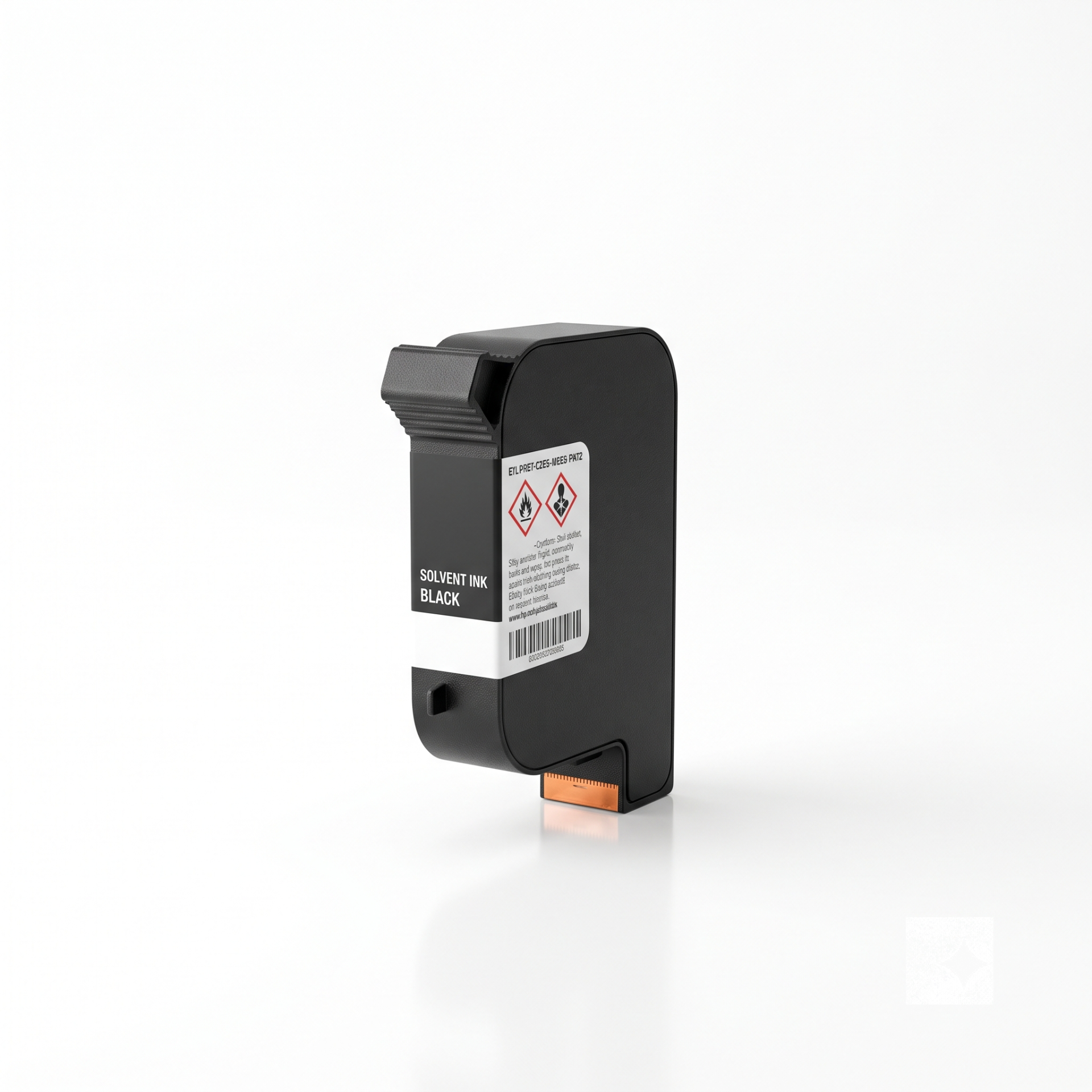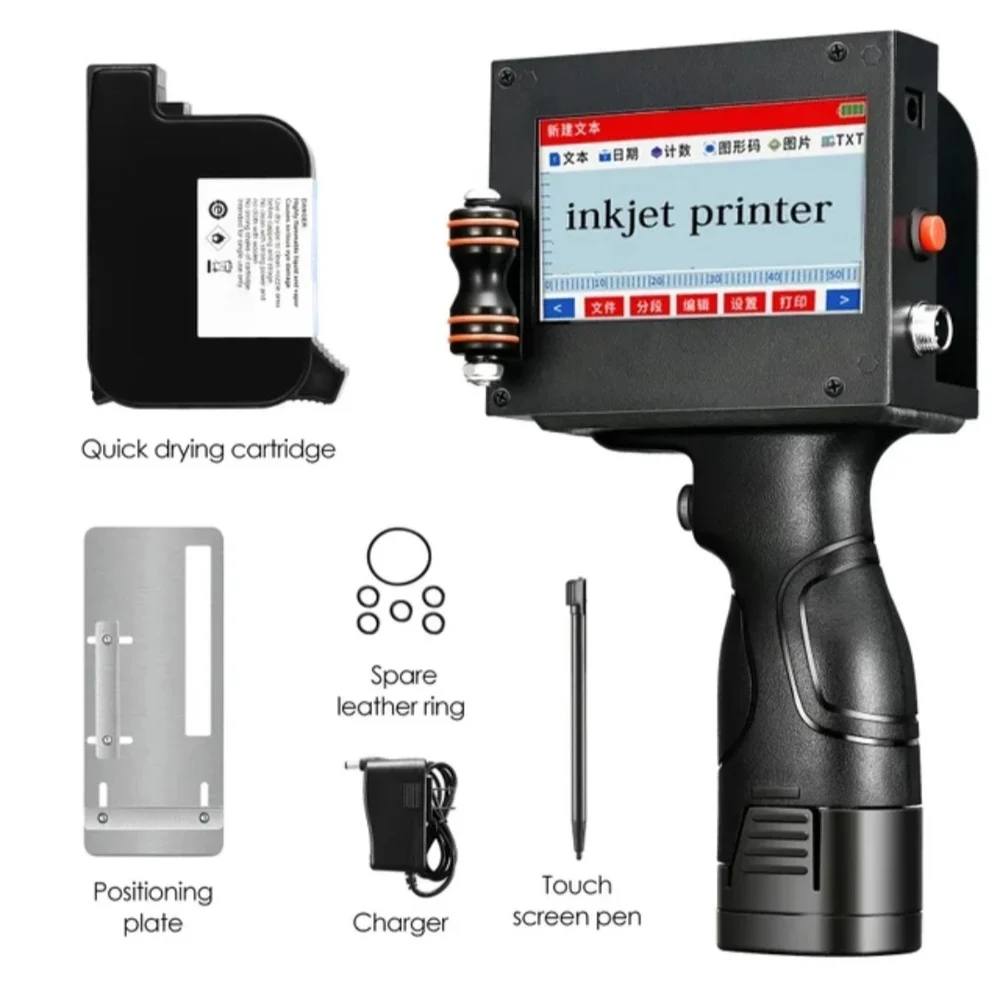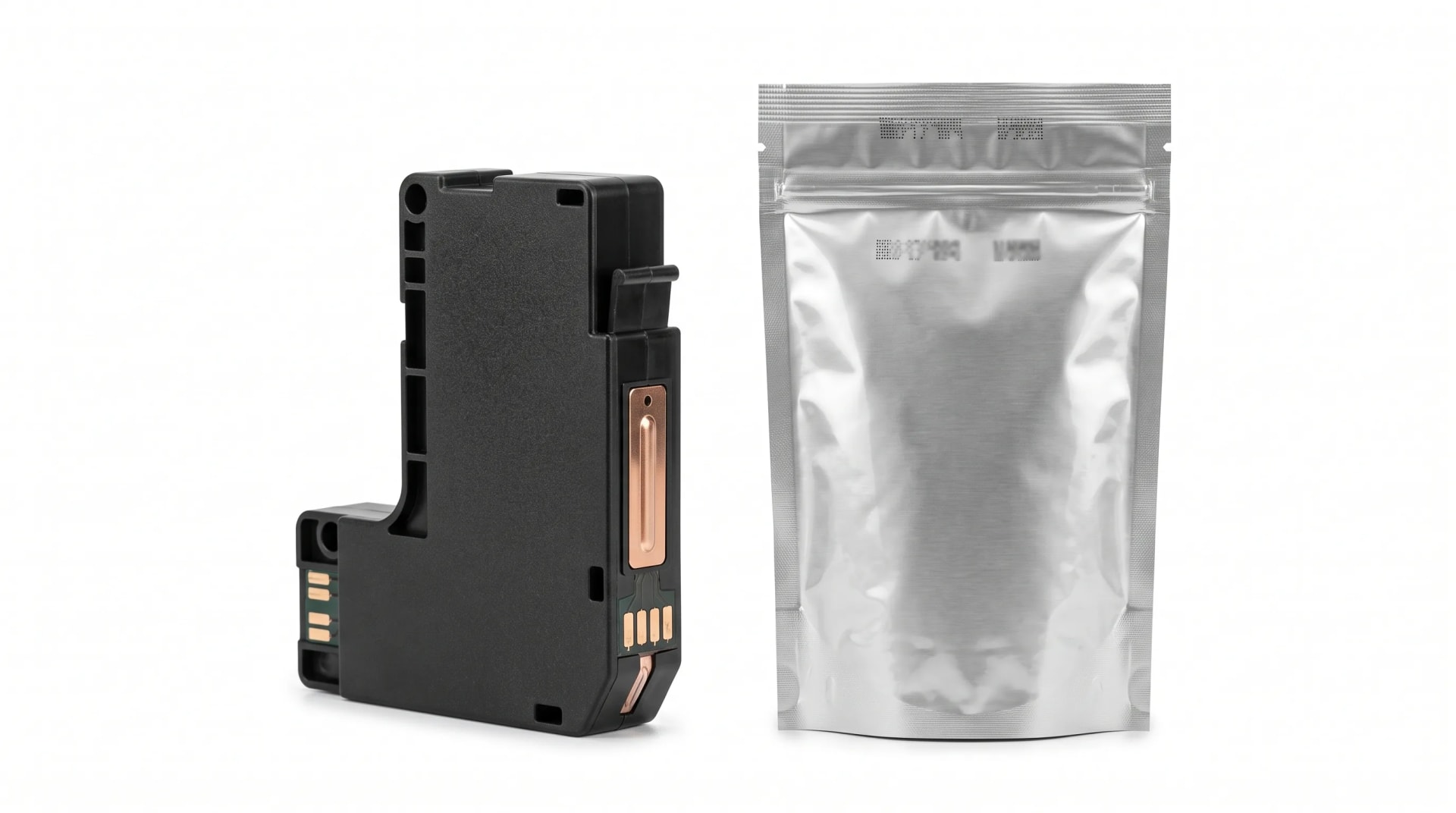
A standard 42ml solvent cartridge prints roughly 150,000 two-line pouches at 300 DPI — about 2.0 paise per pouch. Print density, line count, and optical resolution determine true cartridge yields.
How many prints can you get from one 42ml TIJ cartridge?
A standard 42ml thermal inkjet cartridge delivers between 50,000 and 420,000 package impressions depending directly on character count, selected font height, and firing dot resolution, effectively countering common reseller marketing claims of an unverified flat six lakh characters per single cartridge.
To determine your true ink cost, run your line parameters through this baseline formula:
Total impressions = Cartridge fluid volume (picolitres) ÷ (Character count × Dots per character at chosen DPI × Picolitres per drop)
A standard two-line batch code (B.No, MFD, EXP, MRP) runs between 24 and 30 characters. This table breaks down what you can actually expect from a standard 42ml cartridge under normal production conditions:
Swipe or scroll horizontally to view all columns
| Configuration | Text Content | Font Height & DPI | Indicative Impressions (42ml) | Indicative Ink Cost / Pouch (at ₹3,000 / 42ml) |
|---|---|---|---|---|
| Simple Date Code | 1 Line (8 chars: 20/10/26) | 2.0mm at 300 DPI | ~420,000 | ~0.7 paise |
| Standard Regulatory | 2 Lines (24 chars) | 2.5mm at 300 DPI | ~150,000 | ~2.0 paise |
| High-Density Retail | 2 Lines (24 chars) | 2.5mm at 600 DPI | ~75,000 | ~4.0 paise |
| Extended Compliance | 3 Lines (36 chars) | 2.0mm at 300 DPI | ~100,000 | ~3.0 paise |
| 2D DataMatrix + Text | QR (10x10mm) + 2 Lines | Standard at 300 DPI | ~55,000 | ~5.5 paise |
All NVM prices are ex-works Indore, GST extra. If you are sourcing authentic supplies, the genuine HP 2590 solvent cartridge is available at ₹4,600 ex-works Indore (MRP ₹6,100). The genuine HP 2590 (W3T10B) holds 47ml of solvent black ink. Do not confuse this with third-party 42ml compatible cartridges sold across Indian industrial markets at prices between ₹2,300 and ₹4,500. To see complete online coding solutions, browse our full TIJ batch coding equipment range.
How does cost-per-print arithmetic change between 300 and 600 DPI?
Doubling print resolution from 300 DPI to 600 DPI doubles the droplet density along the horizontal print axis, doubling fluid consumption from roughly 2.0 paise to 4.0 paise per two-line pouch while cutting total cartridge yields by exactly half on production lines.
Switching from 600 DPI solid fonts to 300 DPI draft font modes provides a directional ink consumption reduction of approximately 40% to 50%. At 300 DPI, alphanumeric batch numbers, dates, and prices print cleanly and remain fully legible to shopkeepers and consumers. You only need 600 DPI if your packaging includes high-density 2D DataMatrix codes or micro-QR codes under 8mm. Assuming an indicative compatible cartridge price of ₹3,000, running a 2-line code at 300 DPI costs you about 2.0 paise per pouch. Dial that same printer up to 600 DPI, and your cost climbs to 4.0 paise per pouch. To pick the right print head dimensions for your pouches, see our technical guide on 12.7mm vs 25.4mm printheads.
When should you specify solvent versus water-based ink cartridges?
Substrate porosity and surface tension dictate ink chemistry, requiring fast-drying solvent formulations for non-porous films, plastics, foils, and coated tins, whereas water-based aqueous inks are strictly specified for porous absorbent materials like virgin corrugated outer cartons, kraft paper, and unvarnished paperboard labels.
Swipe or scroll horizontally to view all columns
| Parameter | Water-Based (Aqueous) Cartridge | Solvent-Based (MEK / Ethanol) Cartridge |
|---|---|---|
| Compatible Substrates | Corrugated outer cartons, virgin kraft paper, paperboard tags, unvarnished absorbent labels, wooden shipping crates | Non-porous films (BOPP, PET, LDPE pouches), HDPE rigid bottles, glass containers, aluminium blister foil, tinplate |
| Drying Time | Instantaneous absorption on porous fibers (0.5–1 second) | 3 to 5 seconds on smooth plastic films and metal sheets via solvent flash-off |
| Smudge Resistance | Highly durable on fiber; dissolves if exposed to moisture | High resistance to water, friction, and mild chemical wipes once cured |
| Substrate Surface Tension | Requires high surface energy and open pores | Wetting capabilities down to 36 dynes/cm surface tension |
| Typical Cost Tier | Indicative ₹1,400 to ₹2,500 per 42ml cartridge | Indicative ₹2,300 to ₹4,500 per 42ml compatible; ₹4,600 verified for genuine HP 2590 (47ml) |
Keep upcoming regulatory updates in mind. The Press Information Bureau notice from 6 June 2026 (PRID 2269789) mandated standardized pack sizes and dual volume-and-weight declarations on edible oil containers, taking effect around 6 September 2026. Printing both volume and net weight adds a third line of text, naturally increasing your ink consumption per pouch. Meanwhile, the FSSAI advisory dated 18 October 2026 (PTI) tightened cold-chain transport traceability without creating new on-pack coding rules. However, smeared codes are a compliance risk at inspection. Read our detailed breakdown of FSSAI packaging declarations to keep your labeling audit-ready.
How do you solve ink adhesion failures on oily pouches and cold bottles?
Solving ink adhesion failures on oily pouches and cold beverage containers requires stripping surface barrier films with high-velocity upstream air knives, extending drying time before handling, or switching to aggressive fast-flashing modified solvent cartridges formulated to penetrate low-surface-energy films down to 36 dynes.
On edible oil filling lines, fine aerosol mist or oil drips inevitably coat pouch film surfaces before they hit the coding bracket. Standard solvent inks cannot cut through this film; the droplets bead up and rub off under slight friction. Installing a directional air knife upstream of the TIJ head blows away surface oil and clears condensation from cold bottles filled in refrigerated lines.
On cold bottles, bottle condensation dilutes the fast-evaporating solvent carrier before it can etch into the polymer matrix. If the air knife cannot completely dry the bottle surface, you must use high-adhesion modified solvent cartridges formulated with specialized ketone or ethanol blends. Assess your operational reliability by checking our field guide on batch coding machine reliability or our comparative breakdown of the best batch coding machines.
How do you manage decap time and nozzle drying in 35°C to 42°C factory conditions?
Managing decap time and nozzle crusting in Indian factory heat between 35°C and 42°C requires capping print cartridges during downtime exceeding three minutes, configuring automated micro-spit purge cycles during conveyor pauses, and cleaning dry faceplates exclusively using lint-free wipes dampened with pure isopropyl alcohol.
Decap time is the duration a printhead can sit idle in ambient air and still fire the first ink droplet without missing dots or distortion. In Indian summer conditions, the volatile solvent in exposed 12.7mm nozzles evaporates rapidly, forming a solid polymer skin over the microscopic firing orifices.
To maintain continuous line operation, operators must execute strict maintenance protocols:
Clip the rubber-sealed cartridge travel cap onto the printhead whenever the production line stops for more than 3 minutes.
If nozzles show partial clogging (missing horizontal text lines), wipe the orifice plate in one direction using a lint-free cleanroom wipe dampened with 99% pure isopropyl alcohol. Never shake the cartridge violently.
Program an automated spit function in the printer firmware to purge one microscopic droplet every 15 to 30 seconds during conveyor pauses to keep nozzles open.
Limits and assumptions
Yield models and print calculations in this guide represent indicative engineering estimates assuming standard character drop sizes, non-condensing production conditions, and routine nozzle maintenance, with actual operational costs varying across specific font typography, bar code geometry, and ambient plant temperatures. The 42ml cartridge metrics reflect common third-party compatible cartridges, whereas the verified HP 2590 reference uses its genuine 47ml volume. Machine pricing is ex-works Indore, GST extra, excluding delivery and integration accessories.
Concrete field troubleshooting defects with fixes
Thermal inkjet troubleshooting in fast-paced industrial packaging lines requires resolving nozzle clogging, poor substrate film wetting, electrical firing voltage drift, and excessive throw distance through systematic solvent cleaning, correct cartridge mechanical latching, firmware pulse width adjustments, and precise printhead mounting realignment.
Missing Horizontal White Lines Across Text: Dried solvent residue has crusted over specific firing nozzles along the print array.
Fix: Wipe the nozzle face firmly from top to bottom using a lint-free polyurethane wipe wetted with pure isopropyl alcohol (IPA); do not scrub back and forth.
Ink Beading and Smearing on Laminated Pouches: Film surface tension is below 38 dynes/cm, or surface slip additives prevent proper wetting.
Fix: Increase printer dry time delay before handling, switch to an aggressive solvent-base formulation, or wipe print zone with an inline dry-air jet.
Faint or Ghosted Text Printing: The cartridge is unseated, or low electrical voltage pulses fail to heat the thermal firing resistors adequately.
Fix: Reseat the cartridge into the print carriage clamp, lock the cam lever securely, and bump up the firing pulse width via printer technician settings.
Nozzle Bleeding and Blurred Character Edges: The cartridge printhead is positioned too far from the substrate, causing ink droplets to drift in turbulent line air.
Fix: Readjust the printhead bracket so the nozzle face sits strictly within 1.5mm to 2.0mm of the moving packaging container.
Never leave a solvent TIJ cartridge installed in an idle machine across shift changes or lunch breaks. Storing the cartridge in an airtight plastic clip with a silicone gasket takes 5 seconds and prevents nozzle crusting, saving a meaningful share of ink otherwise wasted in manual purge cycles.
What is the genuine fluid volume of an HP 2590 cartridge?
The genuine HP 2590 (W3T10B) solvent cartridge contains 47ml of black solvent ink, whereas third-party compatible cartridges commonly marketed across India hold 42ml, making fluid capacity verification essential when evaluating true unit cost differences between authentic OEM supplies and aftermarket alternatives.
Can water-based cartridges print batch codes on BOPP laminated pouches?
Water-based aqueous cartridges cannot print batch codes on BOPP laminated film because plastic surfaces lack porosity, preventing water droplets from penetrating the polymer matrix and causing wet ink to bead up and smear immediately upon contacting downstream conveyor guide rails.
How does ink consumption change when printing barcodes instead of text?
Printing scannable barcodes and 2D DataMatrix graphics increases ink consumption substantially compared to standard text because solid dark modules and high optical contrast requirements demand dense drop placement, typically tripling total fluid usage per pouch compared to simple alphanumeric date codes.
Why does a solvent cartridge stop firing after sitting idle for two minutes?
A solvent cartridge stops firing after sitting idle for two minutes because volatile carrier solvents like ethanol or MEK evaporate rapidly when exposed to factory air, forming a solid polymer crust over the microscopic nozzle orifices that blocks subsequent ink droplet ejection.
What damage occurs if you wipe a dry printhead with standard cotton cloth?
Wiping an industrial TIJ printhead with standard cotton cloth or coarse paper towels scratches the delicate silicon orifice plate and deposits loose textile fibers across microscopic nozzle openings, deflecting fired ink trajectories and permanently degrading character print quality on active packaging lines.
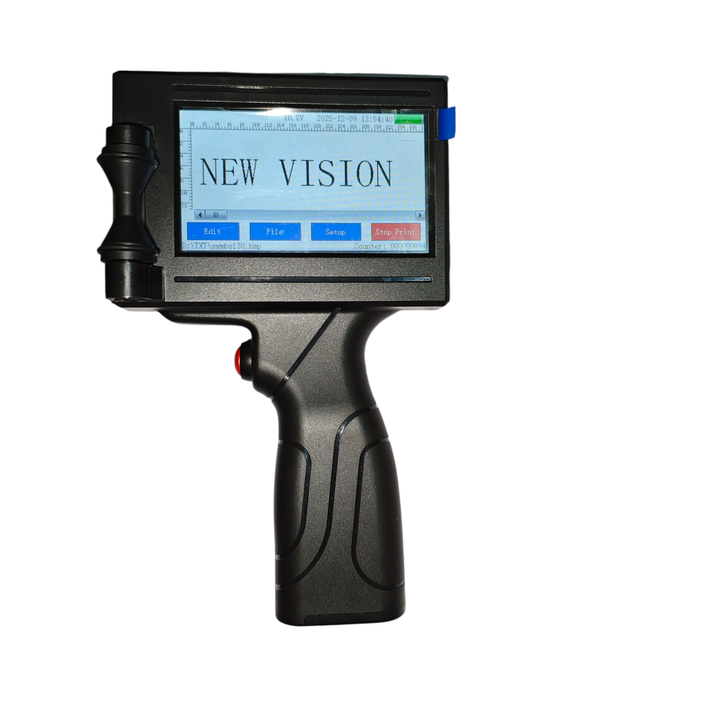
For technical batch coding integration support, purchasing genuine HP cartridges, or testing sample substrates, contact New Vision Machines at +91-9981604279 or visit our works at Lasudia Mori, Indore, MP 452010. Author: Abhishek.