Every packaged product sold in India must carry its MRP and expiry date — that's the law under the Legal Metrology (Packaged Commodities) Rules, 2011. A handheld date MRP printing machine is how most small and mid-size Indian manufacturers get this right without investing in a full conveyor-based coding line. If you're still using rubber stamp coders or outsourcing the job, you're either losing compliance or losing time — probably both.
What Is a Handheld TIJ Date MRP Printing Machine?
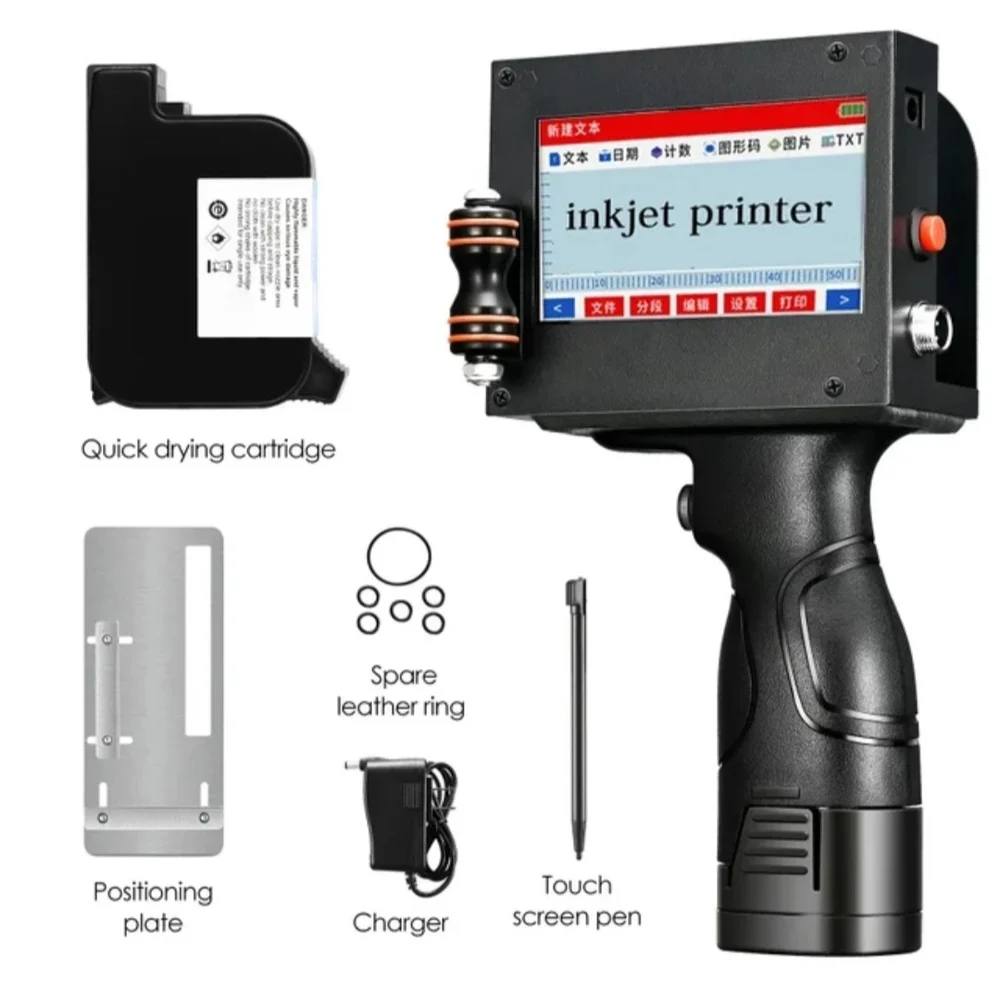
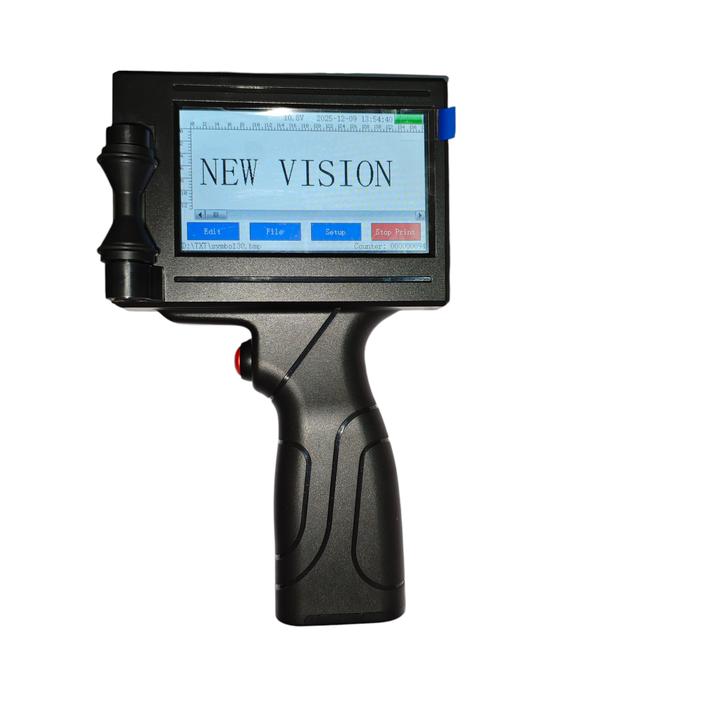
A handheld thermal inkjet (TIJ) printer is a portable, battery-powered coding device that uses heat to fire microscopic ink droplets onto product surfaces — printing dates, MRP, batch codes, barcodes, and QR codes without any surface contact. The 12.7mm model (also called the half-inch or 0.5-inch printer) refers to the maximum print height, which is the standard size for most retail packaging compliance codes in India. You hold it like a gun, press a trigger, and it prints. No compressors, no rollers, no ink rollers to clean.
A TIJ printer doesn't just print dates — it prints compliance. One missing or smudged MRP detail can get your entire batch rejected at the distributor's warehouse.
Which Indian Industries Use This Printer?
The short answer: almost every factory that packages products for retail. The most common use cases we see across India are:
- Food & Beverage: Printing MFG date, expiry date, and MRP on pouches, PET bottles, jars, and tetra packs. FSSAI compliance makes this non-negotiable.
- Pharmaceuticals: Batch number, manufacturing date, and expiry coding on blister packs, cartons, and vials. Often used alongside a conveyor setup.
- FMCG & Cosmetics: Lot number and MRP printing on tubes, bottles, and laminated packaging at production speed.
- Agriculture & Agri-inputs: Batch and date coding on seed packets, pesticide bottles, and fertiliser bags.
- Warehouse & Logistics: Carton coding, pallet marking, and QR code generation for dispatch tracking.
Handheld TIJ Printer vs CIJ Printer: Which Fits Your Factory?
This is the question most production managers ask when they first look at upgrading from manual coders. The answer depends on your production volume and how many product lines you run. Most SME factories in India are far better served by a TIJ printer than a CIJ setup — here's why.
Swipe or scroll horizontally to view all columns
| Feature | Handheld TIJ (12.7mm) | CIJ Printer |
|---|---|---|
| Initial Cost (India) | ₹7,000–₹20,000 | ₹1.5–₹5 lakh+ |
| Maintenance | Near-zero — cartridge swap only | Regular: filters, viscosity checks, nozzle cleaning |
| Portability | Fully portable, handheld | Fixed or mounted on conveyor |
| Resolution | 300–600 DPI (scannable barcodes) | 75–180 DPI (character codes only) |
| Setup Time | Under 2 minutes | 15–30 minutes startup warm-up |
| Best For | SME, multi-SKU, irregular surfaces | High-speed single-product lines running 24/7 |
| Operator Skill Needed | Low — touchscreen operated | High — trained technicians often required |
If your factory runs multiple product types in shorter batches, or if you need to move the printer between workstations, TIJ wins every time. CIJ makes sense only when you're coding at very high conveyor speeds on a single fixed product line running continuous shifts.
Key Benefits That Matter on the Production Floor
- Zero maintenance: When you replace the cartridge, you're essentially getting a new print head. No service contract, no technician call-out charges.
- Quick-dry ink: 1–3 seconds on non-porous surfaces. Products keep moving. No smearing from handling.
- 600 DPI barcodes and QR codes: Properly scannable at retail POS, not just "printed." This is where TIJ beats CIJ on quality.
- Multi-template storage: Store MRP codes for 10 different SKUs. Switch with two taps on the touchscreen. No reprinting, no reconfiguration.
- USB and Wi-Fi data import: Push updated templates directly from a PC. Useful when label details change with new batches or FSSAI revisions.
- Works on 7+ surface types: Plastic, glass, metal, carton, wood, laminated pouches, paper — one printer covers your full packaging range.
4 Mistakes Indian Buyers Make When Choosing This Printer
Most buyers focus on the price tag. The ones who regret their purchase usually made one of these four errors:
- Choosing ink type without checking the surface: Solvent-based ink sticks to non-porous surfaces like plastic and glass. Water-based ink suits paper and cardboard. Ordering the wrong cartridge type is probably the most common mistake we hear about — and it's 100% avoidable.
- Not confirming local cartridge availability: A ₹5,000 machine is useless if the cartridge isn't available in India within a week. Ask the supplier specifically where you can reorder consumables and what the lead time is.
- Buying a 300 DPI machine for barcode printing: 300 DPI works for date and text. For QR codes and barcodes that need to scan at retail, you need 600 DPI. Read the spec sheet before adding to cart.
- Skipping the battery test: Rated battery life and real-world battery life after 18 months are different numbers. If you're running long production shifts, ask about replacement battery availability before the original packs up.
Date MRP Printing Machine Price in India: 2026 Ranges
A 12.7mm handheld TIJ printer in India typically costs ₹7,000–₹18,000 depending on brand, software, and bundled accessories. Machines with touchscreen interfaces and Red Software or equivalent platforms sit in the ₹9,000–₹15,000 range. Ultra-premium cartridge variants — which give darker, faster-drying prints and higher character yields — are priced at the upper end of this range, typically ₹12,000–₹18,000.
Ink cartridges (42ml) cost ₹800–₹2,000 per unit and print roughly 2–3 lakh characters depending on font size and ink density. That works out to a cost per print that most SME owners find genuinely economical — far cheaper than label stickers or outsourced coding. GST at 18% applies on machinery purchases, which is claimable as input credit for GST-registered manufacturers — something worth factoring into your actual cost calculation.
The Bottom Line
For most Indian SME factories — food, pharma, FMCG, cosmetics, or agri-packaging — a handheld date MRP printing machine at the 12.7mm print height is the most practical, affordable, and low-maintenance coding solution available today. It's faster than a stamp coder, cleaner than a manual roller, and far more flexible than a fixed CIJ system. But the machine only performs as well as the ink and surface match — so do the sample test before you commit.
Looking for a date MRP printing machine for your factory? New Vision Machines supplies a range of handheld TIJ printers and batch coding solutions across India — browse our full range or contact us for a free recommendation based on your surface type and production volume.