Granule Filling Machine Types and Dosing Mechanics
On an Indian production floor, choosing a granule filling machine comes down to bulk density, flow friction, and raw ingredient cost — not catalog claims. Dry goods behave differently once dumped into an infeed hopper. Refined crystal sugar drops cleanly through gravity chutes. By contrast, roasted pulses, fried sev, and seasoned snacks interlock, catch on corners, and crumble under rough mechanical force.
Matching your material to the correct mechanical dosing principle protects piece integrity, prevents hopper bridging, and stops profit leaks from chronic overfilling.
Swipe or scroll horizontally to view all columns
| Type | Best-Fit Granule | Accuracy | India Price Band INR |
|---|---|---|---|
| Volumetric Cup Filler | Free-flowing granules (sugar, tea, uniform seeds) | ±1–3% | Rs 15,000–55,000 |
| Weigh Filler (Load-cell) | Namkeen, dal, dry fruits | ±1–2% | Rs 13,000–26,000 |
| Auger Filler | Fine, variable-density powders and spices | ±0.5–1% | Rs 2,25,000–8,50,000 |
Volumetric Cup Fillers
Volumetric telescoping cups meter dry product by cavity volume rather than mass. Material falls by gravity from an overhead hopper into telescoping chambers bored into a rotary disc. Plant operators turn a central threaded pitch screw to adjust cup depth, setting the target pocket volume before sweeping each charge over a discharge chute into open pouches or bottles.
For rigid, free-flowing commodities with consistent bulk density — such as crystal sugar, washed whole grains, and graded CTC tea — this mechanism provides rapid cycle times with minimal mechanical upkeep. The limitation is simple: cups measure space, not mass. When atmospheric humidity or settling changes material density midway through a batch, pocket volume remains fixed while pouch weights wander. Real-world accuracy sits between ±1–3%. It remains the simplest granule filling machine architecture for free-flowing commodities.
Net-Weigh and Gross-Weigh Fillers
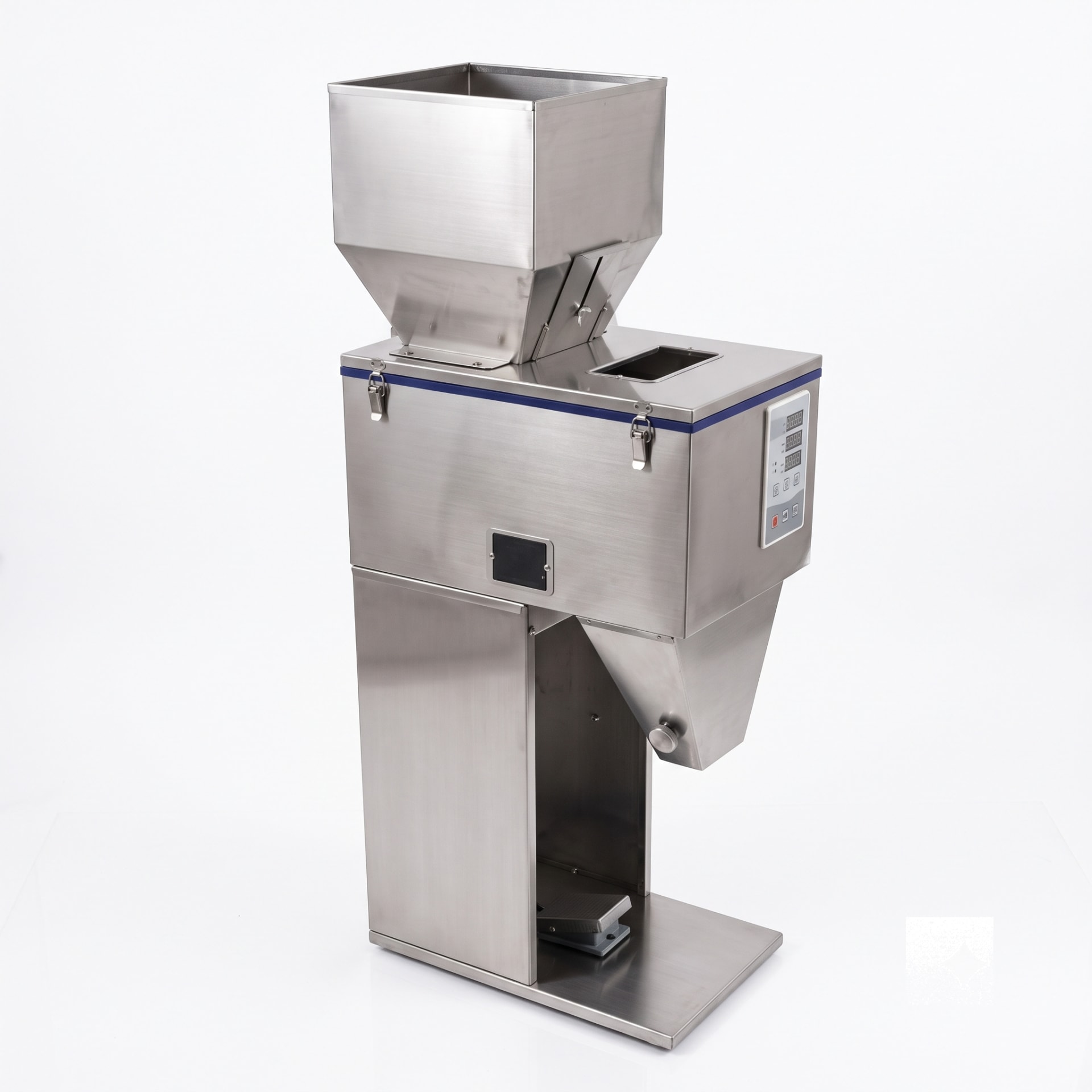
Weigh fillers take density changes out of the equation. Product moves across an electromagnetic vibrating tray into an isolated weigh bucket suspended on digital strain-gauge load cells.
The controller manages feed speed in two stages: an initial high-amplitude bulk feed, followed by a low-amplitude fine trickle feed. The instant target mass registers, a pneumatic or magnetic cutoff gate snaps shut to stop the flow. Because dosing relies entirely on weight rather than cavity dimensions, piece geometry does not skew results. Giveaway stays strictly bounded between ±1–2%, whether you run small uniform moong dal, fragile roasted cashews, or irregular banana chips.
Auger Fillers
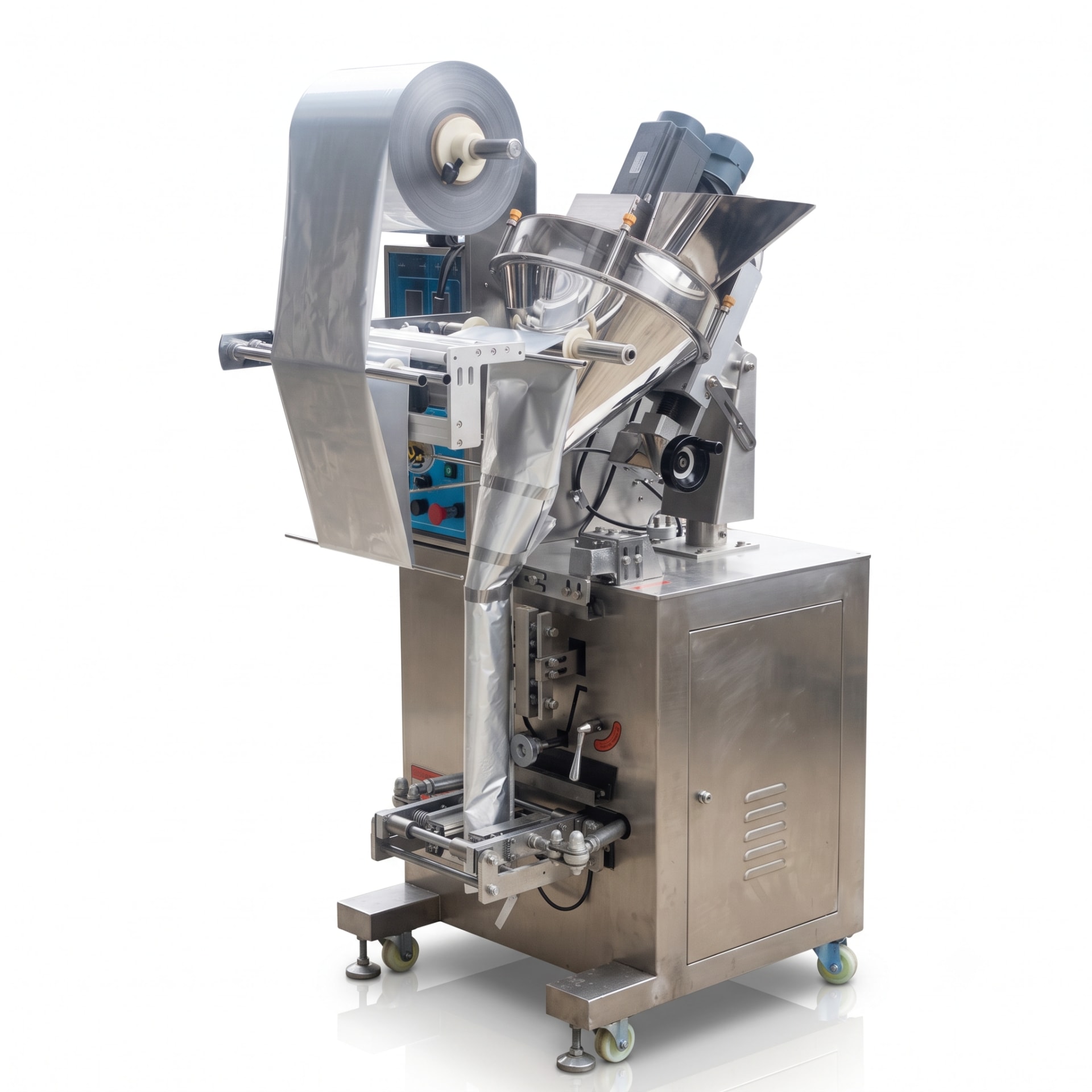
Auger fillers dose product through positive mechanical displacement. A precision flight screw turns inside a polished funnel, driven by an electromagnetic clutch-brake assembly or an indexed servo motor. Each fractional rotation moves a repeatable cross-section of product downward through the funnel nozzle.
Augers are built for non-free-flowing powders and finely ground spices where volumetric cups fail due to rat-holing, cavitation, or dust plumes. The turning flight compresses and stabilizes the column of material before discharge, preventing aeration while holding dosing tolerances to ±0.5–1%. It is the most capital-intensive granule filling machine of the three — justified only when powders cannot be dosed any other way.
Market Price Bands Across Automation Tiers
Setting an equipment budget requires grounded numbers from the domestic market. When surveying the prevailing granule packing machine price India landscape, commercial machinery splits into three distinct categories based on frame build, drive mechanisms, and automation level:
Semi-Automatic Granule Fillers (Rs 13,000–26,000): Benchtop and standalone angle-frame units fitted with a single electromagnetic vibratory pan and a digital load-cell controller. Operators position a premade pouch beneath the discharge cone and press a foot pedal to dump the batch. These entry machines suit startup packaging units, seed packers, and regional spice businesses moving off manual table scales.
Semi-Automatic Cup Fillers (Rs 15,000–55,000): Rotary plate volumetric machines fitted with telescoping brass or stainless steel cups beneath an open stainless hopper. Units run continuously on a motor drive or cycle-on-demand via foot switch. They scale from basic tabletop units to floor-standing stations capable of feeding manual sealing tables.
Automatic Auger Lines (Rs 2,25,000–8,50,000): Fully integrated systems combining vertical screw tooling with automatic pouch form-fill-seal (FFS) baggers or rigid container indexing conveyors. Standard specifications include servo screw drives, level-sensing hopper agitators, motorized film draw belts, and industrial PLC touchscreens engineered for multi-shift industrial duty.
Dosing Selection Logic: Matching Machine Type to Product Physics
Purchasing errors happen when packaging lines treat all granules as uniform cargo. Equipment selection must mirror product physics.
Free-flowing, uniform density (sugar, tea, seeds) → Volumetric Cup Filler (Rs 15,000–55,000 | ±1–3%).
High-value, irregular shape, margin-sensitive (namkeen, dal, dry fruits) → Weigh Filler Machine (Rs 13,000–26,000 | ±1–2%).
Fine, aeration-prone, variable-density (ground spices, blends) → Auger Filler Machine (Rs 2,25,000–8,50,000 | ±0.5–1%).
Free-Flowing Grains and Pulses
Granulated crystal sugar, table salt, washed lentils, and mustard seeds pour smoothly without clumping. A volumetric cup filler handles these commodities reliably at low capital cost. Because batch density stays steady under dry storage conditions, volumetric drift remains low enough that secondary checkweighers are rarely necessary.
Namkeen, Dal, and Dry Fruits
Fried mixtures, roasted cashews, whole almonds, and packaged namkeen pose two challenges: irregular geometry and high per-kilo ingredient cost. Volumetric sliding gates crush delicate sev and papdi against chamber walls. Unpredictable air pockets inside the cup also produce broad pouch-to-pouch weight variations. Installing a dedicated weigh filler machine stops piece breakage and cuts overfill losses. Cutting giveaway on cashew or almond lines adds up fast on an active packaging line.
Powders and Micro-Granules
When material transitions from granular to fine grinds — turmeric, red chilli powder, or blended curry masalas — ambient humidity and hopper compaction alter bulk density dramatically. Fine grinds also generate heavy airborne dust around open cups. An auger filler machine drives material down the funnel under positive displacement, maintaining a sealed column that stops bridging, air cavitation, and product dusting.
New Vision Machines: Live Range and Pricing
At New Vision Machines, we build packaging machinery for demanding factory floors. Every granule filling machine uses heavy-gauge steel structural framing, off-the-shelf industrial electricals, and unobstructed component layouts so shop technicians can service wear parts without proprietary tools.
Our current Indore manufacturing run includes two verified, production-ready models:
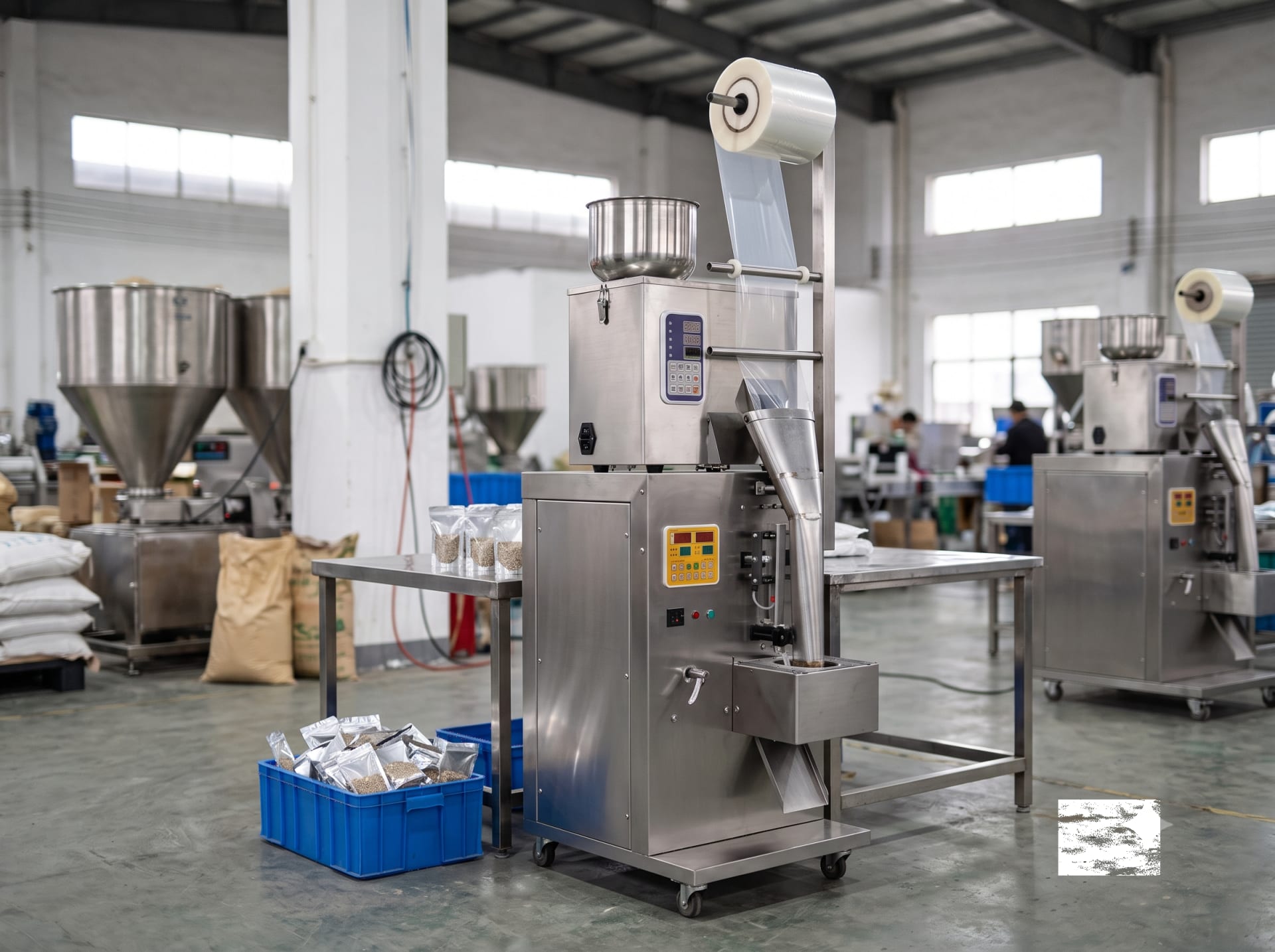
Semi-Automatic 200g Weigh Filler: Rs 13,600 (ex-works, Indore). Configured with a food-grade stainless steel hopper, an electromagnetic vibratory feed tray, and an electronic load-cell controller delivering ±1–2% accuracy. Built for benchtop packing of dry fruits, tea, pulses, and ground spices.
~100g Side-Seal FFS Bagger: Rs 42,900 (ex-works, Indore). An automated vertical form-fill-seal unit that pulls roll film over a forming tube, doses granular commodities, and heat-seals side and end seams in a single automated stroke.
Both units are assembled and run-tested at our manufacturing facility in Lasudia Mori, Indore, MP 452010. Factory acceptance trials and test runs using your own production granules can be scheduled with our engineering team at +91-9981604279.
Share your granule type and target fill weight with our engineering team, and we will size the right granule filling machine for your line before you spend a rupee.