
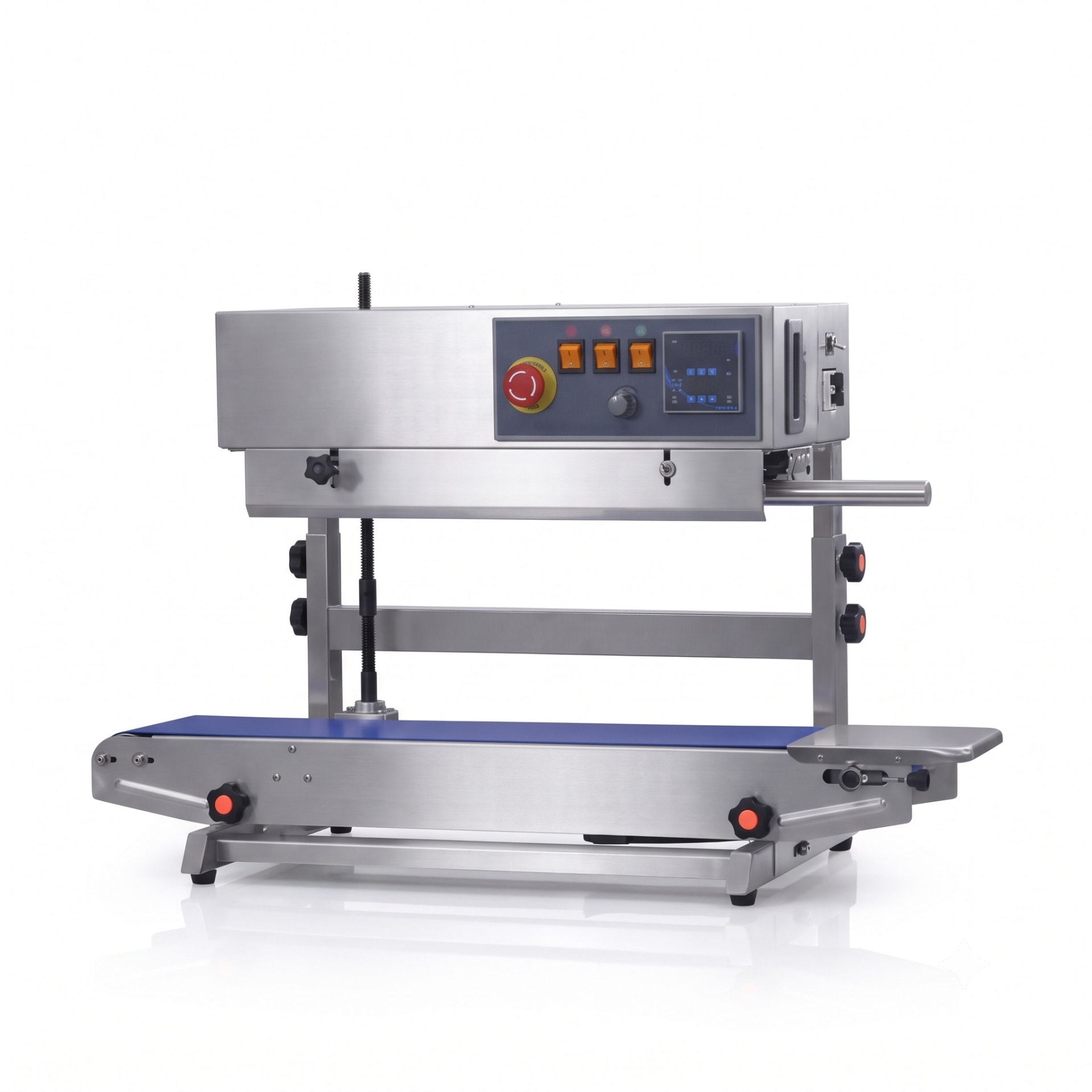
The commercial nitrogen flushing band sealer price in India starts at ₹37,700 ex-works Indore (GST extra), replacing atmospheric oxygen inside barrier pouches to stop lipid rancidity without the cost of automated VFFS equipment.
Before buying, review how an entry-level vertical band sealer with nitrogen flushing handles your film stack, pouch dimensions, and daily production cadence.
- Verified baseline price: ₹37,700 (MRP ₹47,000, ex-works Indore, GST extra) for mild-steel vertical gas-purging machinery.
- Throughput runs 0–12 m/min with a 10–12 mm seal width and a digital PID temperature range from 0–300°C.
- Mechanical gas purge flushes atmospheric oxygen out of barrier pouches right before brass blocks close the seal.
- Integrated drive handles 3–5 kg continuous conveyor load with adjustable height for stand-up pouches and gusset bags.
- Direct bracket mount accepts 12.7 mm or 1-inch thermal inkjet (TIJ) heads for date, batch, and MRP printing.
What Is the Nitrogen Flushing Band Sealer Price in India Across Different Configurations?
A baseline vertical band sealer with nitrogen flushing price in India is ₹37,700 ex-works Indore (MRP ₹47,000, GST extra) for powder-coated mild steel, while stainless steel builds are priced on application.
Machine pricing tracks three hardware variables:
Orientation Axis: Horizontal units run flat, lightweight pillow packs that lie flush on the conveyor without spilling contents. Vertical units rotate the sealing head and conveyor 90 degrees to run standing pouches, gusseted bags, and free-flowing namkeen without product dropping out of open tops.
Material Axis: Powder-coated Mild Steel (MS) frames handle dry processing rooms for chips, makhana, and dry fruits. Grade SS 304 Stainless Steel frames are built for washdown zones and corrosive environments with salted savories or acidic ground spices.
Conveyor Load Axis: Light table-top conveyors carry up to 3 kg distributed weight, while reinforced drives support 3–5 kg continuous pouch loads.
Small-to-medium snack processors evaluating the namkeen nitrogen packing machine price often compare continuous sealers to fully automated vertical form-fill-seal (VFFS) systems. A manual-feed continuous band sealer delivers consistent modified-atmosphere flushes at a fraction of an automatic nitrogen VFFS line.
A commercial vertical nitrogen flushing band sealer retails at ₹37,700 ex-works Indore (MRP ₹47,000, GST extra) as of October 2026 (source: New Vision Machines verified factory pricing).
Swipe or scroll horizontally to view all columns
| Machine Configuration | Sealing Orientation | Frame Construction | Conveyor Load Capacity | Sealing Speed (Class-Typical) | Commercial Price (Ex-Works Indore, GST Extra) |
|---|---|---|---|---|---|
| Vertical Gas Flush Platform (FR-900 class) | Vertical | Powder-Coated Mild Steel (MS) | 3–5 kg | 0–12 m/min | ₹37,700 (MRP ₹47,000) |
| Horizontal Gas Flush Unit | Horizontal | Powder-Coated Mild Steel (MS) | 3 kg | 0–12 m/min | Price on application |
| Sanitary Food-Grade Unit | Vertical / Horizontal | Stainless Steel (SS 304) | 5 kg | 0–12 m/min | Price on application |
Note on specifications and pricing: Pricing reflects verified baseline rates from New Vision Machines in Indore, Madhya Pradesh (October 2026). Standard commercial GST and transit freight apply extra. Mechanical metrics (0–12 m/min feed rate, 10–12 mm seal profile, 0–300°C temperature range) represent generalized class-typical continuous band sealer standards.
When comparing the nitrogen flushing band sealer price in India across frame materials, factor in local plant humidity and ambient salt exposure to choose the right chassis.
How Does Continuous Gas Flushing Work and What Utilities Are Needed?
A continuous gas flushing pouch sealing machine injects food-grade nitrogen at 0.1 to 0.4 MPa into the pouch mouth via an extended stainless nozzle immediately before motorized Teflon bands seal the film.
The mechanical cycle runs in a continuous sequence:
An operator slides the open pouch mouth over the extended gas injection tube. A foot switch or automated pneumatic valve releases pressurized nitrogen into the headspace, sweeping atmospheric air out of the package cavity. As the conveyor pulls the bag forward, the nozzle clears the pouch lip, and motorized PTFE bands grip the top edge. Two heated brass blocks (digitally set from 0–300°C) apply consistent pressure across a 10–12 mm strip to melt the inner polymer sealant layer. Air-cooled or water-cooled knurled wheels immediately press the molten seam, curing an airtight lock before the bag drops off the discharge end.
Running this line requires two utilities on your plant floor:
Electrical Service: Standard single-phase 220V AC, 50 Hz power. Power draw typically sits around 500W to 750W across the motor, cooling fan, and heating elements.
Nitrogen Supply: A standard industrial nitrogen cylinder holds 7 m³ of gas (47-litre water capacity) compressed at roughly 15 MPa, regulated down via a dual-stage line gauge. Plants with multiple packing stations can hook the line directly to an on-site Pressure Swing Adsorption (PSA) generator typically delivering 99.5% to 99.9% pure gas.
A standard 47-litre water capacity industrial nitrogen cylinder holds approximately 7,000 litres of compressed gas at 15 MPa to supply continuous packaging nozzles (source: standard commercial gas supply specifications).
Working with an established continuous band sealer with nitrogen flushing manufacturer ensures proper nozzle timing, preventing gas blasts from scattering light products like sev or popped chips. Choosing an optimized dry fruit and makhana nitrogen sealer stops ambient oxygen from dulling roasted textures during storage.
How Much Does Nitrogen Purging Extend Shelf Life for Namkeen, Makhana, and Spices?
Flushing pouches with food-grade nitrogen displaces residual headspace oxygen down to roughly 2% to 3%, extending snack shelf life from 30–45 days to 120–180 days under typical commercial storage conditions (indicative packaging benchmark).
Atmospheric oxygen breaks down packaged Indian snacks through clear chemical pathways:
Fried Namkeen & Farsan: Oxygen reacts with unsaturated vegetable frying oils, creating volatile peroxides and hexanal that cause rancid odors and stale flavors. Flushing dry nitrogen halts auto-oxidation and inflates the bag to protect brittle sev, mixtures, and chips from crushing in transit.
Roasted Makhana (Foxnuts): The porous sponge structure of popped lotus seeds draws in airborne moisture within hours. A dry nitrogen cushion keeps moisture out and preserves crunch.
Cashews, Almonds, and Walnuts: Nut oils oxidize quickly under warm ambient warehouse temperatures, developing bitter off-notes. Displacing oxygen keeps lipids chemically stable.
Whole & Ground Spices: Turmeric, chili powder, and garam masala lose color and volatile aromatic oils when exposed to air. An inert gas flush holds spice potency and color depth over extended shelf periods.
Purging snack headspaces with nitrogen gas extends fried namkeen shelf life from an unpurged 30–45 days to 120–180 days by retarding oil oxidation in barrier packaging (source: indicative packaging industry field benchmark).
Swipe or scroll horizontally to view all columns
| Food Category | Primary Quality Threat | Standard Air Seal (Indicative) | Nitrogen Flushed Barrier Pouch (Indicative) | Shelf-Life Multiplier (Indicative) |
|---|---|---|---|---|
| Fried Namkeen & Farsan | Lipid rancidity & crushing | 30–45 Days | 120–180 Days | 3× to 4× |
| Roasted Makhana | Moisture pickup & softness | 20–30 Days | 90–150 Days | 3× to 5× |
| Raw / Roasted Dry Fruits | Fat rancidity & bitterness | 60–90 Days | 180–270 Days | 2× to 3× |
| Ground Spices & Coffee | Aroma loss & color fading | 45–60 Days | 180–360 Days | 3× to 6× |
Note: Stated shelf-life values are typical packaging industry ranges. Actual stability depends heavily on frying oil turnover, initial moisture, ambient warehouse heat, and specific film barrier values.
Which Pouch Materials Work Best on a Gas Flushing Pouch Sealing Machine?
A continuous gas flushing pouch sealing machine seals heat-sealable laminated multi-layer barrier films between 50 and 250 microns, including MET-PET, aluminum foil laminates, and co-extruded polymers.
Single-layer unlaminated films like plain LDPE will not preserve a nitrogen flush. Monolayer films have high Oxygen Transmission Rates (OTR), allowing oxygen to diffuse straight back through the plastic within days. Nitrogen preservation requires composite barrier films:
Metallized Polyester (PET / MET-PET / Poly): The packaging staple for namkeen and extruded snacks. The vapor-deposited aluminum layer blocks oxygen and moisture at an economical price point.
Pure Aluminum Foil (PET / AL / PE): Near-zero OTR and Water Vapor Transmission Rates (WVTR). Essential for roasted ground coffee, spray-dried flavors, and export-grade cashews.
Polypropylene Laminates (BOPP / CPP or PET / PE): Clean, transparent films used for roasted makhana and flavored nuts where consumers want to see the product.
Pre-Formed Stand-Up Pouches (Doypack): Handled cleanly on vertical machines. The operator feeds the pouch mouth over the gas nozzle, which purges the interior before the PTFE bands clamp and seal above the zipper line.
Review our technical guide to food packaging sealing machines to match your exact pouch gauge with proper heating element wattage.
How Do You Calculate Operating Gas Cost per Pouch?
Operating gas cost per pouch equals total commercial nitrogen cylinder refill expense divided by the number of usable pouches flushed per cylinder.
Because cylinder refill charges and local transport fees vary across industrial zones in India, operational gas cost should always be tracked as an engineering formula rather than an arbitrary paise estimate:
Gas Cost per Pouch (₹) = Commercial Cylinder Refill Invoiced Cost (₹) / Total Usable Pouches Flushed per Cylinder
To calculate your plant's usable pouches per cylinder:
Total Usable Pouches Flushed = Cylinder Volume (Litres STP) × Line Purge Efficiency Factor / Required Headspace Flush Volume per Pouch (Litres)
Headspace Flush Volume: Set your regulator to deliver 1.5× to 2.0× the physical void space of the filled pouch to sweep out remaining oxygen pockets.
Line Purge Efficiency Factor: Typically 0.60 to 0.75 (60% to 75%) on continuous lines, reflecting continuous nozzle gas flow during brief operator loading pauses.
Cylinder Volume: A standard 47-litre water capacity industrial cylinder holds roughly 7,000 litres of expanded nitrogen gas at normal operating temperatures.
Budgeting your nitrogen flushing band sealer price in India alongside gas line plumbing keeps direct production costs clear from day one. For detailed line calibration steps, check our practical nitrogen flushing band sealer working guide.
Can You Mount a TIJ Batch Coder on a Nitrogen Band Sealer?
A standard 12.7 mm or 25.4 mm (1-inch) Thermal Inkjet (TIJ) printhead mounts onto the sealer frame with an adjustable bracket to print batch codes, MRP, and expiry dates directly downstream of the sealing belts.
Mounting the printer inline eliminates hand-stamping and separate tabletop batch coding machines:
Photocell Triggering: An optical sensor detects the leading edge of the pouch as it leaves the heating blocks, firing the printhead at speeds synchronized with conveyor travel.
Solvent-Based Inks: Industrial quick-drying cartridges typically set in 1 to 3 seconds on slick metallized films, plain foil, and glossy laminates without smearing.
Vibration Resistance: Packaging plants running high-salt namkeen often choose a heavy-duty SS 304 nitrogen band sealer from an Indore builder, ensuring the coder bracket stays steady and rigid during daily production shifts.
What Are the Operational Limits and Technical Assumptions?
Continuous nitrogen band sealers support distributed conveyor loads up to 3–5 kg and rely on open-mouth gas displacement rather than complete vacuum chamber evacuation.
Before deploying these machines, keep four practical operating limits in mind:
Conveyor Weight Capacity: Standard belt assemblies typically carry single packs up to 1 kg and distributed loads up to 3–5 kg. Packing 5 kg to 10 kg bulk bags requires an auxiliary idler roller table to avoid burning out the drive motor.
Displacement Flushing vs. Vacuum: This equipment uses active gas displacement; it does not pull a vacuum inside a closed chamber. Reaching 2% to 3% residual oxygen requires tight, rhythmic feeding. Gaps between pouches waste gas and drop purge efficiency.
Film Thickness Limits: Usable film thickness ranges from 50 to 250 microns. Films thinner than 50 microns can melt or wrinkle under the drive belts; films thicker than 250 microns require slower line speeds to fuse the inner sealant layer.
Regulatory Guidelines: Machine design helps meet FSSAI packaging hygiene standards and is built for food-contact compliance, but equipment alone cannot guarantee regulatory compliance. Food processors must maintain frying oil turnover, seal integrity, and clean handling procedures.
Machines ship under standard New Vision Machines business terms: ex-works Indore, Madhya Pradesh, with GST extra. Every unit includes a 12-month manufacturer warranty, pre-dispatch factory testing, commissioning support, and free phone/WhatsApp/video support from our plant at Lasudia Mori, Indore (+91-9981604279).