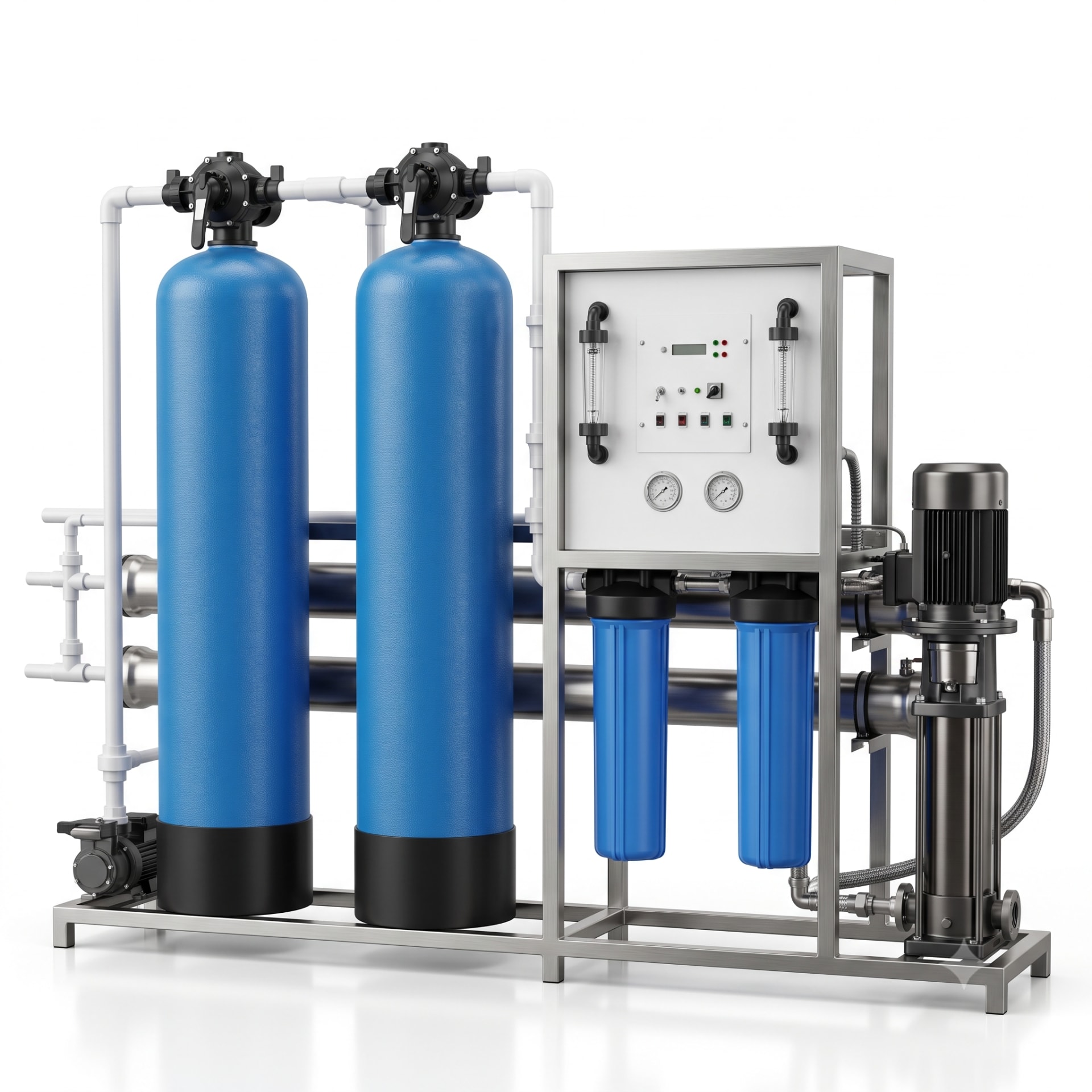
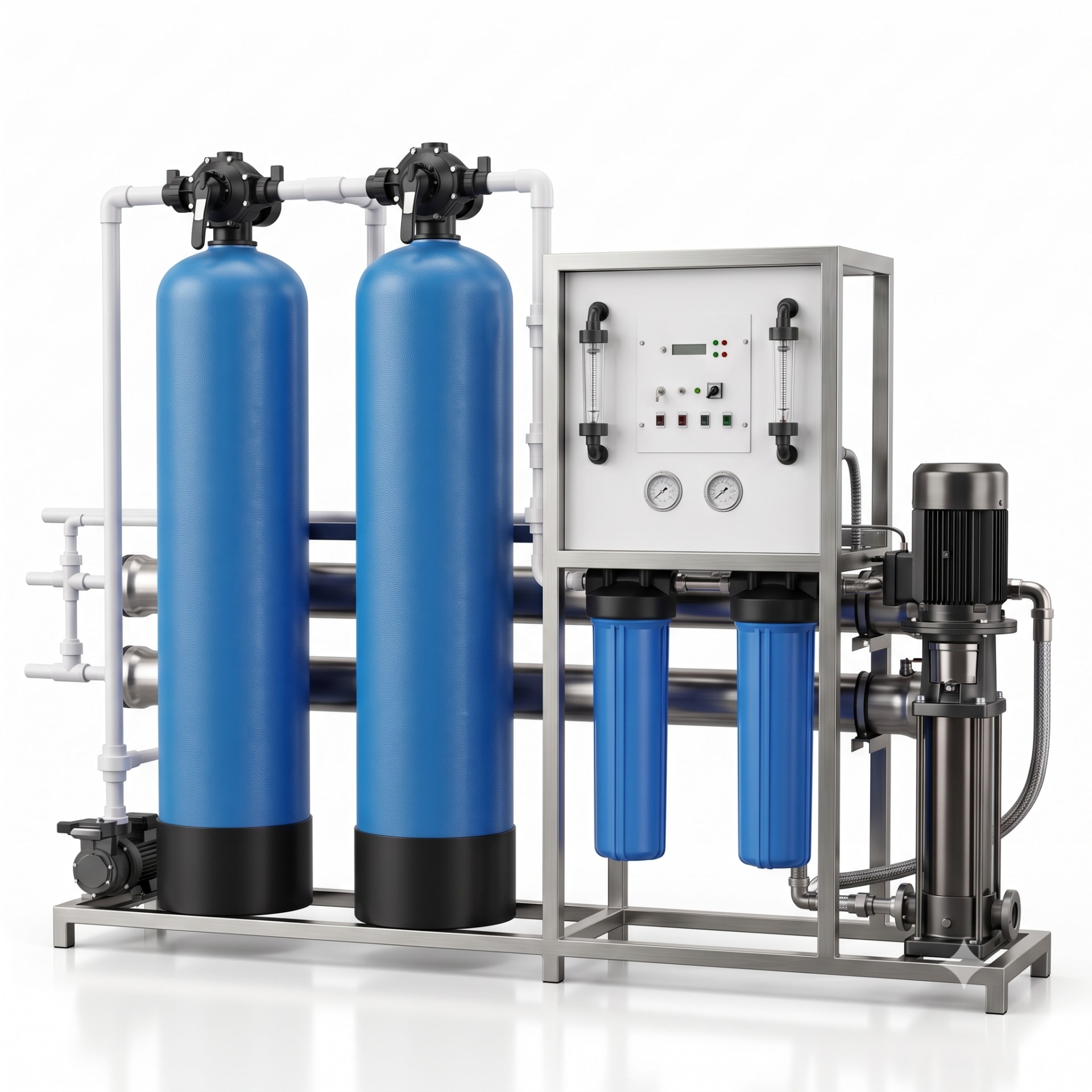
The industrial ro plant price in india is ₹1,10,000 for 500 LPH, ₹1,70,000 for 1000 LPH, and ₹2,70,000 for 2000 LPH, ex-works Indore with GST and freight charged extra at actuals.
- 500 LPH skid: ₹1,10,000 ex-works Indore, GST extra, configured for industrial boiler feed and utility lines.
- 1000 LPH skid: ₹1,70,000 ex-works Indore, GST extra, built with 2×8040 TFC membrane elements.
- 2000 LPH skid: ₹2,70,000 ex-works Indore, GST extra, sized for continuous process water applications.
- All published prices are ex-works Indore; GST, freight, and transit insurance are charged extra at actuals.
- Commercial skids operate at a class-typical 50% to 65% permeate recovery band on clean municipal water.
Selecting industrial RO plants requires auditing raw feed chemistry, target delivery volume, and physical skid footprint.
What Is the Industrial RO Plant Price in India Across Standard Capacities?
Capital costs for baseline commercial skids ex-works Indore are ₹1,10,000 for 500 LPH, ₹1,70,000 for 1000 LPH, and ₹2,70,000 for 2000 LPH, with GST and transport billed extra at actuals.
Establishing an accurate baseline for evaluating the industrial ro plant price in india allows plant engineers to size capital expenditure before procuring downstream packaging lines. For small workshops or localized rinsing units, the entry-level 500 lph ro plant price in india begins at ₹1,10,000. Evaluating a 500 LPH RO water plant price in India involves checking raw-water turbidity and selecting appropriate pre-filtration media to protect membrane surfaces.
Moving up to commercial production, the 1000 lph ro plant price in india is ₹1,70,000 for an industrial skid engineered around a dual-element membrane rack. A standard 1000 LPH skid configuration utilizes a 2×8040 TFC membrane setup to deliver 1,000 litres of permeate per hour at factory baseline testing. Technical specifications for this configuration are detailed on the 1000 LPH RO plant product page.
For continuous manufacturing runs, the 2000 lph ro plant price in india is ₹2,70,000 ex-works. Operations running multiple shifts often select the 2000 LPH RO plant to ensure steady treated water delivery to production holding tanks.
| Capacity | Price (Ex-Works Indore) | Membrane Configuration | Best-For |
| 500 LPH | ₹1,10,000 | Not specified | Small batch bottling, boiler feed, utility rinse |
| 1000 LPH | ₹1,70,000 | 2×8040 TFC | Mid-speed packaging lines, commercial jar washing |
| 2000 LPH | ₹2,70,000 | Not specified | High-throughput beverage plants, continuous production lines |
Note: All prices are ex-works Indore, GST extra. Freight and transit insurance are charged extra at actuals and are not included in any total. Membrane configuration for 500 LPH and 2000 LPH is not specified in the verified baseline schedule.
How Do FRP and SS304 Pressure Vessels Compare in Water Treatment?
FRP pressure vessels suit general process and utility water streams, whereas SS304 sanitary skids are typically specified for packaged drinking water operations.
Fiberglass-reinforced plastic (FRP) housings handle non-potable feed streams, industrial cooling circuits, and boiler feed setups without external rust or surface corrosion. When evaluating frp vs ss ro plant price india, procurement teams weigh up-front capital outlay against specific cleanability protocols. FRP vessels provide corrosion resistance when processing brackish well water, but they do not accommodate steam or high-temperature chemical sanitization.
Stainless steel construction provides sanitary, smooth interior surfaces that support chemical-in-place (CIP) regimens. In packaged drinking water projects, the BIS IS 14543 packaged-drinking-water standard is the reference, and SS304 contact piping and housings are the established industry choice. The standard BIS IS 14543 specifies packaged drinking water requirements in India. Pricing for stainless steel skids depends entirely on tubing gauge, manifold diameter, and finish requirements, and is available as Price on application. Detailed structural differences are covered in the 2000 LPH RO plant FRP vs SS guide.
What Components Are Included in an Industrial RO Bill of Materials?
A standard industrial reverse osmosis skid bill of materials comprises raw-water feed pumps, dual-media sand and activated-carbon filters, micron cartridge housings, high-pressure pumps, TFC membranes, and chemical antiscalant dosing systems.
Understanding how the industrial ro plant price in india shifts across component grades requires inspecting each treatment stage. Feed water passes through quartz sand to capture particulate matter before entering activated granular carbon to strip out chlorine and organic compounds. A cartridge filter housing with 5-micron spun polypropylene elements traps residual fines to prevent abrasive wear on the high-pressure booster pump.
Industrial high-pressure vertical multistage booster pumps develop a class-typical operating pressure of 10 to 14 kg/cm² across brackish water membrane elements. Polyamide thin-film composite (TFC) elements perform the molecular separation, while positive-displacement metering pumps dose antiscalant compounds to stop mineral crystallization. Sizing criteria for these elements are analyzed in the 4040 vs 8040 RO membrane sizing guide.
- Raw-Water Feed Pump: Centrifugal transfer pump; class-typical 1.0–2.0 HP rating.
- Dual-Media Pre-Filters: Sand (MGF) and activated-carbon (ACF) columns for suspended solids and chlorine reduction.
- Micron Safety Filter: 5-micron spun polypropylene cartridge inside an industrial housing.
- High-Pressure Pump: Vertical multistage pump; class-typical 3.0–7.5 HP rating.
- RO Membranes: Polyamide thin-film composite (TFC) elements.
- Dosing System: Electronic diaphragm metering pump with chemical storage vessel.
Note: All horse-power ratings, stages, and operating pressures listed above are class-typical only, never New Vision Machines specifications or contractual guarantees.
How Does Permeate Output Map to Packaging and Filling Equipment?
Permeate generation operating within a class-typical 50% to 65% recovery band must match or exceed the maximum continuous volumetric intake of downstream packaging machinery.
Standard commercial reverse osmosis systems recover between 50% and 65% of raw feed water as treated permeate under class-typical operating conditions. As a commercial RO plant supplier in Indore, New Vision Machines evaluates total line balancing between the treatment skid and filling machines. Running packaging lines directly off membrane permeate lines without intermediate buffer tanks causes pressure drops and erratic filling valve performance.
Permeate supply links to downstream packaging lines across three primary formats:
- Water Pouch Packing Lines: Single-track and twin-track form-fill-seal pouch machines require uniform hydrostatic pressure to keep liquid levels stable in the overhead dosing hopper.
- 20-Litre Jar Filling Lines: Automated jar washing, filling, and capping equipment consumes treated water in distinct pulses during internal bottle rinses and five-gallon filling strokes.
- PET Bottle Filling Lines: Rotary or linear monoblock machines require consistent supply volumes for high-speed spray rinsing nozzles and gravity-fed filling carousels.
What Site Checklist Must Buyers Complete Prior to Ordering?
Buyers must verify three physical site prerequisites before ordering: a certified raw-water laboratory test report, confirmed connected three-phase electrical supply, and dedicated reject-water drainage capacity.
Confirming site readiness before committing to an industrial ro plant price in india quotation prevents installation delays and costly plumbing adjustments. Plant engineers should gather the following technical data:
- Certified Water Test Report: Comprehensive analysis detailing total dissolved solids (TDS), silica, iron, total hardness, and pH to calculate membrane scaling indexes.
- Connected Electrical Load: Dedicated three-phase 415V electrical supply (class-typical) with adequate breaker capacity to handle class-typical motor startup currents.
- Reject-Water Disposal Capacity: Hydraulic floor drainage sized to manage 35% to 50% of the raw water feed volume continuously without back-pressure.
What Operational Limits and Engineering Assumptions Apply to Factory Pricing?
Baseline ex-works pricing assumes clean borewell or municipal feed water with an inlet TDS below a class-typical 2,000 ppm threshold and standard ambient operating temperatures.
Understanding the operational factors determining the final industrial ro plant price in india requires reviewing factory baseline assumptions. Higher raw-water salinity requires custom membrane staging and larger booster pumps, shifting skid design beyond standard baseline configurations.
Standard pricing exclusions:
- Taxes: Goods and Services Tax (GST) is extra on all skid models.
- Freight and Transit Insurance: Transport charges from Indore to customer unloading points are extra at actuals, not included in any total.
- Civil and Electrical Works: Interconnecting piping between source tanks, intermediate permeate storage tanks, primary cabling from the electrical substation, and drainage trenches are client-supplied.