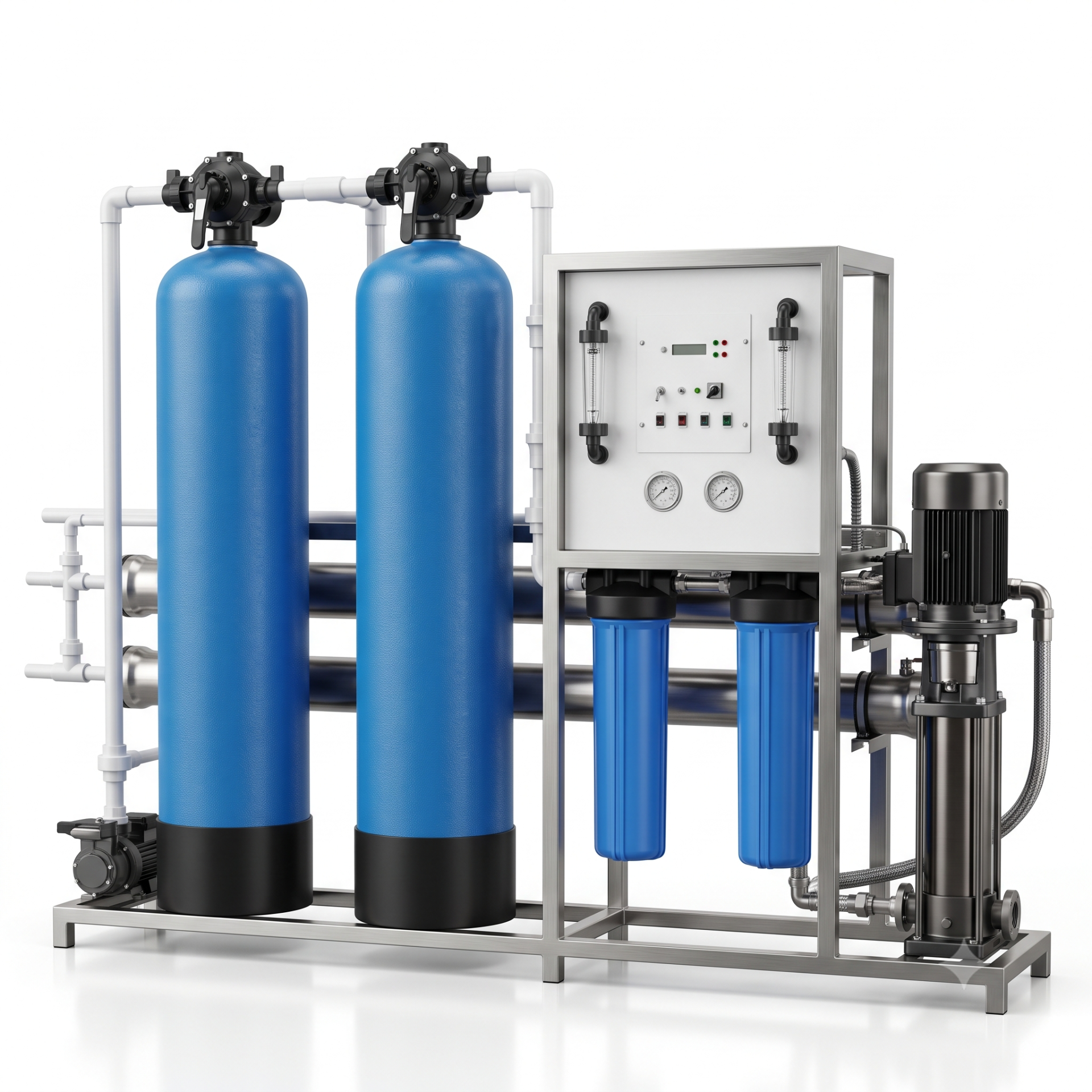
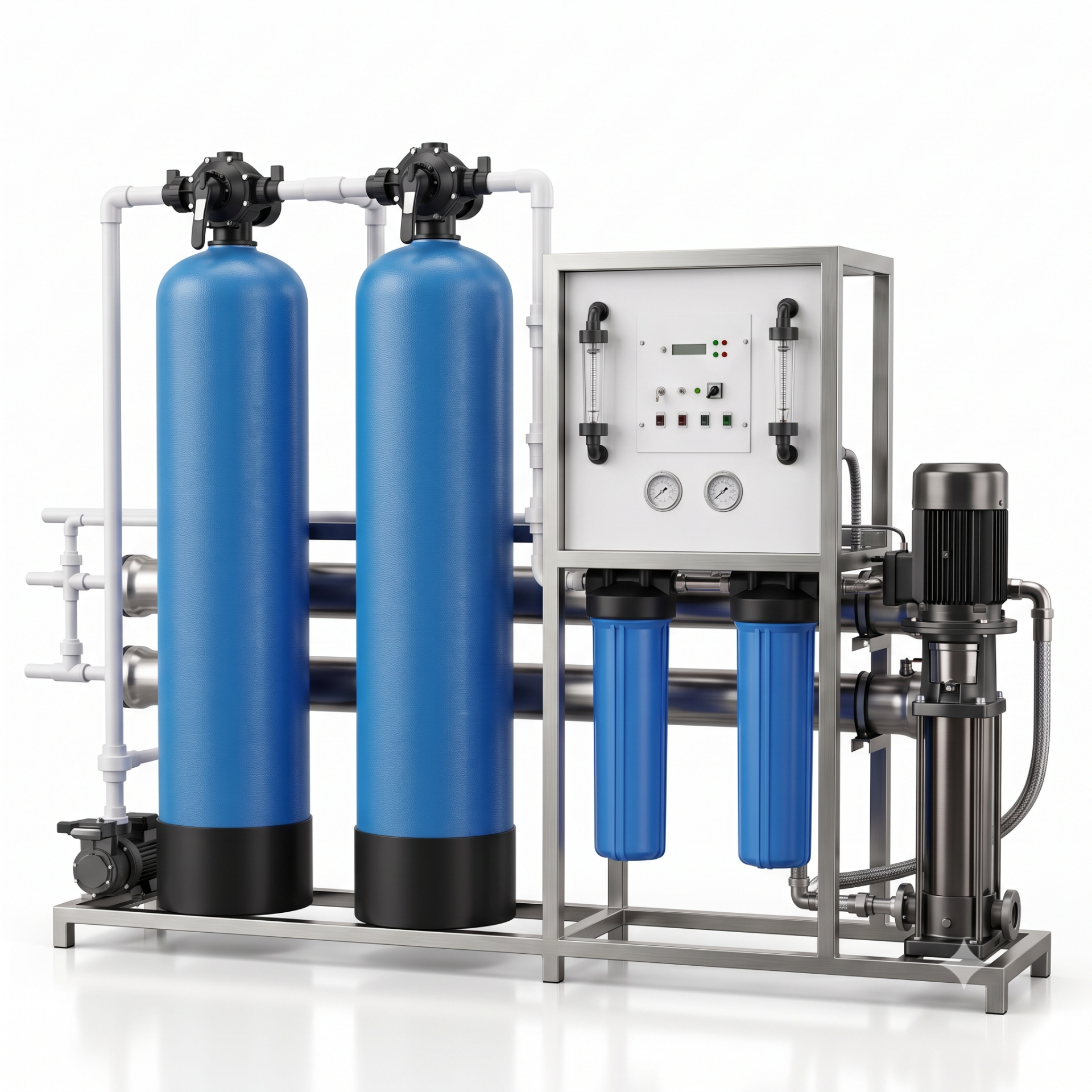
For a 1000 LPH plant, two 8040 elements (NVM's verified configuration); for 500 LPH, the smaller 4040 elements in compact pressure vessels. The 4040 vs 8040 membrane choice trades vessel footprint against capital cost.
Selecting between these two form factors dictates your high-pressure manifold layout, frame footprint, and replacement cycle. Sizing a 1000 LPH RO plant around 4040 elements needs four to five pressure tubes by the same worked arithmetic — more pipe fittings, more O-ring leak points. An 8040 layout consolidates membrane area into larger vessels, lowering maintenance overhead across standard commercial RO skids.
How do 4040 and 8040 RO membrane specs compare on commercial skids?
4040 and 8040 describe the element's diameter in inches and its 40-inch length. The difference that matters for plant sizing is active membrane area per element.
Swipe or scroll horizontally to view all columns
| Parameter | 4040 RO Membrane | 8040 RO Membrane |
|---|---|---|
| Physical dimensions | 4.0-inch diameter × 40-inch length | 8.0-inch diameter × 40-inch length |
| Active membrane area | 7.9 m² (82 ft²) (typical manufacturer spec) | 37.2 m² (400 ft²) (typical manufacturer spec) |
| Indicative permeate flow | ~200–250 LPH (indicative, Indian borewell conditions) | ~900–1,100 LPH (indicative, Indian borewell conditions) |
| Nominal salt rejection | 95%–98% (standard TFC spec range) | 95%–98% (standard TFC spec range) |
| Elements per 500 LPH skid | ~2–3 (worked arithmetic from indicative flux) | 1 (worked arithmetic from indicative flux) |
| Elements per 1000 LPH skid | ~4–5 (worked arithmetic from indicative flux) | 2 — NVM's verified 1000 LPH configuration |
What are the standard 500 to 2000 LPH RO plant prices and specifications?
New Vision Machines builds standard commercial skids at verified ex-works rates (GST extra), confirmed by Abhishek on 12 October 2026 — the same ex-works Indore pricing discipline we apply across our powder packing machine range:
- 500 LPH Industrial Skid: ₹1,10,000 ex-works, GST extra.
- 1000 LPH Commercial Skid: ₹1,70,000 ex-works, GST extra (configured with 2×8040 TFC membranes). Note: an older online listing showing ₹1,19,000 reflects stale historical data; the confirmed current production rate is ₹1,70,000.
- 2000 LPH Industrial Skid: ₹2,70,000 ex-works, GST extra.
For the full commercial picture, see our mineral water plant project cost guide and 2000 LPH RO plant pricing.
How do you calculate membranes and recovery for a 1000 LPH RO plant?
Pair permeate flux constraints with a feed-water recovery balance so the thin-film composite membranes run without rapid scaling or premature fouling on high-dissolved-solids borewell feed.
Recovery rate and reject water
Run the mass-balance arithmetic at a standard 55% recovery target:
- Product flow (permeate) = 1,000 LPH
- Recovery rate = 55% (0.55)
- Feed flow (worked arithmetic, not plant test data): Feed = Permeate ÷ Recovery = 1000 ÷ 0.55 ≈ 1,818 LPH
- Reject flow (worked arithmetic, not plant test data): Reject = Feed − Permeate = 1,818 − 1,000 ≈ 818 LPH
At 55% recovery, your raw-water feed pump must supply 1,818 LPH continuously, generating 818 LPH of concentrated brine reject.
Permeate TDS arithmetic
Standard TFC elements offer a 95%–98% salt rejection range. On typical borewell water running 800 to 1,200 ppm raw TDS:
- Salt passage = 2% to 5%
- Resulting permeate TDS (worked arithmetic consequence): at 800 ppm feed → 16–40 ppm; at 1,200 ppm feed → 24–60 ppm
- General permeate TDS output ≈ 20–50 ppm
How do plants hold 150–500 ppm TDS for BIS compliance?
Under BIS IS 14543, packaged drinking water TDS is capped at 500 mg/L (ppm). The industry works to an operational floor of ~150 ppm to avoid a demineralised classification — treat ~150 ppm as an industry working interpretation and confirm your target directly with your BIS auditor.
Plants are commonly engineered with mineral dosing skids or controlled bypass blending to raise pure permeate above the demineralised threshold while respecting the BIS ceiling.
Regulatory scrutiny on mineral composition is active. Under the UP FSDA directive of 14 October 2026 (Commissioner Dr. Roshan Jacob), BIS certification is mandatory for packaged drinking water units in Uttar Pradesh; the existing 968 units must obtain it by 31 March 2027. In the enforcement campaign behind it, 152 licences were suspended after testing 660 samples — 176 came back unsafe and 337 sub-standard, with deficient calcium and magnesium identified among the failure causes (source: UP FSDA order, 14 Oct 2026, via The Statesman / PTI). See our guide on packaged water plant rules and lab standards.
What are the limits and assumptions of this membrane sizing?
- Manufacturer membrane area: 4040 elements reflect ~7.9 m² (82 ft²); 8040 elements ~37.2 m² (400 ft²) — typical manufacturer specs.
- Permeate flow: indicative operating ranges under Indian borewell conditions span ~200–250 LPH per 4040 element and ~900–1,100 LPH per 8040 element — not factory test-bench maximums.
- High-TDS pre-treatment: plants on high-TDS borewell sources need antiscalant dosing plus expanded sand/carbon media filtration to preserve membrane surface flux.
- Mass-balance formulas: feed and reject volumes are worked arithmetic at standard recovery targets, not individual plant field data.
Concrete field troubleshooting defects with fixes
Membrane surface scaling. Symptom: permeate flow drops while permeate TDS rises, typically on the tail-end elements. Fix: verify antiscalant dosing-tank levels and stroke frequency; run low-pH chemical cleaning (CIP) followed by high-pH flushing to restore flux.
TDS creep in permeate. Symptom: gradual or sudden rise of product-water TDS toward raw-water values. Fix: inspect vessel interconnectors, internal end-cap O-rings, and brine seals for mechanical bypass; replace damaged seals or aged TFC elements that have passed their rejection lifespan.
Pressure-drop rise (differential pressure). Symptom: the feed-to-brine pressure differential rises noticeably above its commissioned baseline. Fix: inspect 5-micron pre-filter cartridges for sediment loading; run a clean-in-place flush to clear particulate fouling from front-end membrane feed spacers.
Low recovery rate. Symptom: permeate output falls well below the 55% target while reject volume rises. Fix: calibrate high-pressure pump discharge pressure against the brine throttling valve; balance hydraulic backpressure without exceeding maximum membrane feed pressure.
Size the reject line before you size the membranes. A 1000 LPH plant at 55% recovery throws 818 LPH of brine — if the drain or ETP inlet cannot take that continuously, the plant will never hold its rated output no matter which elements you buy.
How many 4040 membranes are needed for a 1000 LPH RO plant?
By worked arithmetic from the indicative 200–250 LPH flux range, a 1000 LPH plant needs four to five 4040 membranes, but standard commercial engineering replaces them with two 8040 elements to cut pressure tubes, interconnector O-rings, and structural footprint.
What is the confirmed ex-works cost of an NVM 1000 LPH RO plant?
As confirmed by Abhishek on 12 October 2026, the verified ex-works price for a New Vision Machines 1000 LPH industrial skid is ₹1,70,000 (GST extra), configured with two 8040 TFC membranes.
Why is permeate TDS so low on commercial borewell RO systems?
Standard TFC membranes achieve 95%–98% salt rejection. On an 800 to 1,200 ppm borewell feed, normal arithmetic passage yields permeate of 20 to 50 ppm, which is why post-treatment remineralisation is engineered in.
What TDS range must commercial packaged drinking water maintain in India?
BIS IS 14543 mandates a maximum ceiling of 500 ppm TDS. Plants run an industry working floor of ~150 ppm to avoid demineralised classification — confirm your target directly with your regional BIS auditor.
For technical specifications, skid engineering, or a 4040 vs 8040 membrane sizing check for your plant, contact our plant engineers at +91-9981604279. Works: Lasudia Mori, Indore, MP 452010.