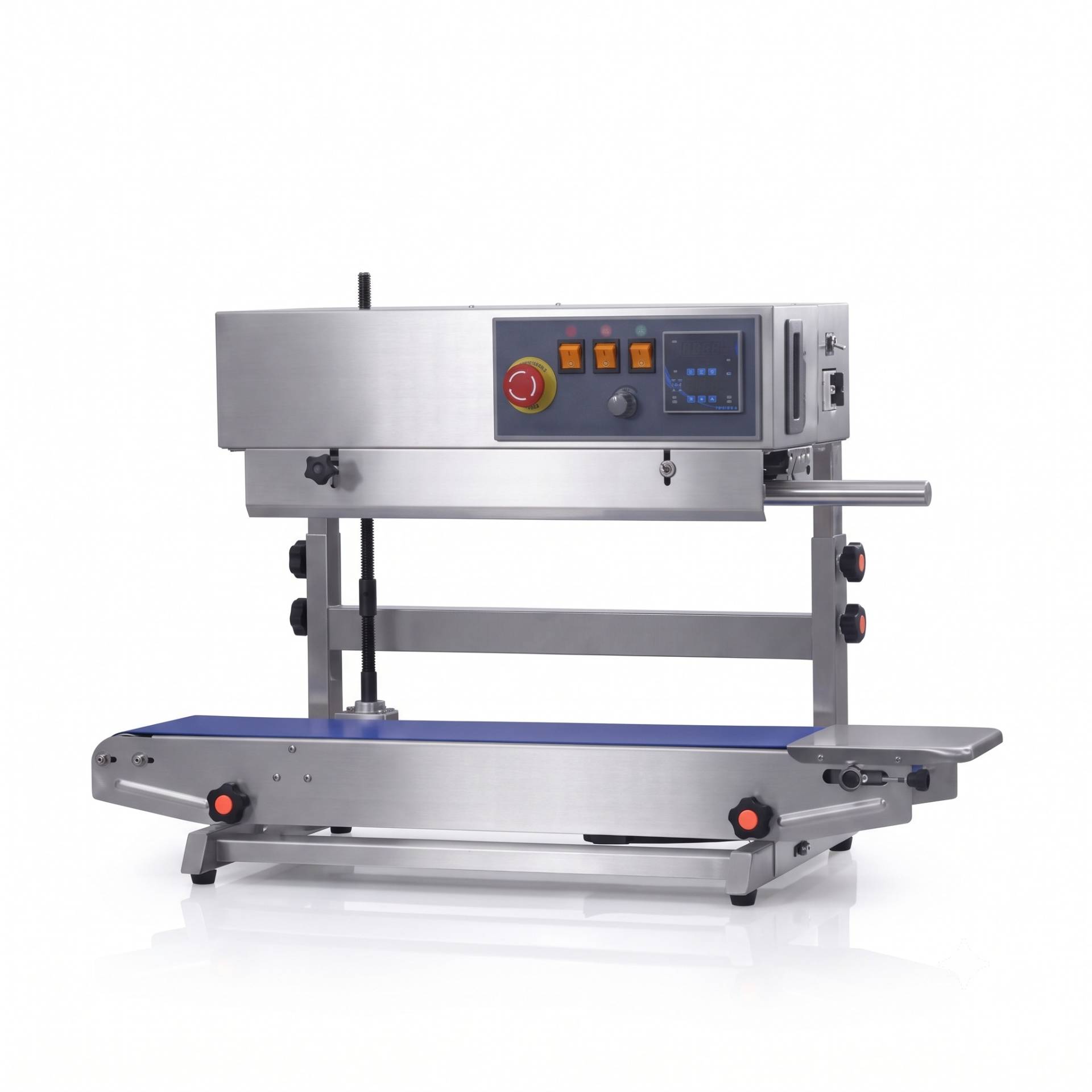
Yes. A nitrogen flushing band sealer slows oil oxidation and rancidity in namkeen, dry fruits, spices, bakery items and fried snacks by displacing oxygen inside the pouch just before sealing — without reaching vacuum-level oxygen removal.
How a Nitrogen Flushing Band Sealer Works Step by Step
A continuous band sealer flushes nitrogen through a four-stage cycle: pouch alignment, stationary-nozzle gas purge, conveyor pinch transfer, and heated-band sealing with forced cooling.
- Infeed and nozzle positioning. Operators guide filled pouches onto the moving conveyor so each open pouch mouth passes around a stationary stainless-steel gas nozzle positioned just ahead of the heating jaws.
- Nitrogen injection. Synchronised valves release dry, food-grade nitrogen into the pouch headspace, forcing trapped air up and out through the still-open mouth.
- Pinch transfer. PTFE-coated sealing belts grip the pouch lips immediately past the nozzle tips, pinching the film flat to trap the nitrogen cushion before room air re-enters.
- Heat sealing and cooling. Heated blocks compress the moving belts across the seal band to weld the inner sealant layers; cooling wheels then stabilise the hot seam.
Because the pouch mouth travels a short open gap between the nozzle tip and the pinch belts, nozzle-flushed pouches always retain some residual oxygen. Unlike chamber vacuum machines that evacuate air inside a closed dome, a continuous band sealer works purely by positive-pressure gas displacement.
Continuous Band Sealer vs VFFS Nitrogen Flushing
For low-to-mid volumes of pre-made pouches, a nitrogen flushing band sealer costs a fraction of an automatic VFFS line — but the two serve different volume bands.
When comparing the band sealer with nitrogen flushing price in India, New Vision Machines in Indore supplies its MS Band Sealer with Nitrogen Flushing at Rs 37,700 ex-works (GST extra), aimed at factories packing pre-made pouches.
Swipe or scroll horizontally to view all columns
| Specification | Nitrogen Flushing Band Sealer | VFFS with Nitrogen Flushing |
|---|---|---|
| Residual oxygen level | Typically 3%–8% O2 | Typically 1%–3% O2 |
| Machine cost band | Rs 37,700 ex-works (GST extra) | Around Rs 4.5–18 lakh |
| Packing speed | Around 15–25 pouches/min | Around 35–80 pouches/min |
| Pouch format | Pre-made 3-side-seal or stand-up pouches | Roll-stock film formed on the collar |
| Changeover downtime | A few minutes | Tens of minutes |
| When each wins | Multi-SKU runs under ~5,000 pouches/shift | Single-SKU runs above ~15,000 pouches/shift |
Buyer checklist
Choose a nitrogen flushing band sealer when you pack a few hundred to a few thousand pouches per shift across multiple SKUs, use pre-made stand-up or pillow pouches, or need packing capacity ready before the October–November festive peak across MP, Gujarat, Rajasthan and UP.
Choose an automatic VFFS machine when you run high volumes of a single free-flowing snack SKU, buy printed roll-stock film in bulk, and need lower residual oxygen through an enclosed forming-tube gas lance.
Before ordering either, confirm plant utilities: stable single-phase 220V power, a two-stage nitrogen pressure regulator, and enough conveyor load capacity for heavy dry-fruit or spice packs.
The machine is only half the system — the pouch film decides whether the flush survives the supply chain. A nitrogen-flushed snack in plain LDPE loses its gas cushion within hours; the same flush in a metallised barrier laminate holds for weeks. Budget the laminate first, the machine second.
Which Products Need Nitrogen Flushing
High-fat and aroma-sensitive foods gain the most: fried namkeen, dry fruits, ground spices and bakery items, paired with multi-layer barrier laminates such as MET-PET/PE or BOPP/MET-PET/PE.
For plant managers working out how to increase shelf life of namkeen pouches, displacing headspace oxygen slows lipid oxidation and rancidity in sev, bhujia, mixture, fried dal and wafers. With FSSAI's 18 October 2026 advisory tightening food-grade packaging expectations, preventing rancidity across regional distribution chains matters through every festive dispatch window.
Products that need it:
- Namkeen and fried snacks — slows oil oxidation in palm, cottonseed and groundnut frying oils; the gas cushion also reduces transit breakage.
- Dry fruits and nuts — retards rancidity in high-oil cashews, almonds, walnuts and pistachios.
- Spices and masalas — protects volatile essential oils and natural pigments in chilli, turmeric, coriander and blended masalas.
- Bakery items — slows fat staleness in rusks, khari, cookies and low-moisture roasted snacks.
Products that do not:
- Low-fat dry grains and sugar — raw rice, whole pulses and crystal sugar oxidise too slowly to justify gas consumption.
- High-moisture fresh foods — paneer, wet batters and fresh produce need refrigeration and tuned CO2/N2 modified-atmosphere ratios, not a pure nitrogen purge.
- Compacted brick packs — rigid brick immobilisation calls for a chamber vacuum machine, not a flushing band sealer.
Pouch film specs that hold the flush
Flushing nitrogen into plain mono-layer LDPE fails because LDPE is gas-permeable: nitrogen escapes and ambient oxygen re-enters within hours. Specify barrier laminates instead. A typical fried-snack pouch uses a PET / metallised-PET / food-grade PE structure; matte or window pouches use BOPP-based equivalents; heavy 500 g–1 kg dry-fruit packs step up to foil or nylon-reinforced barriers. Confirm exact micron structures with your film supplier for your product's fat content and target shelf life.
Nitrogen Supply Setup: Cylinder vs Generator
A continuous flushing sealer needs food-grade nitrogen (around 99.5%–99.9% purity) at regulated low pressure and modest flow rates, drawn from high-pressure cylinders or an air-compressor-driven PSA nitrogen generator.
High-pressure nitrogen cylinders (standard 7 m³ D-type) suit factories running one or two band sealers or handling seasonal October–November spikes. A two-stage regulator steps cylinder pressure down to line pressure through food-grade tubing.
Compressor + PSA nitrogen generator pays off for plants running three or more packaging machines across double shifts: a filtered compressor feeds air at around 7–8 bar into pressure-swing-adsorption sieve towers that generate nitrogen on site, removing cylinder logistics entirely.
Gas cost per pouch. At roughly 1.5–3 litres of nitrogen per 200 g pouch including purge losses, cylinder nitrogen typically works out to a few paise to around twenty-five paise per pouch. Confirm against your local industrial gas supplier's refill rate before costing a product.
Limits and Assumptions
Residual oxygen and shelf-life results vary with machine setup, laminate grade, product porosity and shop-floor conditions: nozzle diameter and solenoid timing, wrinkles or spice dust on seal jaws, air trapped inside porous fried snacks that desorbs over a day or two, and cross-drafts from ceiling fans diluting the purge stream all move the numbers. Treat every figure in this guide as an industry-typical range, not a guarantee for your line — validate on your product and film with a trial run.
Frequently Asked Questions
How does nitrogen flushing compare to vacuum sealing for snacks?
Nitrogen flushing leaves a protective gas pillow inside the pouch with a few percent residual oxygen; chamber vacuum sealing pulls oxygen below 1% but compresses the pack tight. Use nitrogen flushing for brittle namkeen and chips that would crush under vacuum, and reserve vacuum sealing for dense products like cashews or solid blocks.
What is the running cost of nitrogen gas per pouch?
From standard commercial cylinders, nitrogen typically costs a few paise to about twenty-five paise per 100–250 g pouch, depending on nozzle flow rate, purge time, pouch headspace and operator feeding speed. A PSA generator lowers the per-pouch cost further at high volumes but adds upfront capital.
Can I retrofit nitrogen flushing to a plain band sealer?
Aftermarket nozzle kits exist, but retrofits rarely match factory purge timing: purpose-built machines integrate synchronised solenoid valves, custom nozzle brackets and pre-seal guide geometry. Improvised retrofits tend to leak gas and leave inconsistent residual oxygen, so cost the purpose-built machine before modifying a plain sealer.
How long does nitrogen flushing extend namkeen shelf life?
Paired with a 3-layer metallised barrier pouch, nitrogen flushing can stretch fried namkeen shelf life from roughly a month unflushed to two to four months. The actual gain depends on frying-oil quality, product moisture and hermetic seals — validate with accelerated shelf-life testing on your own product.
Does FSSAI mandate nitrogen flushing for packaged snacks?
No. FSSAI does not mandate nitrogen flushing, but its 18 October 2026 advisory requires strict food-grade packaging compliance and consignment traceability from perishables handlers. Date-batch coding on food-grade barrier laminates, sealed on a nitrogen flushing band sealer, helps snack manufacturers clear distributor and retail audits.
To inspect the MS Band Sealer with Nitrogen Flushing (Rs 37,700 ex-works Indore, GST extra) or trial-seal your barrier laminate pouches before purchase, contact New Vision Machines in Indore, Madhya Pradesh at +91-9981604279.