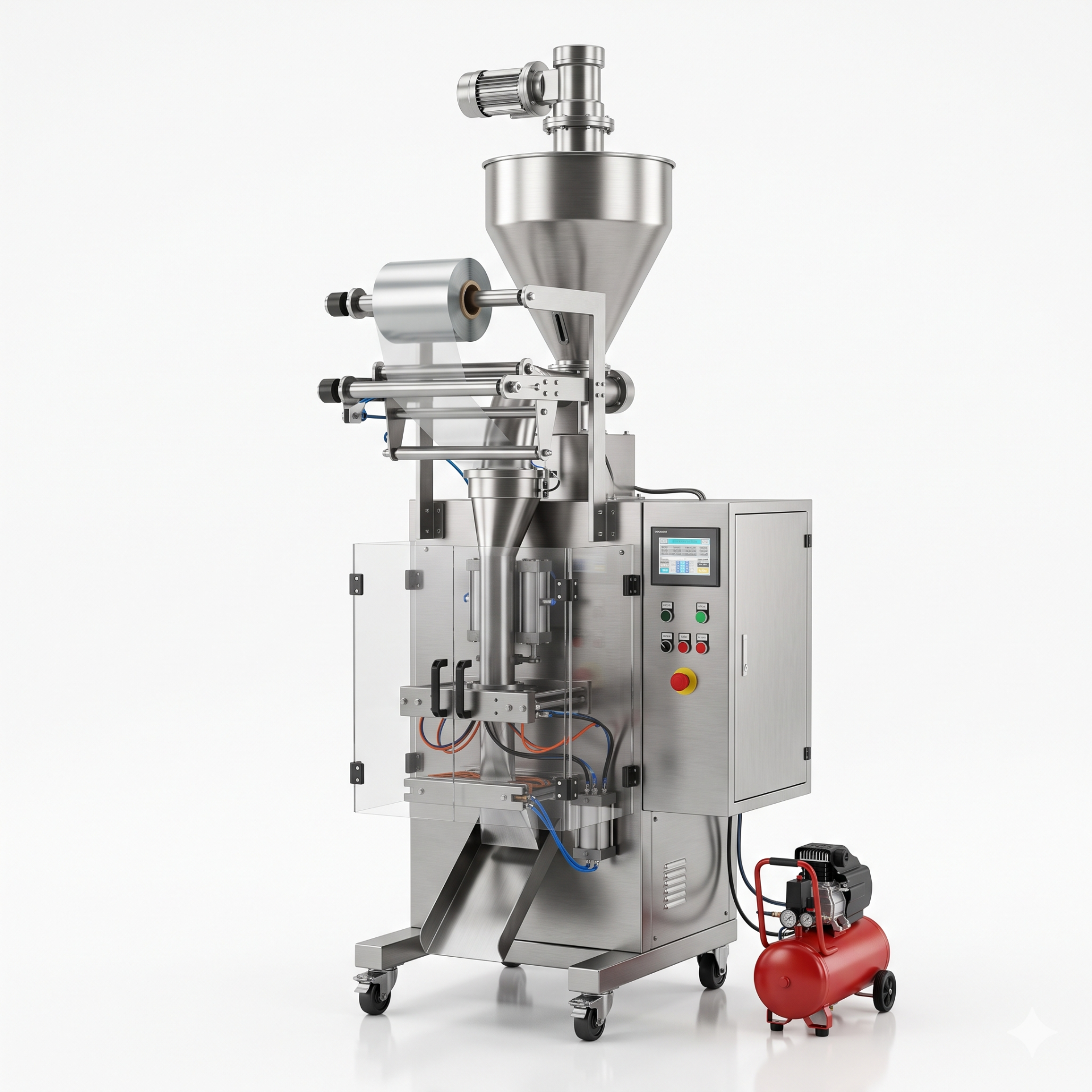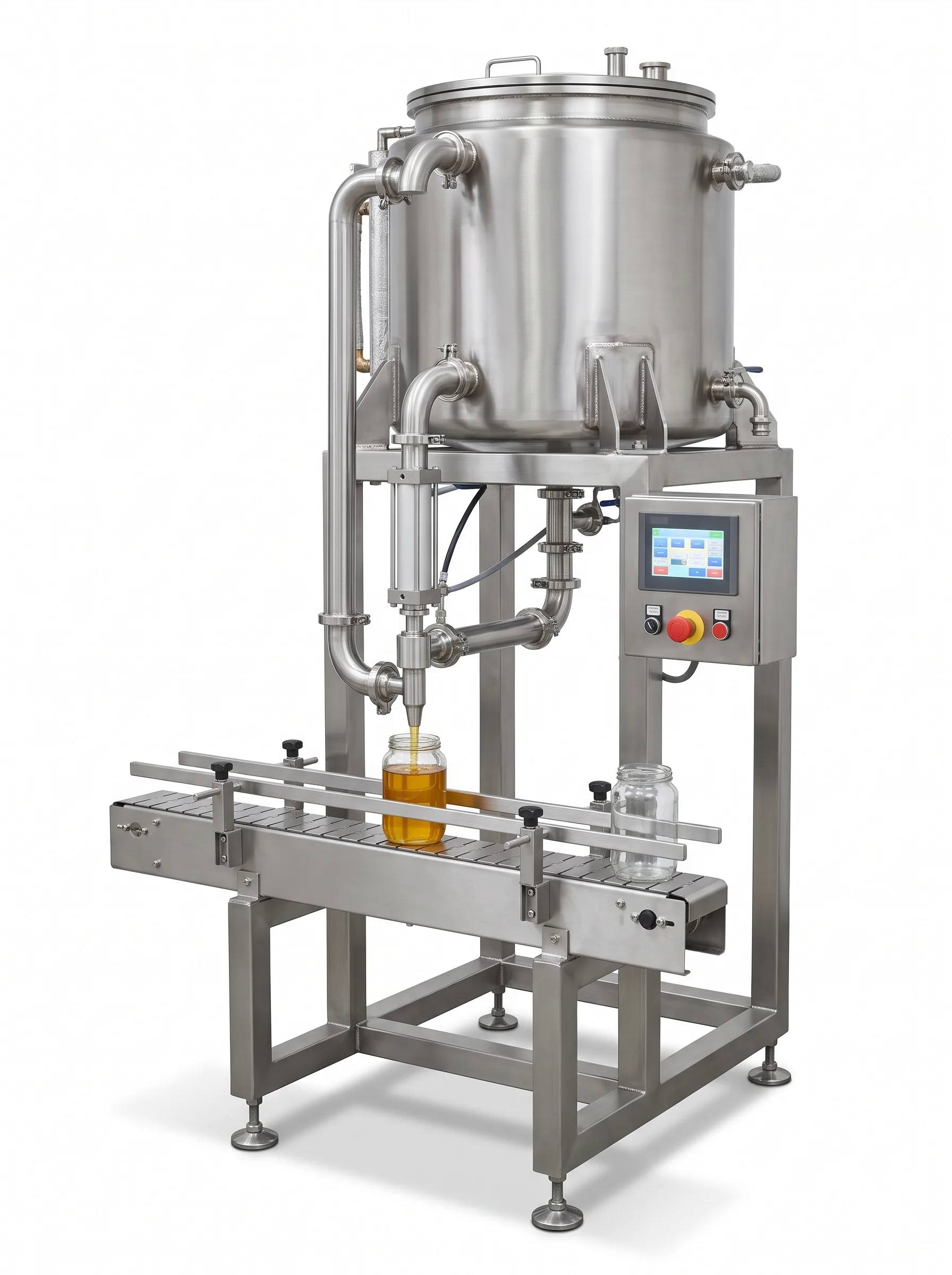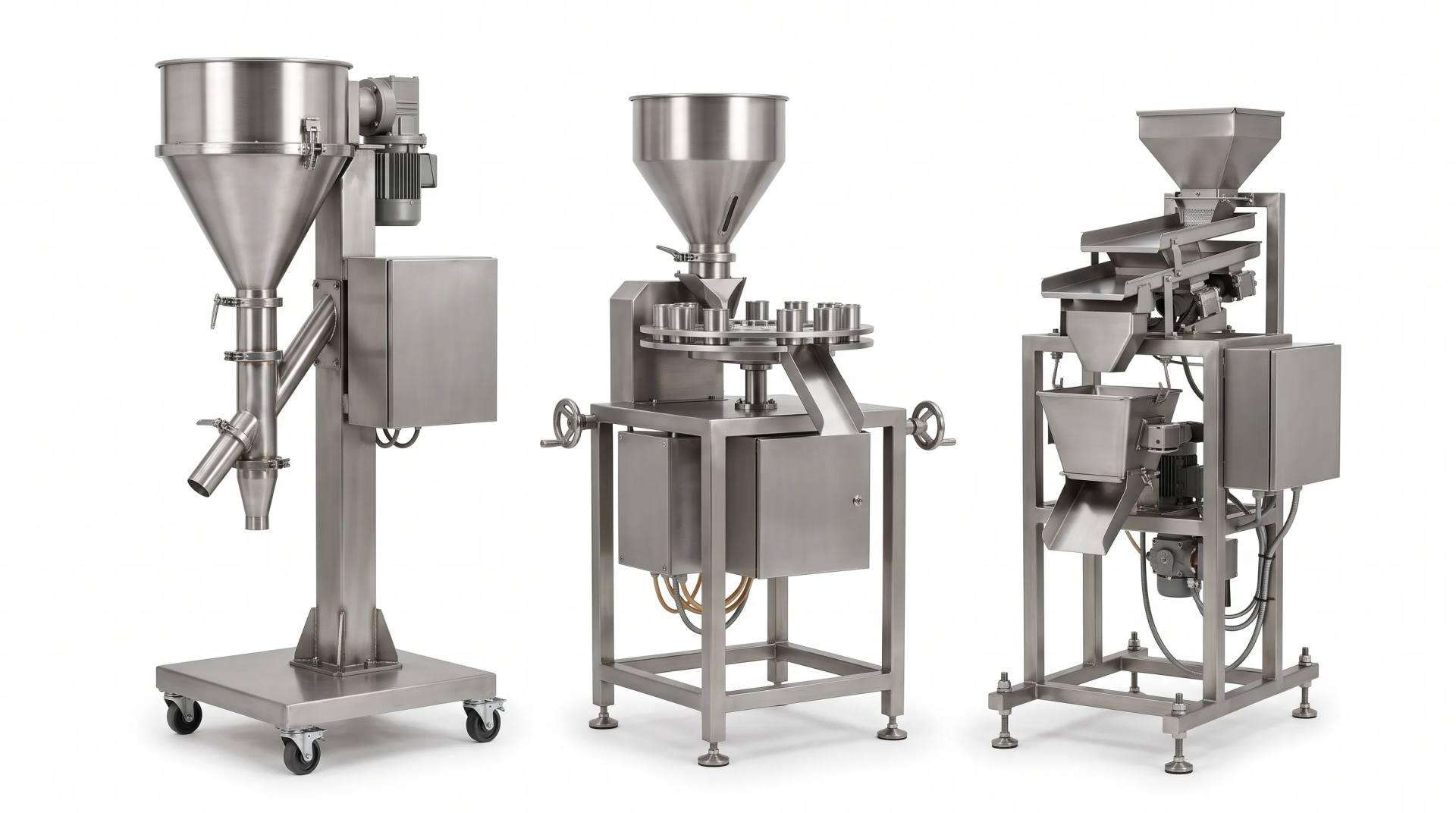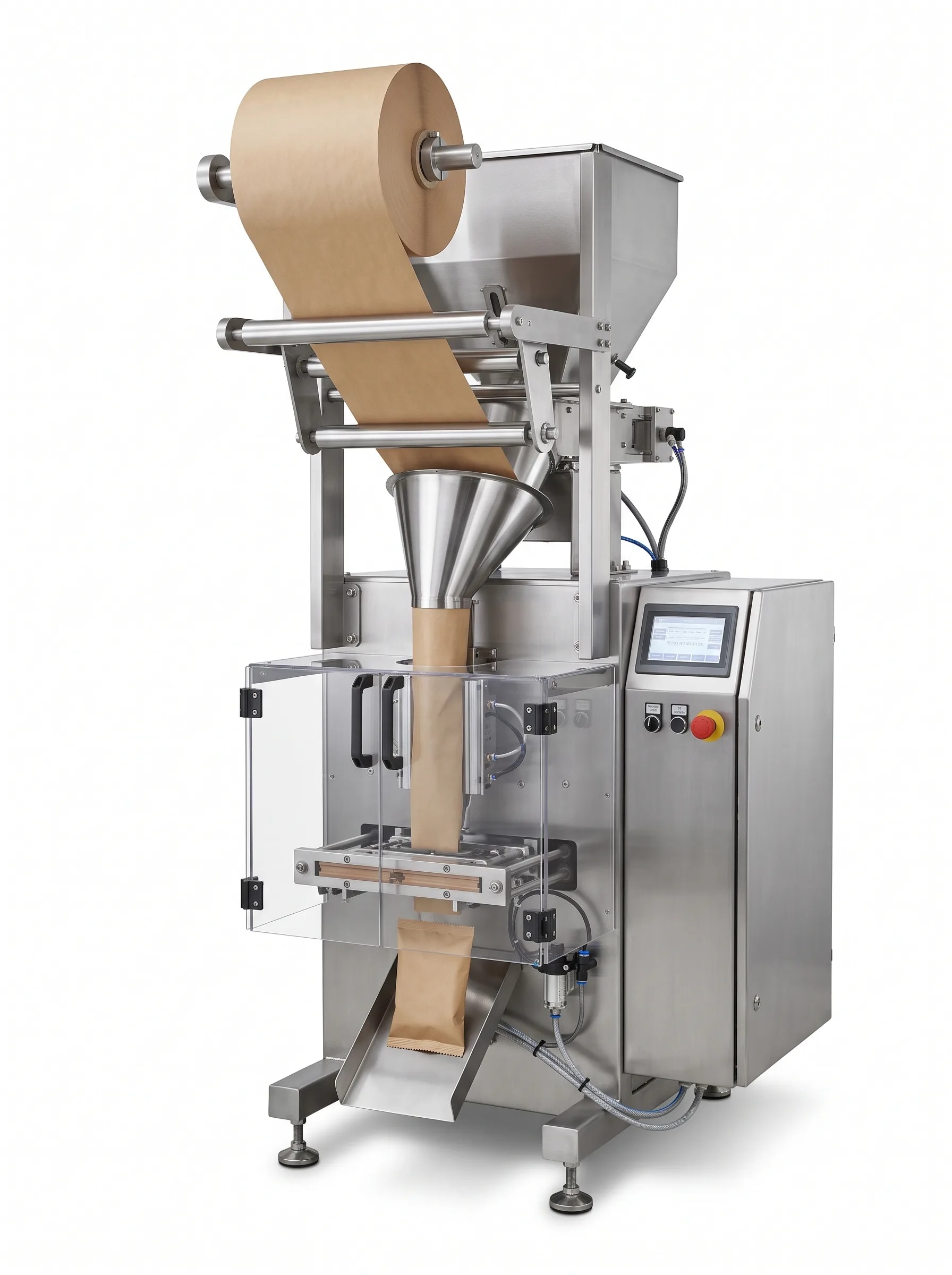
Following the Food Safety and Standards (Packaging) Amendment Regulations, 2026, gazetted on 10 August 2026, manufacturers must transition to a pan masala packing machine for paper pouch substrates, pure cellulose, or rigid tin containers.
- FSSAI Gazette notification (10 August 2026) bans all plastics, laminates, and foil for pan masala under Schedule IV, Serial No. 11.
- Permitted substrates: plastic-free paper, pure cellulose, paperboard, tinplate, and glass containers.
- Existing VFFS forming collars need re-polishing and radius expansion to stop high-friction paper webs tearing.
- Rigid tin lines (50g–1000g) replace pouch sealing with rotary cup fillers or 4-head linear weigh fillers.
What does the 10 August 2026 FSSAI ban prohibit for pan masala packaging?
The Food Safety and Standards (Packaging) Amendment Regulations, 2026 strictly prohibit polyethylene, polypropylene, polyester, PVC, synthetic polymer laminates, aluminium foil, and metallised film layers for packaging pan masala, permitting only plastic-free paper, pure natural cellulose, tinplate containers, and glass under Schedule IV, Serial Number 11 of the 2018 packaging regulations.
FSSAI CEO Rajit Punhani signed the notification on 7 August 2026. Three days later, on 10 August 2026, it was published in the Gazette of India. That finalized the draft notification issued on 28 April 2026 following its 60-day public consultation window. Under these rules, which tie directly into the Plastic Waste Management Rules, 2016, multi-layer plastic pouches for mouth fresheners and gutkha are eliminated. There is no grace period for conventional laminates.
For plant engineers and procurement teams, the boundaries are clear:
Banned substrates: Polyethylene (PE), polypropylene (PP), polyvinyl chloride (PVC), polyester (PET), synthetic co-extrusions, multi-layer laminates, aluminium foils, and vacuum-metallised barrier films.
Permitted substrates: Uncoated or naturally barrier-treated plastic-free paper, virgin paperboard, pure regenerated cellulose films, tinplate metal canisters, and glass jars.
Search industrial marketplaces today, and you will still find outdated machinery listings. Portals like IndiaMART and aajjo feature entry-level pouch packing machines priced between ₹1.05 lakh and ₹2.20 lakh (listed excluding GST). Those units were built for multi-layer PE/PET foil webs. Mount 50 GSM plastic-free paper or pure cellulose onto an uncalibrated frame, and the web will tear at the collar within seconds, seal jaws will burn through the coating, and finished packs will violate FSSAI statutory coding and packaging rules. The coding half of compliance — printing dates, batch codes and MRP on paper vs tin — is covered in our FSSAI batch-coding requirements guide for food pouches.
Why do standard VFFS machines tear plastic-free paper rollstock?
Standard vertical form-fill-seal machines tear plastic-free paper rollstock because paper exhibits a kinetic coefficient of friction exceeding 0.45—more than double that of biaxially oriented polypropylene—creating severe mechanical drag and web tearing across sharp 30-degree forming shoulders engineered exclusively for low-friction synthetic polymer laminates.
Polymer films like BOPP and laminated PE have slick surfaces that slide across sheet metal. Paper does not. Its unlaminated surface grabs collar wings like fine abrasive cloth. The moment mechanical draw-down belts tug from below, drag spikes. The paper reaches its tensile limit, wrinkles, and splits right at the throat.
Elasticity explains the difference. Plastic films stretch 15% to 120% before rupture, absorbing dancer-arm chatter and tension surges. Unlaminated kraft paper offers less than 3% elongation before catastrophic failure. If your web path uses abrupt 90-degree guide rollers, edge shear will slice paper reels immediately. Run that at 70 strokes a minute on passive friction brakes, and roll inertia snaps the web right behind the reel shaft.
How do you configure a pan masala packing machine for paper pouch lines?
Configuring an industrial pan masala packing machine for paper pouch production requires fitting custom mirror-polished forming collars with shoulder radii enlarged beyond 4.5 mm, replacing mechanical friction brakes with active servo-driven unwinds, and dropping web draw-down tension from 22 N down to 8–12 N.
Maintaining consistent output on a pan masala packing machine for paper pouch substrates requires four mechanical modifications:
Forming Collar Geometry: Standard steel collars feature 30-degree entry angles and tight 1.5–2.0 mm turn radiuses. That works for elastic plastic, but it shreds paper webs. You need a custom collar hand-lapped with 1200-grit compound or hard-chrome plated, with transition radiuses opened to at least 4.5 mm to let the paper tube form without creasing.
Active Servo Web Unwind: Mechanical friction bands cannot handle paper. As the parent roll shrinks from a 350 mm outer diameter to the 75 mm core, drag spikes uncontrollably. A motorized servo unwind driven by an analog dancer arm holds web tension at 8–12 N through the entire cycle.
Vacuum-Assisted Pull Belts: Standard rubber friction belts slip against dry paper backing. Operators often tighten clamp pressure to compensate, which scuffs pre-printed statutory warnings and crushes paper fibers. Perforated vacuum belts grip the web using suction (-0.4 bar), pulling fragile stock cleanly without slippage.
Vertical Fin-Seal Drive: Plastic-free heat-sealable papers rely on water-based dispersion coatings. Unlike molten polyethylene, these coatings require steady, linear contact pressure rather than brief, high-impact pinching to fuse.
Investing in a dedicated plastic free pouch packing machine India factories can run across multiple shifts cuts down scrap rates. A calibrated pan masala packing machine for paper pouch production keeps line efficiency above 90% while meeting Schedule IV testing requirements.
How do you retrofit an FFS line for heat-sealable cellulose films?
Retrofitting a vertical form-fill-seal machine for heat-sealable cellulose film requires narrowing the horizontal sealing jaw operating window to exactly ±3°C, extending jaw dwell time to 280–350 milliseconds, and grinding flat-face cross-hatch serrations to prevent piercing delicate biopolymer barrier layers during continuous thermal bonding.
Cellulose films made from regenerated plant pulp provide excellent oxygen barriers and natural compostability, but they do not behave like petroleum thermoplastics. Standard polyethylene tolerates a wide sealing band of 125°C to 155°C. Coated cellulose operates within a narrow window between 115°C and 125°C. Drop below 115°C, and pouch seams separate during transport. Exceed 130°C, and the base sheet scorches, turns brittle, and tears along the seam.
Converting an operational unit into a heat sealable paper VFFS machine requires ditching old mechanical bimetallic thermostats. Install digital dual-loop PID controllers with fast-response RTD sensors set 1.5 mm behind the sealing faces. Remove aggressive diamond serration bars; sharp pyramids pierce 40-micron cellulose sheets. Replace them with ground flat-face sealing jaws with fine 0.5 mm pitch cross-hatch serrations to distribute clamping pressure evenly without cutting the base web.
Cup filler vs auger filler for mouth freshener: which doses pan masala into tins?
When evaluating a cup filler vs auger filler for mouth freshener products, rotary volumetric cup fillers are optimal for coarse, abrasive areca nut blends to eliminate particle degradation, whereas servo auger fillers are required for fine, aromatic powder additives requiring dosing repeatability within ±0.5%.
Pan masala is an abrasive mixture of chopped betel nut (supari), catechu (kattha), slaked lime, cardamom, and volatile flavoring oils. Pairing the wrong dosing tooling to your product damages ingredients and wears down contact parts:
Rotary Volumetric Cup Fillers: The standard choice for coarse-cut supari grains. Telescopic cups measure volume without crushing the betel nut granules against metal walls. They discharge 40 to 80 doses per minute into paper pouches or rigid cans without generating product dust.
Vertical Auger Servo Fillers: Necessary for fine powders and formulations with micro-ground menthol or delicate flavor carriers. When dosing fine powders, volumetric cups create dust and spill product across sealing areas. A vertical auger servo FFS machine uses an enclosed stainless-steel flight screw driven by an independent servo motor, preventing dusting, separation, and oil loss.
Multi-Head Linear Weigh Fillers: Essential for rigid tin packaging from 100g to 1000g. Bulk areca nut settles unevenly inside feed hoppers, causing volumetric cup weights to drift by 5% to 8%. A 4-head weigh filler isolates every batch with real-time load-cell feedback, holding fill repeatability within ±1% of target weight — comfortably inside Legal Metrology permissible-error bands for 50g–1000g packs.
What changes for batch coding and statutory warnings on tin vs paper?
Switching from paper pouches to rigid tin containers forces packaging facilities to replace water-based thermal inkjet inks with fast-evaporating solvent or methyl ethyl ketone formulations to ensure statutory batch details and warning texts adhere permanently to non-porous coated tinplate surfaces.
Schedule IV compliance requires legible manufacturing dates, batch codes, retail pricing, and mandatory health warnings. The packaging material determines your printer setup:
Paper Pouches: Porous kraft and cellulose sheets absorb water-glycol thermal inkjet (TIJ) inks in under 0.2 seconds. Print cures instantly at 300 DPI and resists rub-off when pouches drop down collation chutes into secondary cartons.
Tinplate Containers: Varnished metal resists water-based ink absorption. Running an automatic pan masala tin filling machine requires continuous inkjet (CIJ) or solvent-based TIJ cartridges running ethanol or methyl ethyl ketone (MEK) carriers. Cans need 1.0 to 1.5 seconds of open conveyor travel before hitting transfer rails or starwheels. Touch them too early, and statutory warnings smudge into illegible streaks.
Technical comparison: paper pouch vs rigid tin vs glass packaging
Evaluating primary packaging options after the 2026 mandate reveals that paper pouches typically achieve 60–90 packs per minute using constant thermal jaws, rigid tin containers deliver maximum physical protection at 35–55 cans per minute via mechanical seaming, and glass delivers premium impermeability but limits output below 40 units.
Swipe or scroll horizontally to view all columns
| Packaging Format | Seal Method | Jaw Temp Behaviour | Dosing Equipment | Coding Surface | Typical Line Speed Implication |
|---|---|---|---|---|---|
| Paper / Cellulose Pouch | Thermal conduction | Constant band at 120°C ±3°C | Servo auger or rotary cup | Porous kraft / coated paper | 60–90 pouches/min |
| Tin Container (50g–1000g) | Mechanical double seam | Not applicable (cold seaming) | Volumetric rotary cup or weigh filler | Non-porous tinplate lid | 35–55 tins/min |
| Glass Container | Mechanical lug / crimp cap | Not applicable (cold capping) | Rotary tare-weigh or liquid-paste filler | Non-porous glass side/base | 25–40 bottles/min |
Under the FSSAI pan masala packaging rules 2026, single-serve sachets (0.5g to 10g) run primarily on high-speed paper VFFS lines. Medium and premium SKUs (50g to 250g) are moving to tinplate canisters. Tinplate costs more per unit, but mechanical seaming eliminates heat-seal rejects and prevents aromatic flavor loss during monsoon distribution.
Field troubleshooting: four common compliance defects and mechanical fixes
Resolving conversion defects across converted packing lines requires systematic recalibration of forming collar friction, sealing bar thermal stability, ambient plant humidity exposure, and non-porous print drying speeds to prevent batch rejects and maintain production yields above 96% on every operational shift.
1. Paper Web Snapping at the Collar Throat. Root cause: High unwind back-tension combined with sharp angles on a stock plastic collar. Fix: Reduce web tension on the reel brake to 8–10 N. Polish the collar apron with 1200-grit diamond paste, or fit a dedicated paper collar with enlarged 4.5 mm transition radiuses.
Root Cause: High unwind back-tension combined with sharp angles on a stock plastic collar.
Fix: Reduce web tension on the reel brake to 8–10 N. Polish the collar apron with 1200-grit diamond paste, or fit a dedicated paper collar with enlarged 4.5 mm transition radiuses.
2. Weak Cellulose Seam Separation in Transit. Root cause: Sealing jaw temperatures dipping below 115°C, or insufficient dwell time under pressure. Fix: Install solid-state relays on digital PID controllers. Lengthen horizontal jaw dwell to 300 milliseconds and verify uniform jaw pressure across the entire seal width with pressure-indicating film.
Root Cause: Sealing jaw temperatures dipping below 115°C, or insufficient dwell time under pressure.
Fix: Install solid-state relays on digital PID controllers. Lengthen horizontal jaw dwell to 300 milliseconds and verify uniform jaw pressure across the entire seal width with pressure-indicating film.
3. Severe Tin Dosing Variation on Humid Days. Root cause: Slaked lime and catechu absorbing ambient humidity and packing into volumetric cup corners. Fix: Feed dry compressed air into the hopper headspace. For sticky or hygroscopic formulations, switch from volumetric cups to a 15-litre auger filler with continuous counter-rotating agitation blades.
Root Cause: Slaked lime and catechu absorbing ambient humidity and packing into volumetric cup corners.
Fix: Feed dry compressed air into the hopper headspace. For sticky or hygroscopic formulations, switch from volumetric cups to a 15-litre auger filler with continuous counter-rotating agitation blades.
4. Smudged Statutory Batch Details on Metal Lids. Root cause: Using water-based ink on varnished metal, or can guide rails touching fresh print before flash-off. Fix: Switch to an MEK-based fast-dry solvent ink. Extend conveyor travel by at least 300 mm between the print head and the next mechanical transfer rail.
Root Cause: Using water-based ink on varnished metal, or can guide rails touching fresh print before flash-off.
Fix: Switch to an MEK-based fast-dry solvent ink. Extend conveyor travel by at least 300 mm between the print head and the next mechanical transfer rail.
Before ordering a single spare, run your existing FFS on a 20-metre trial reel of certified heat-sealable paper. If the web survives the forming collar at 8–12 N tension, a retrofit kit (polished collar + servo unwind + PID jaws) will carry you through the mandate. If it shreds at the throat, budget for a paper-rated machine instead of fighting the frame.
Operating limits and engineering assumptions
Operating parameters in this guide assume base paper stock weights between 45 and 70 GSM with certified aqueous heat-seal dispersion barriers, standard factory ambient conditions of 22°C to 28°C with 45% to 65% relative humidity, and round three-piece welded tin cans.
Factory results will vary based on your raw materials and facility setup:
Substrate Barrier Variations: Uncoated kraft paper coated with water-based dispersion barriers seals differently from paper laminated with biopolymer cellulose. Check each batch with a calibrated peel-force gauge before clearing commercial runs.
Plant Humidity: Paper reels absorb moisture rapidly. If your packaging hall lacks climate control and ambient humidity climbs past 70% during monsoons, paper tensile strength drops by up to 25%. Expect tear frequency to double unless reels remain sealed until mounted.
Can Dimensions and Seaming Profiles: Dosing and seaming parameters for 50g pocket tins do not translate directly to 1000g institutional cans. Seaming chuck clearances and roller profiles must be calibrated specifically for your tinplate thickness.
Frequently asked questions about pan masala machine conversion
Packaging plant operators evaluating machine conversions after the August 2026 mandate encounter recurring engineering bottlenecks regarding mechanical compatibility, thermal jaw heat dissipation, IndiaMART marketplace listing risks, volumetric dosing accuracy, and ambient moisture interference across converted paper and rigid tin container assembly lines.
Can an existing plastic pouch packing machine run paper-based rollstock?
An existing plastic form-fill-seal machine cannot run plastic-free paper rollstock without replacing the forming collar with a low-friction polished unit, lowering film pull tension by 40% to 50%, and replacing aggressively serrated sealing jaws with flat or fine-pitch heated sealing bars.
Mounting paper on an uncalibrated machine leads to continuous web breaks and leaky vertical seams. A functional conversion kit must include a motorized servo unwind, broad-radius forming shoulders, vacuum pull belts, and digital PID controllers.
What sealing temperature is required for heat-sealable cellulose film?
Heat-sealable cellulose films typically seal between 115°C and 130°C, operating within a tight window of ±3°C that requires dual-loop PID digital temperature controllers to prevent incomplete seam bonding below 115°C or brittle film scorch marks and seal embrittlement above 135°C.
Standard polymer heating bars can drift by ±10°C, scorching natural biopolymers. Upgrading to solid-state relays and high-precision RTD temperature sensors guarantees an airtight, pinhole-free seal.
Why do marketplace machines priced under ₹2.5 lakh fail new FSSAI standards?
Budget form-fill-seal machines priced between ₹1.05 lakh and ₹2.20 lakh on marketplace portals are built exclusively for multi-layer polyester and polyethylene laminates, lacking the servo web tension control, wide-radius forming geometry, and precise thermal dwell capabilities required to process delicate plastic-free paper webs.
Low-cost frames use passive friction bands and rudimentary on-off heating thermostats. Attempting to run certified plastic-free paper or pure cellulose on these units causes chronic web snapping, scorched film, and unbonded pouches that leak aromatic oils.
Which dosing mechanism works best for 50g to 1000g pan masala tins?
Dosing 50g to 1000g rigid pan masala tins requires a multi-station rotary volumetric cup filler or a 4-head linear weigh filler, both of which preserve areca nut particle geometry while delivering cycle speeds between 30 and 50 tins per minute within ±1% target weight.
For coarse, granular supari, volumetric cups offer fast, low-maintenance dosing. For premium aromatic formulations or larger tin sizes subject to density shifts, multi-head weigh fillers provide the load-cell precision required to protect product margins.
Does ambient plant humidity cause paper web ruptures during packaging?
Elevated ambient plant humidity exceeding 70% softens unlaminated paper fibers, lowering web tensile strength by up to 25% and causing catastrophic web snapping across high-friction forming collars unless production areas maintain controlled relative humidity between 45% and 55% during continuous operation.
Store paper reels on raised pallets inside wrapped plastic film in climate-controlled anterooms. Installing spot dehumidification over machine unwind bays prevents web softening and keeps lines running smoothly during wet weather.
For machinery consultation and factory retrofits, contact New Vision Machines at +91-9981604279. Works: Lasudia Mori, Indore, MP 452010.
New Vision Machines verified catalog
- Vertical Auger Servo FFS Powder Packing Machine: ₹4,55,000 ex-works Indore (MRP ₹5,99,000). Servo-driven auger dosing for fine powders into pouches.
- Four Head Weigh Filler 1000g: ₹1,69,000 ex-works Indore (MRP ₹2,03,000). Four independent vibratory lanes with load-cell feedback for 50g–1000g rigid tins.
- Auger Filler 15 Litre: ₹1,27,000 ex-works Indore (MRP ₹1,59,000). For non-free-flowing powders and hygroscopic formulations.
All New Vision Machines prices are quoted ex-works Indore; GST is extra.
Master the August 2026 pan masala packaging shift. Learn how to retrofit VFFS machines for paper pouches and rigid tin lines under strict new FSSAI rules.
An engineering compliance guide for converting pan masala lines to plastic-free paper pouches and rigid tins under the notified August 2026 FSSAI mandate.