Choose a load-cell weigh filler over cup fillers to cut an illustrative 2.5% giveaway on irregular snacks. For cohesive powders, choose an auger filler to hold illustrative ±1–2% accuracy across severe density shifts.
How do auger, volumetric cup, and load-cell weigh fillers work?
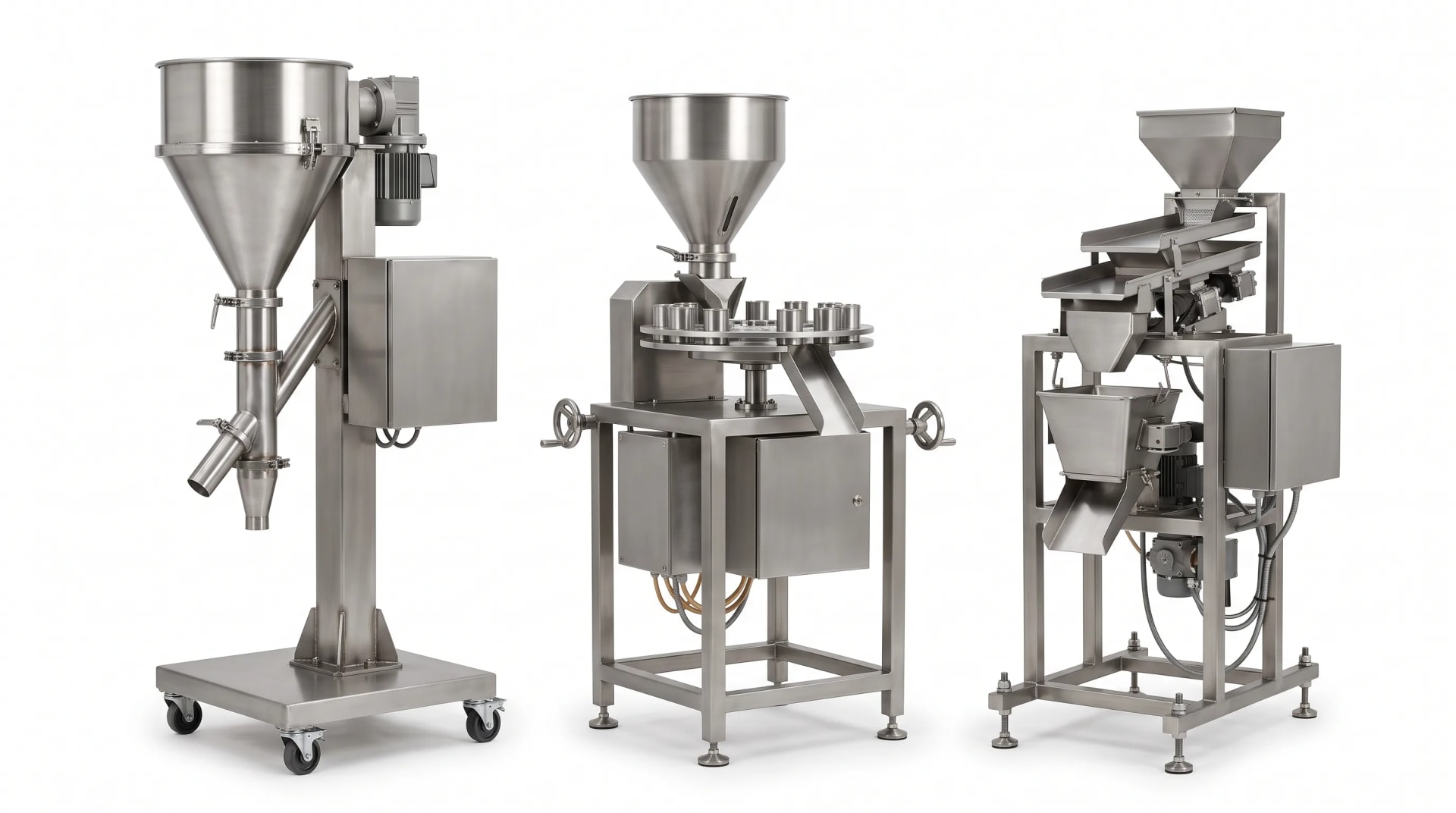
Volumetric cup fillers isolate dry goods using mechanical telescopic cylinders, auger fillers displace cohesive powders through vertical servo-driven tooling screws, and digital load-cell weigh fillers meter bulk products by measuring net gravitational mass on strain-gauge platforms independent of product volume shifts.
Telescopic cup fillers rely entirely on mechanical volume. Product drops out of a top hopper into matched cylindrical chambers, a wiper plate levels off the top, and a trap door drops the charge into your packaging collar. The design is simple, robust, and completely blind to changes in product density. For dry, free-flowing pulses or sugar, these integrate directly with our granule filling machine solutions.
Augers tackle sticky, cohesive dry goods. Inside the hopper, an agitator blade spins continuously, pushing aerated powder down into the vertical screw flights while wiping down the side walls. As the central servo indexes a set number of revolutions, it forces an exact physical displacement of powder out through the bottom funnel. If your factory processes non-free-flowing ground spices or flours, you will need a dedicated powder filling machine to hold your tolerances.
Load-cell weigh fillers ditch physical volume indexing completely in favor of gravimetric measurement. Vibratory trays feed product into a hopper bucket mounted on an electronic strain gauge. The controller pulses bulk feed rapidly, switches to an incremental trickle to dial in the target grammage, and dumps the bucket only when the digital mass signal matches your target weight.
How do dosing mechanisms compare side by side?
Comparing dosing systems side by side reveals that volumetric cups offer economical speeds for free-flowing grains, vertical augers provide dedicated positive displacement for cohesive spices, and digital strain-gauge weighers deliver superior accuracy to prevent giveaway on irregular, fragile, or mixed snack foods.
Swipe or scroll horizontally to view all columns
| Mechanism | Accuracy class | Best product fit | NVM ex-works price (verified only) |
|---|---|---|---|
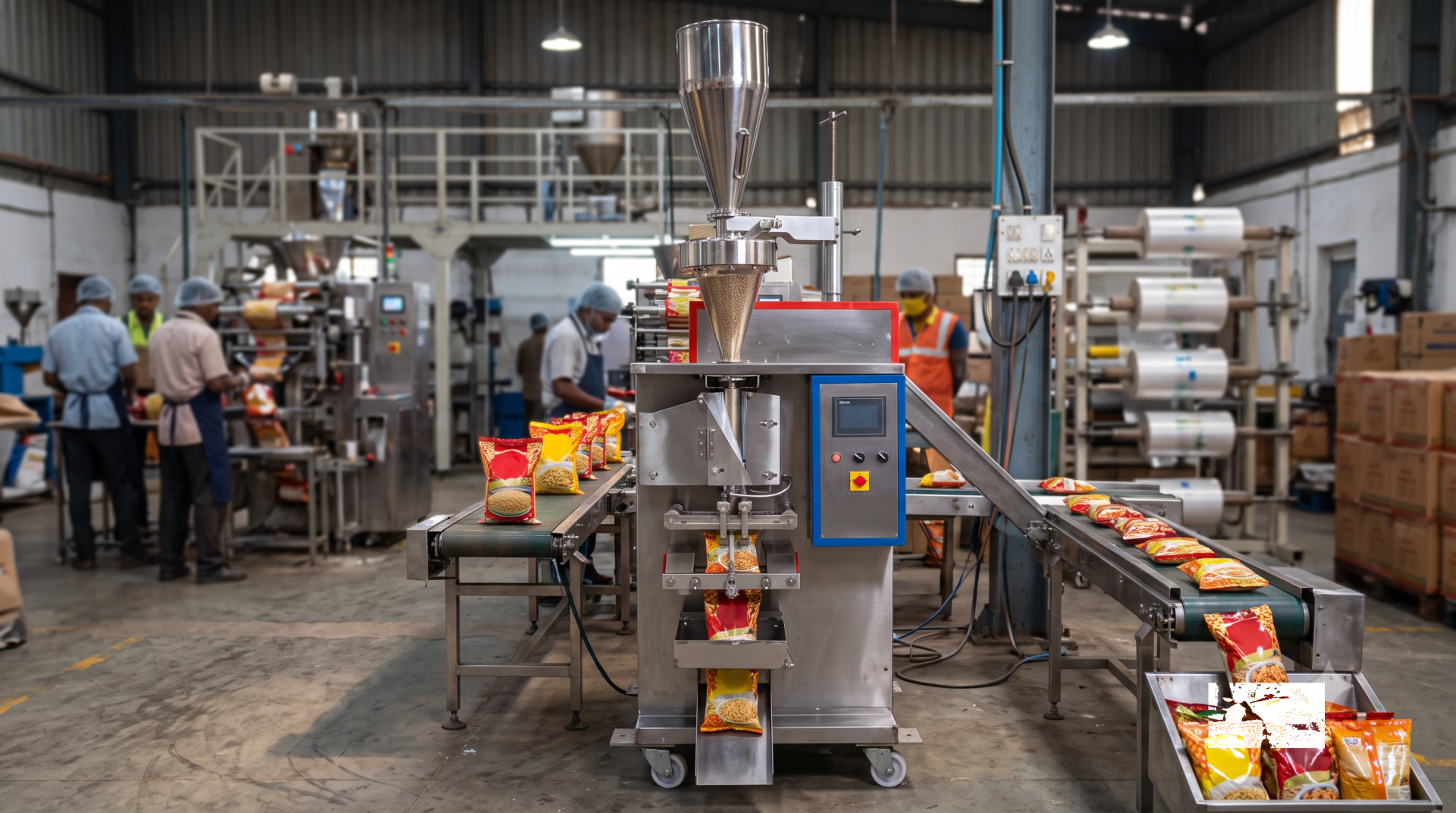
| Volumetric telescopic cup | Illustrative ±1.5% to ±3% on uniform grains | Free-flowing uniform dry goods: white sugar, whole lentils, tea grains, poha | ₹2,47,000 (MRP ₹2,84,000; automatic powder pouch FFS with stirrer) |
| Vertical tooling screw (auger) | Illustrative ±1% to ±2% on uniform powders | Non-free-flowing cohesive powders: haldi, ground spices, atta, besan, detergents | ₹1,27,000 (MRP ₹1,59,000; auger filler 15L) |
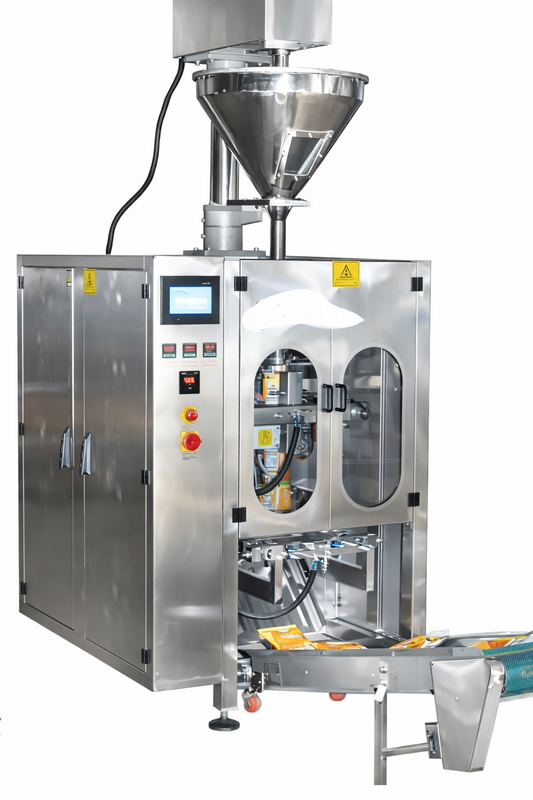
| Servo-driven vertical auger | Illustrative ±0.5% to ±1.5% on consistent feed | Precision non-free-flowing fine powders: fine ground spices, chemical powders | ₹4,55,000 (MRP ₹5,99,000; vertical auger servo FFS) |
| Digital strain-gauge weigh filler | Illustrative ±0.2% to ±1% on discrete pieces | Irregular piece sizes, fragile snacks, mixed namkeen, dry fruits | ₹30,000 (MRP ₹36,000; 100g double-head) |
| Digital strain-gauge weigh filler | Illustrative ±0.2% to ±1% on discrete pieces | Coarse dry goods, grains, whole pulses, dry fruits | ₹37,700 (MRP ₹47,000; 5kg weigh filler) |
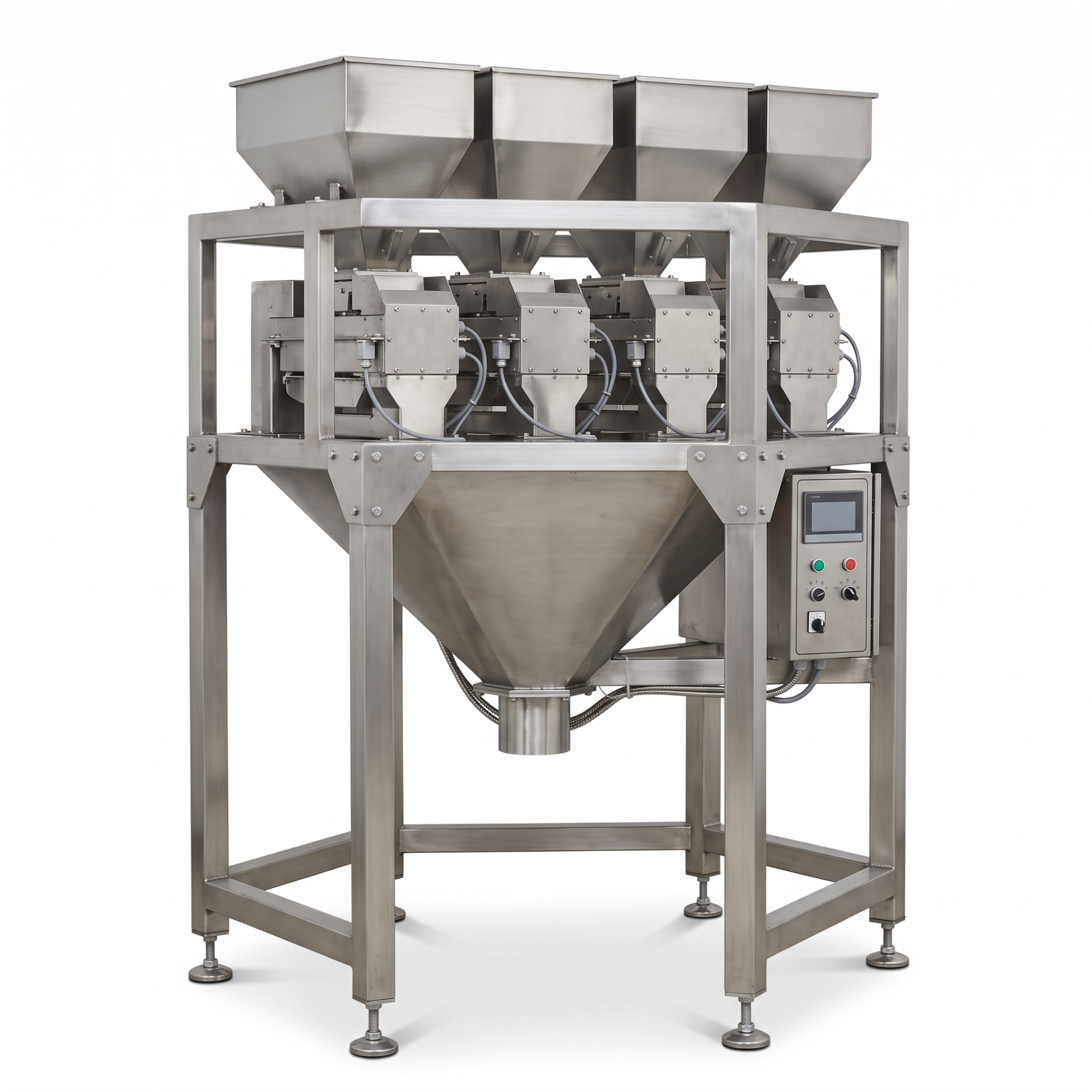
| Multi-head strain-gauge weigh filler | Illustrative ±0.2% to ±0.8% on high-speed lines | High-speed snack packaging, mixed namkeen, kurkure, potato chips | ₹1,69,000 (MRP ₹2,03,000; four-head 1000g) |
All NVM prices are ex-works Indore, GST extra. If you need standalone units, inspect the bench-level 15L auger filler station, the floor-mounted vertical servo auger FFS system, or the multi-channel four-head weigh filler 1000g unit.
Why does the bulk-density trap cause volumetric cup fillers to fail?
Volumetric cup fillers fail whenever raw ingredient bulk density shifts because fixed-volume cavities cannot adapt to physical compaction, aeration, or ingredient settling, directly causing severe package weight drift that produces either illegal underfilled pouches or costly product giveaway across daily production runs.
A volumetric cup operates blindly on spatial volume. If an incoming lot of raw spices has an illustrative 8% to 12% lower bulk density than the batch before it, every single pouch you pack will come out light. Fine spice powders like turmeric showcase this problem immediately: freshly pulverized powder holds trapped air and packs loosely, but as the hopper sits and vibrates, the powder consolidates and packs tighter. That variation creates an illustrative ±5% to ±8% weight swing if you attempt to meter it through fixed cups.
Mixed namkeen poses an even tougher challenge. A blend of fried sev, boondi, and whole peanuts will settle out under the mechanical vibration of your packaging line. Peanuts sink, sev stays near the surface, and volumetric cups scoop up erratic proportions with wild variations in package weight.
What is the actual financial cost of product giveaway?
Product giveaway costs Indian packaging plants substantial daily revenue when operators deliberately bias volumetric dosing heads heavy to avoid violating statutory net weight limits during routine ingredient density fluctuations, leading to massive annual material losses that easily justify investing in precision gravimetric equipment.
Under Schedule II of the Legal Metrology (Packaged Commodities) Rules, 2011 (scout-sourced baseline), shipping packs below maximum permissible error limits invites severe compliance penalties. Because volumetric cups drift, operators protect themselves by tuning their equipment heavy.
Here is an illustrative worked example with stated operating assumptions: an Indian spice mill packs 10,000 pouches of 200g ground spices daily valued at ₹400/kg. If density swings force the line supervisor to set an intentional 2.5% overweight margin (5g extra per pouch) to stay legal, you give away 50 kg of spice every shift. That comes out to an illustrative loss of ₹20,000 per working day. Upgrading from volumetric cups to a precision weigh filler or servo auger pays for itself in an illustrative payback window of under 15 shifts. The same financial arithmetic applies to liquid lines, which we detail in our edible oil filling systems guide.
Which dosing system matches your product profile?
Matching a dosing system to your product profile requires selecting volumetric cups for free-flowing grains, vertical tooling augers for cohesive spice powders, and multi-head or linear strain-gauge weighers for brittle, irregular, or mixed snacks prone to mechanical segregation and breakage during packaging.
Free-Flowing Granules and Grains: Sugar, polished dal, tea leaves, and dry grains flow easily without clumping. These run cleanly on cup fillers or linear weighers without gumming up the hoppers. For entry-level automated lines, the automatic powder pouch FFS with stirrer is priced at ₹2,47,000 (MRP ₹2,84,000).
Irregular, Brittle, or Mixed Solids: Sev, banana chips, potato wafers, mixed namkeen, and cashews cannot tolerate rough handling. Volumetric scrapers break brittle edges, and mixed recipes separate in the feed hopper. These products require gravimetric load cells:
For retail pouches up to 100g, the 100g double-head weigh filler is priced at ₹30,000 (MRP ₹36,000).
For institutional packs up to 5kg, the 5kg weigh filler runs at ₹37,700 (MRP ₹47,000).
For continuous automated retail lines, the four-head weigh filler 1000g is priced at ₹1,69,000 (MRP ₹2,03,000).
Cohesive, Non-Free-Flowing Powders: Besan, fine turmeric, wheat atta, maida, and laundry detergents hold air, cake under pressure, and bridge across discharge spouts. They demand positive-displacement tooling screws to maintain throughput:
For manual packaging stations, the auger filler 15L is priced at ₹1,27,000 (MRP ₹1,59,000).
For high-speed form-fill-seal packaging, the vertical auger servo FFS runs at ₹4,55,000 (MRP ₹5,99,000).
Limits and assumptions
Operational limits and technical assumptions in this guide assume dry, unadulterated product delivered under consistent hopper head-pressure at ambient relative humidity below 65%, with all stated equipment payback periods representing illustrative mathematical models rather than universal performance guarantees across varying factory environments. Ambient temperature shifts, raw ingredient moisture swings, and changing head-pressure from empty hoppers degrade volumetric performance. All stated payback timelines are illustrative mathematical scenarios requiring site-specific verification of ingredient raw material costs and shift run-times. All NVM machinery pricing is ex-works Indore, GST extra, excluding freight, in-transit insurance, and local municipal entry levies.
Concrete field troubleshooting defects with fixes
Common packaging machinery field defects stem from improper agitator clearances, abrasive particulate ingress, unshielded environmental vibration, and delayed nozzle cutoffs, all of which require immediate systematic mechanical recalibration or component servicing to prevent costly production line downtime and inaccurate fill weights.
Product Bridging in Auger Funnel: Sticky powder forms a hollow vault directly over the screw throat, causing empty flighting and short fills.
Fix: Adjust the agitator blade down until it sweeps within 2mm of the funnel walls, or bump up continuous scraper drive speed to keep powder moving.
Telescopic Cup Scuffing and Seizing: Fine sugar crystals or abrasive salt grains work their way between the concentric telescoping rings, locking the adjustment collar.
Fix: Strip the cylinder assembly down, clear abrasive grit using industrial dry solvent, apply food-grade PTFE dry-film lubricant, and replace worn wiper seals.
Load-Cell Signal Zero Drift: Floor vibration from nearby bag sealers or cross-breezes from plant ventilation disrupt sensitive millivolt scale readings.
Fix: Mount the weighing frame on isolated vibration-damping pads, ensure chassis electrical ground tests below 5 ohms, and fit clear acrylic wind baffles around the weigh buckets.
Pouch Seal Contamination from Dosing Dribble: Fine powder dust drifts from the discharge nozzle after rotation stops, settling inside the open pouch film cross-seal.
Fix: Fit an active pneumatic flap or wire cut-off grid to the funnel tip, and increase the servo deceleration ramp on your control panel.
Always install an automated level sensor in your main overhead feed hopper linked to an in-feed screw conveyor or bucket elevator. Maintaining a constant product head height keeps mechanical pressure stable over the dosing chamber, preventing a large share of common volume-shift errors on continuous packaging runs.
How often do volumetric cups need mechanical adjustment during a production shift?
Volumetric cups require manual physical adjustment whenever raw material bulk density shifts, which typically occurs during morning and evening atmospheric humidity changes or raw ingredient lot transitions, demanding routine sample check-weighing every thirty to forty-five minutes to prevent out-of-spec packages on commercial lines.
Can an auger filler pack free-flowing white sugar?
An auger filler can package free-flowing white sugar only when configured with a specialized pneumatic cut-off valve or rotary dribble-collector at the discharge nozzle, without which low-friction crystalline granules continuously sift past stationary screw flights via gravity to cause severe overfills.
Why do load-cell weighers run slower than volumetric cup fillers?
Load-cell weigh fillers run at lower cycle speeds than volumetric cups because mechanical vibratory trays must decelerate from bulk delivery to fine trickle feed, after which the digital strain-gauge controller requires a brief stabilization pause to accurately settle and verify net gravitational mass.
Can a four-head weigh filler run fine red chili powder?
A four-head weigh filler cannot efficiently package fine red chili powder because cohesive spices bridge along vibratory supply trays, coat weigh bucket sidewalls, and generate airborne particulate dust that infiltrates sensitive load-cell flexures to cause persistent zero-signal drift and line shutdowns.
What is the primary operational difference between stepper and servo augers?
Servo-driven augers maintain constant rated torque across variable operating speeds and utilize closed-loop optical encoder feedback for exact fractional-degree stopping precision, whereas open-loop stepper motors risk losing positional synchronization steps under sudden cohesive powder resistance, creating undetected package dosing discrepancies.
For tailored technical dosing assessments, testing raw material samples, or procuring automated packaging machinery, contact New Vision Machines at +91-9981604279 or visit our engineering facility at Lasudia Mori, Indore, MP 452010. Author: Abhishek.