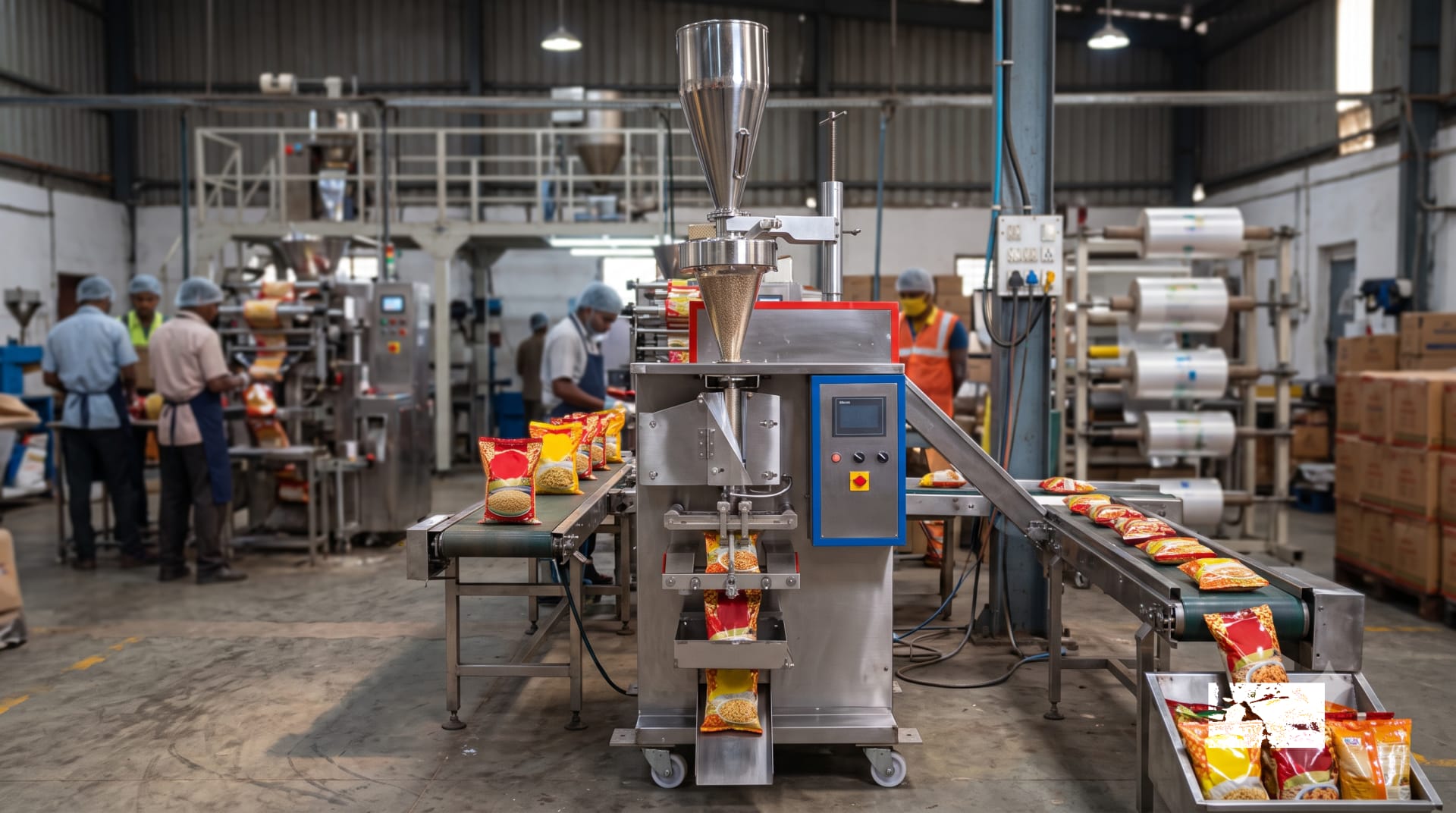
In the cup filler vs auger filler decision, pick volumetric cups for free-flowing grains, augers for cohesive powders, and load-cell weigh fillers for irregular dal or namkeen, where giveaway eats your margins.
Packaging engineers and plant managers always run into the same compromise when buying dosing hardware: upfront capital outlay versus long-term operational giveaway. If you misjudge product rheology against the dispenser mechanism, your line will bleed profit on every pouch that leaves the conveyor.
Cup Filler vs Auger Filler: Which Dispensing Mechanism Fits Your Granule?
The mechanical split comes down to physical displacement versus fixed volume: volumetric cups meter material inside a fixed cylinder cavity at ±1–3% accuracy, while an auger screw rotates through a funneled barrel, positively displacing non-free-flowing particles at ±0.5–1% accuracy.
Deciding between them requires looking straight at particle friction and inter-particle cohesion.
Volumetric cup fillers run on pure gravity. Telescoping cups cycle underneath an open hopper, draw material down, scrape flush against a stationary doctor plate, and discharge cleanly into a formed pouch. This sequence works reliably for dry, free-flowing bulk goods: refined table sugar, polished non-basmati rice, dry pigeon peas, and crystalline salt. Because uniform grains settle at a predictable bulk density, cavity volume converts neatly into a repeatable target weight.
Volumetric Cup (Gravity Feed): Hopper Feed → Telescoping Cup Cavity → Doctor / Scraper Plate → Discharge Funnel
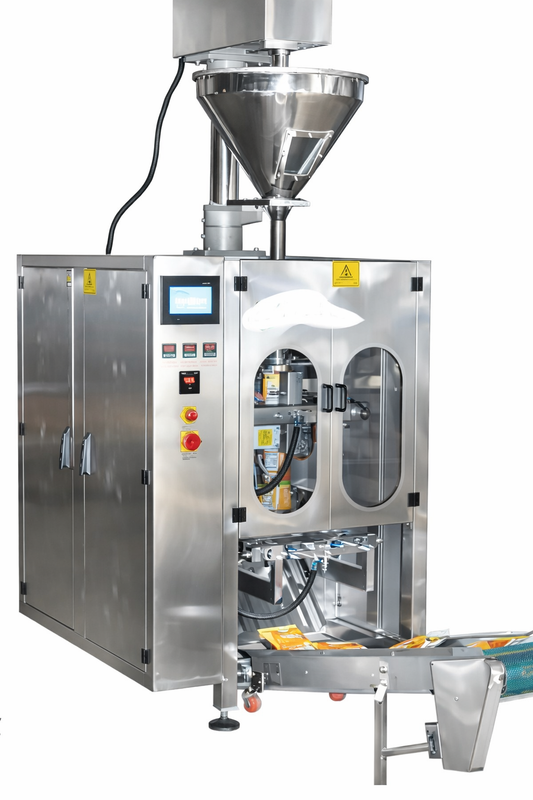
Auger Screw (Positive Displacement): Bulk Hopper → Machined Funnel Barrel → Flighted Drive Screw → Measured Pouch Dose
This side-by-side is the entire cup filler vs auger filler argument: gravity versus positive displacement.
Cohesive solids behave differently. They pack, bridge, and stick. An auger filler for powder handles this through positive mechanical feed, driving a precision flighted screw inside a conical, machined funnel. Each rotation of the drive motor advances a fixed pitch volume of compressed material down the tube. That mechanical drive eliminates the aeration, dusting, and hopper rat-holing that starve gravity cups whenever you run ground turmeric, wheat starch, or fine protein premixes.
If your blended mix bridges across a narrow throat, gravity cups will fail. You need auger flights.
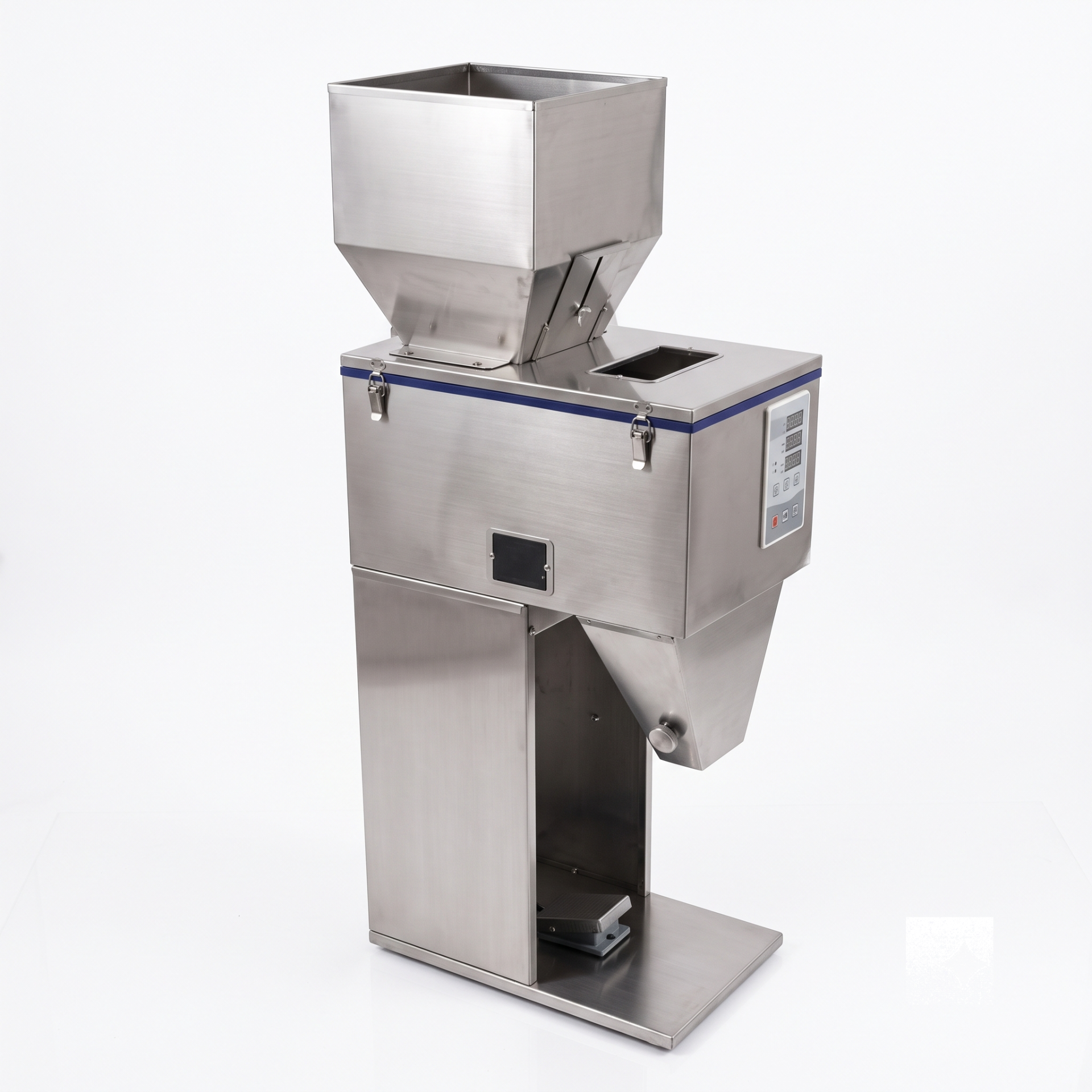
Where does a weigh filler granule machine come into play? When grain geometry varies wildly or bulk density shifts mid-run — think mixed fried namkeen, unpolished lentils, or whole cashews — volumetric cavities produce unacceptable weight scatter. A load-cell weigh filler drops product along a vibratory tray into an isolated weigh bucket. Strain gauges monitor the live mass continuously, verifying target weight within ±1–2% accuracy before release. That decision sits outside the cup filler vs auger filler debate — once piece geometry gets irregular, volumetrics lose to gravimetrics.
How Do Volumetric, Auger, and Weigh Fillers Compare on Accuracy and Cost?
On Indian packaging lines, volumetric cup fillers hold ±1–3% accuracy within a Rs 15,000–55,000 bracket. Commercial auger fillers hit tighter ±0.5–1% tolerances across heavy industrial builds reaching Rs 14,50,000. Compact load-cell weigh fillers hold ±1–2% accuracy across an economical Rs 13,000–26,000 window.
Checking current granule filling machine price India listings helps engineering and procurement teams calculate realistic payback schedules.
On the TradeIndia Indore directory, benchtop semi-automatic cup fillers sell between Rs 15,000 and Rs 55,000, while entry-level semi-automatic granule fillers list across Rs 15,500–44,000. Across Gujarat, the TradeIndia Ahmedabad portal lists heavy-duty plant machinery from Rs 15,000 up to Rs 14,50,000, depending on automated multi-head integration and servo drives.
Operations wanting gravimetric accuracy on tight budgets usually start with small benchtop weigh units. One Indore manufacturer's listed prices run Rs 13,000 for 1–100g semi-automatic units, Rs 14,900 for 5–100g weighmetric units, Rs 15,500 for 100g granule filling, Rs 22,000 for mid-range models, and Rs 26,000 for 1kg capacity machines (named price anchor in the table below).
Broader market aggregators show similar pricing bands:
- IndiaMART listings: Rs 18,000 for standard semi-automatic 1–100g machines.
- ExportersIndia listings (Satna suppliers): Rs 16,000 for digital particle weighing units.
- New Vision Machines (Indore): Rs 13,600 ex-works for a semi-automatic 200g granule weigh filler.
Swipe or scroll horizontally to view all columns
| Filler Type | Best-Fit Granule | Accuracy | India Price Band (INR) | Maintenance Note |
|---|---|---|---|---|
| Volumetric Cup | Free-flowing granules (sugar, rice, beans, salt) | ±1–3% | Rs 15,000–55,000 (TradeIndia Indore) | Scraper plate inspection |
| Auger Screw | Fine, variable-density powders and spices | ±0.5–1% | Rs 15,000–14,50,000 (TradeIndia Ahmedabad) | Drive screw alignment |
| Load-Cell Weigh Filler | Namkeen, dal, dry fruits | ±1–2% | Rs 13,000–26,000 (Genuine Packaging Solutions: Rs 13,000 1–100g; NVM: Rs 13,600 200g) | Load-cell tare check |
What Is the Real Plant Cost of Product Giveaway?
Giveaway is the unbilled product mass sealed into every pouch past your declared net weight. You calculate the financial damage on the floor with this formula:
Daily giveaway cost = (overfill grams per pouch ÷ 1000) × pouches per day × product cost per kg
Every extra gram packed into a pouch directly erodes your gross margin.
Because volumetric cup dispensers run a wider tolerance band of ±1–3% compared to ±1–2% on load-cell weighers, floor operators rarely set cups dead-on nominal weight. To avoid statutory underweight penalties under the Legal Metrology Act, they intentionally calibrate cups high. That safety buffer compounds through the whole shift.
The financial impact hinges on four variables:
- Overfill grams per pouch: average surplus mass dosed per cycle above nominal target.
- Divisor factor of 1000: standard mathematical conversion from grams to kilograms.
- Pouches per day: actual throughput across scheduled operating shifts.
- Product cost per kg: factory procurement or blended batch processing cost of the bulk ingredient.
On bulk, low-cost commodities like raw crystal salt or industrial white sugar, a ±1–3% cup variance represents pocket change. When you pack fried sev, bhujia, split pulses, or cashew kernels, that same variance becomes a serious cash leak. Moving high-value dry goods from a volumetric cup to a precision weigh filler granule machine cuts out chronic overfill and preserves pack margins.
Match the doser to the product, not the price tag. Volumetric cups (±1–3%) are built for free-flowing grains like sugar and rice; augers (±0.5–1%) for cohesive powders and spices; load-cell weigh fillers (±1–2%) for namkeen, dal and dry fruits, where every extra gram is money. Then re-tare the load cell at every shift break — a drifting zero turns ±1–2% accuracy into steady overfill.
How Do You Troubleshoot Common Granule Filling Defects on the Floor?
Packaging defects trace back to mechanical wear, bulk density swings, and electrostatic charges that push fill accuracy outside rated machine limits of ±0.5% to ±3%.
When fill weights become erratic on the floor, check these four mechanical failure points:
1. Bridging in the Hopper
Non-free-flowing particles lock together into a self-supporting dome right above the hopper throat, starving the dosing cup or weigh pan below.
Fix: install an internal low-speed mechanical sweep agitator to break particle shear lines, or mount an external electromagnetic vibrator on the hopper cone to maintain continuous downward head pressure.
2. Weight Drift Through the Shift
Fill weights start on-spec at the beginning of the shift but drift steadily heavier or lighter by mid-shift.
Fix: recalibrate zero-tare on the load-cell sensor at scheduled shift breaks. Scrape off product crusting from the vibratory feeder tray, and check that the machine base has dampeners isolating it from line conveyor vibrations.
3. Seal Contamination from Dust
Airborne fines coat the pouch sealing zone prior to heat-sealing, producing pinhole leaks and channel blowouts under pressure.
Fix: drop the discharge nozzle lower into the pouch opening to shorten free-fall distance. Add localized vacuum dust extraction shrouds at the fill station, or shift fine spice lines to an enclosed auger filler for powder.
4. Static Cling on Film
Friction between dry packaging laminate and tumbling granules generates a high electrostatic charge, pulling fines onto the sealing jaws and pouch inner walls.
Fix: position an active de-ionizing static bar across the film unwind path before the forming collar, and verify low-resistance earthing on the main machine chassis.
What Operating Limits and Sizing Assumptions Apply Across India?
Published equipment ratings and price quotations assume dry, non-hygroscopic material behavior and ex-works factory dispatch.
Factor these plant realities into your procurement plan:
- Capacity scaling: benchtop semi-automatic units cover small-batch weights from 1–100g, 200g, and up to 1kg; automated form-fill-seal lines require multi-head electronic weighers or multi-track cup drives.
- Taxes and freight: machinery quotes exclude crating, transit freight, transit insurance, and statutory GST.
- Atmospheric conditions: monsoon relative humidity causes hygroscopic materials like iodized table salt, ground chaat masala, and jaggery sugar to pull ambient moisture, clumping up free-flowing lines and altering bulk density.
- Line voltage stability: load-cell microcontrollers and servo drives require clean, surge-protected line power to prevent electronic zero-point drift during continuous production shifts.