How Each Mechanism Meters Oil: Piston vs Gear Pump vs Flow Meter
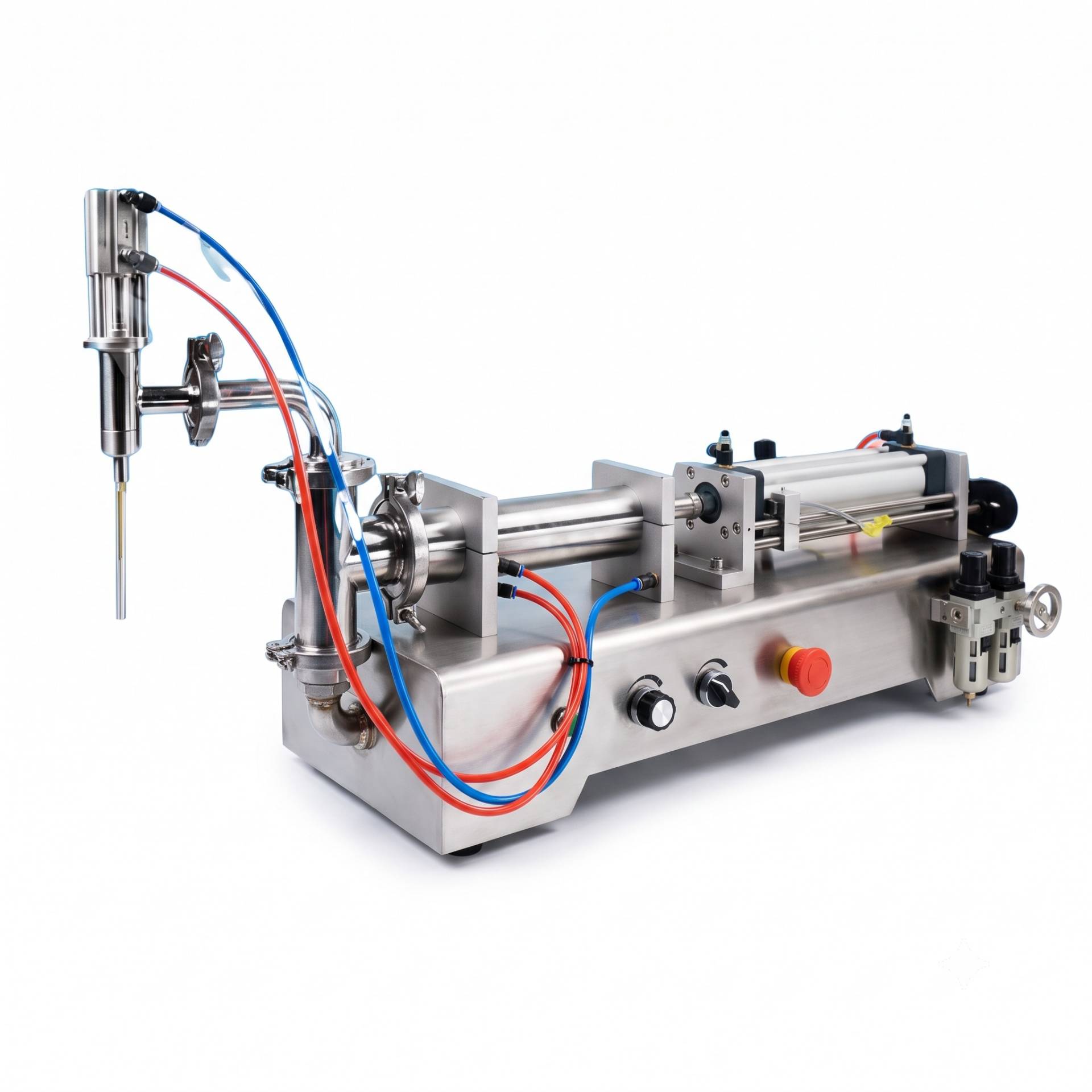
A piston filler vs gear pump vs flow meter oil filling comparison comes down to one mechanical question: how does the machine know when to shut the nozzle? Under class-typical operation, a pneumatic piston filler displaces a fixed cylinder stroke volume, a gear pump filler runs meshing rotary gears for a set time or pulse count (where internal slip shifts with oil viscosity), and a flow meter filler measures real-time liquid movement in the pipe to trigger a programmable logic controller (PLC) shut-off valve. As of October 2026, New Vision Machines (newvisionmachines.com, Indore) supplies single-head and double-head pneumatic piston liquid filling machines covering 10–100 ml through 500–5000 ml fill ranges, priced from Rs 23,400 to Rs 58,500 ex-works (GST extra) for single-head units. New Vision Machines does not list gear-pump or flow-meter fillers; those two technologies appear here strictly as machine classes for engineering comparison.
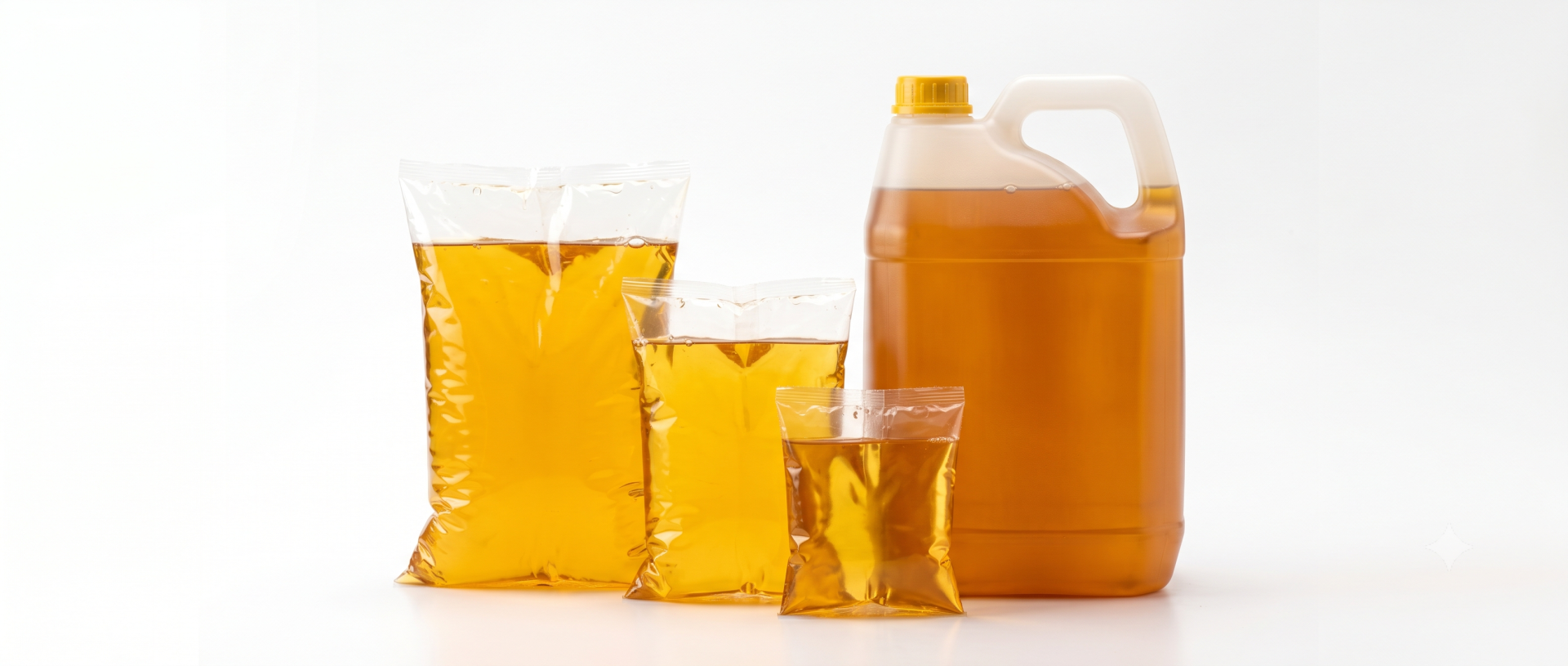
Your pack range and shop-floor temperature swing dictate which mechanism makes sense on your line. On 6 June 2026, India's Department of Consumer Affairs revised the Legal Metrology Standard Operating Procedure (Press Information Bureau Release ID 2269789, 6 June 2026; reported by Moneycontrol, The Hindu BusinessLine, News18, Times Now, and Akashvani News in June 2026) to mandate 9 standard edible oil pack sizes (200 ml/g, 500 ml/g, 1 L/kg, 2 L/kg, 3 L/kg, 4 L/kg, 5 L/kg, 15 L/kg, and 20 L/kg, with packs below 200 ml or 200 g exempt) and require dual volume (ml/L) and weight (g/kg) declarations from around 6 September 2026 after a 3-month transition window.
1. Pneumatic Piston Fillers (Class-Typical Volumetric Displacement)
A pneumatic piston filler works like a calibrated industrial syringe. As the air cylinder retracts, it pulls oil from an overhead hopper or floor tank through an inlet check valve into a honed stainless-steel metering cylinder. When the cylinder strokes forward, the inlet valve snaps shut, the discharge check valve opens, and the piston pushes that exact swept volume through the nozzle into the bottle.
How volume is set: The operator turns a mechanical handwheel on the machine frame to shift the magnetic reed switch or physical stop along the cylinder barrel, lengthening or shortening the stroke.
What happens when oil thickens (class-typical): Stroke volume stays mechanically locked between the front and rear stops. Thick winter oil moves slower during intake—so you may need wide suction hoses and a throttled intake speed to avoid cavitation—but the cylinder still displaces the same geometric volume once full.
Where it hits a wall: Every cylinder bore has a fixed volume ceiling and floor, such as 50–500 ml or 500–5000 ml. You cannot fill a 200 ml bottle and a 5 L Jerrycan on the same cylinder without swapping cylinder assemblies or running two separate machines.
2. Gear Pump Fillers (Class-Typical Rotary Volumetric)
Gear pump fillers drop the reciprocating cylinder in favor of two tight-mesh gears spinning inside a machined housing. Oil enters the suction port, rides around the outside of the housing trapped between the gear teeth, and exits through the discharge port as the teeth mesh again. A timer, variable-frequency drive (VFD), or servo encoder counts how long or how many turns the pump shaft spins per bottle.
How volume is set: Operators punch a pump run-time or shaft pulse count into the control panel.
What happens when oil thickens (class-typical): Every rotary gear pump has tiny radial and side clearances between the spinning gear faces and the stationary casing. A fraction of the oil always leaks backward through those clearances from the high-pressure outlet to the low-pressure inlet. Engineers call this internal slip. Slip changes whenever oil viscosity or discharge back-pressure changes. Cold morning oil slips less than warm afternoon oil, forcing the operator to recalibrate the timer or pulse count as shop temperatures shift.
Where it shines: One pump head can fill a 200 ml bottle on one batch and a 5 L jar on the next just by increasing the rotation count on the panel—no mechanical cylinder swap needed.
3. Flow Meter Fillers: Oval-Gear, Turbine, and Coriolis Mass Flow (Class-Typical Closed-Loop Metering)
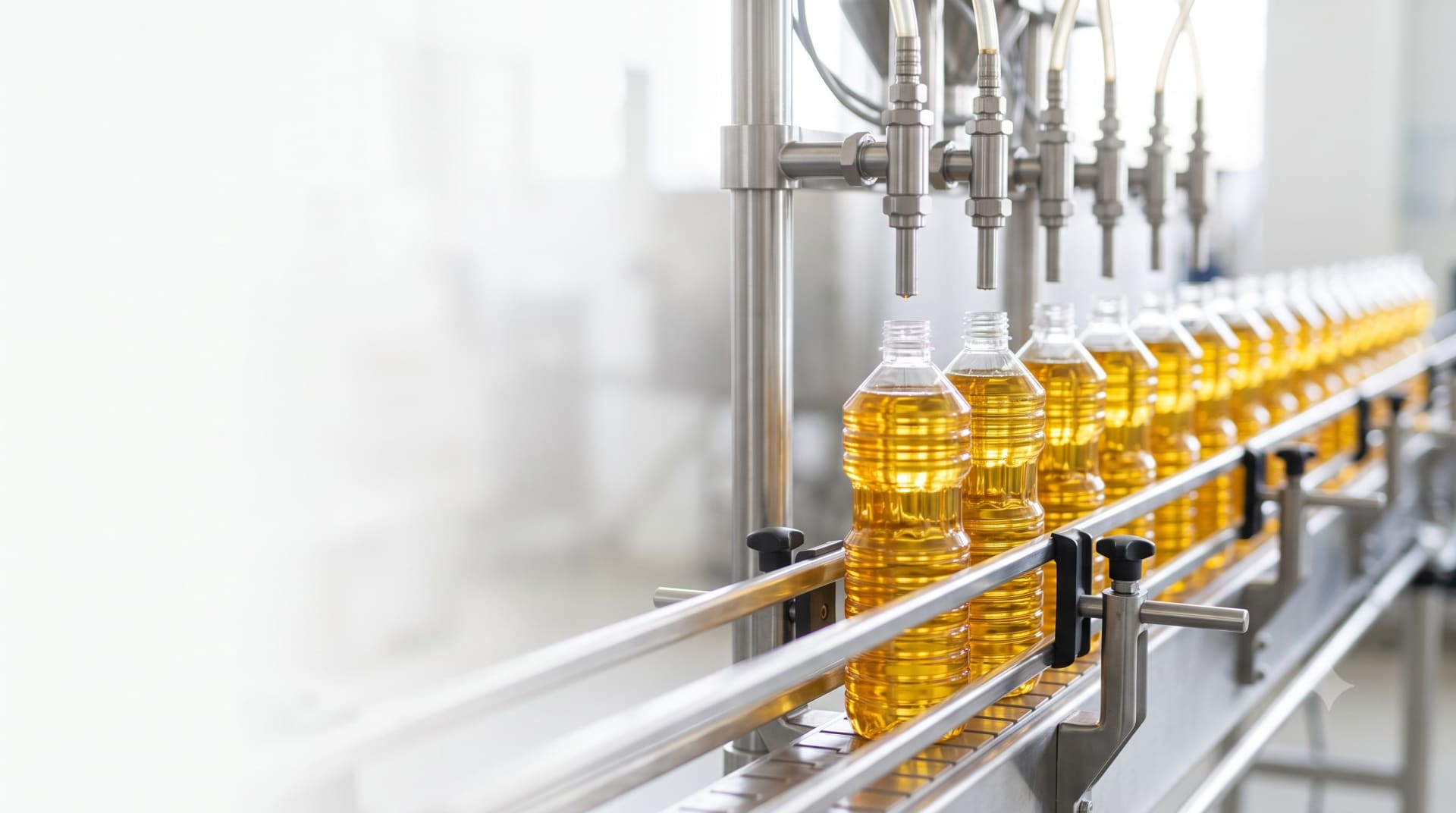
Flow-meter fillers separate the pump from the measurement. A feed pump or pressurized manifold pushes oil through a pipe, an inline flow sensor counts the oil passing through each filling lane, and a PLC snaps the pneumatic nozzle valve shut the instant the target count arrives.
Volumetric flow meters (oval-gear and turbine, class-typical): Oval-gear meters trap fixed pockets of oil between two elliptical gears and fire a pulse to the PLC on every rotation. Turbine meters spin a bladed rotor in the fluid stream. Both styles measure volume (ml or L), not mass (g or kg), and oval-gear rotors handle viscous edible oils better than light turbine blades.
Mass flow meters (Coriolis, class-typical): When evaluating a volumetric vs mass flow oil filler, the key distinction is density independence. Inside a Coriolis meter, oil flows through oscillating tubes; the fluid's mass causes a measurable phase twist in the tube vibration. The PLC reads true mass (g or kg) directly, ignoring oil temperature, entrained micro-bubbles, and seasonal density drift.
The Winter Problem: Viscosity, Density Drift, and Dual Labels
Controlling edible oil filling machine winter viscosity is a practical shop-floor headache for oil mills across North and Central India. Most small and mid-scale packaging halls are unheated. Between a hot June afternoon and a cold January morning, ambient floor temperatures drop sharply, changing both the viscosity (flow resistance) and the density (mass per milliliter) of the oil sitting in your storage tanks.
1. How Temperature Alters Volume-to-Weight Conversion
Cold oil contracts. As it contracts, it packs slightly more mass into every milliliter while thickening enough to resist flowing through narrow pipes.
Take any volumetric filler—whether it uses a pneumatic piston, a rotary gear pump, or an oval-gear/turbine flow meter. Suppose you set a piston filler in June to dispense an exact target volume in milliliters (ml). In January, that same mechanical cylinder stroke still pushes out the exact same geometric volume in milliliters (assuming the suction pipe hasn't cavitated), yet the bottle weighs more in grams (g) on your digital check-weigher because cold oil is denser. Flip the problem around: if your operator adjusts the stroke handwheel in January so the scale reads the exact summer gram weight, the liquid fill line in the bottle neck drops slightly because you are dispensing fewer milliliters.
Gear pumps get hit twice when the weather turns cold. Under class-typical operation, the oil's density shifts just like it does in a piston filler, and the thicker winter oil simultaneously alters internal slip across the gear teeth and back-pressure in the nozzle manifold. That changes the actual volume delivered per pump turn.
Semi-solid fats demand even more intervention. In ghee filling machine India plants—as well as lines packing coconut oil or palm olein—winter floor temperatures turn the product into a crystalline slurry or solid block inside unheated hoppers. No ambient suction pump or piston can pull solid fat through a check valve. Running ghee in winter requires a water- or oil-jacketed heated balance tank, trace-heated transfer piping, and heated nozzle blocks to keep the fat fully melted until it clears the nozzle tip.
2. Why the 2026 Dual-Label Rule Makes Drift Visible
Before 2026, many packers watched either volume or weight in isolation. That leeway ended with the 6 June 2026 Department of Consumer Affairs amendment to the Legal Metrology Standard Operating Procedure (Press Information Bureau Release ID 2269789, 6 June 2026; reported by Moneycontrol, The Hindu BusinessLine, News18, Times Now, and Akashvani News in June 2026). Under this mandate, packers of major edible oils and blended oils must declare both volume (ml or L) and equivalent weight (g or kg) across the 9 standard pack sizes (200 ml/g, 500 ml/g, 1 L/kg, 2 L/kg, 3 L/kg, 4 L/kg, 5 L/kg, 15 L/kg, and 20 L/kg), with enforcement starting around 6 September 2026 after the 3-month transition period. We break down the exact label declarations and line changeover steps in our edible oil standard pack sizes 2026 filling line guide.
Printing both ml/L and g/kg on every bottle leaves nowhere to hide seasonal drift. Operators running volumetric piston or gear-pump lines cannot lock a cylinder stop in May and ignore it until December. At the start of every shift—and whenever incoming oil tank temperature changes—the line supervisor needs to pull sample bottles, check weight on a calibrated digital scale alongside volume in a graduated flask, and tweak the piston handwheel or pump pulse count so both numbers stay inside legal tolerances.
Why Mustard Oil Foams and How to Stop It on the Filling Line
Anyone who has bottled kachi ghani or refined mustard oil into narrow-neck polyethylene terephthalate (PET) bottles knows how stubborn surface foam can be. Bubbles cling to the shoulder of the bottle, fool visual level checks, and overflow onto the cap threads before sealing. Building a reliable edible oil foaming solution filling line setup doesn't require chemical defoamers; it requires fixing how air gets mixed into the oil stream.
Root Causes of Mustard Oil Foaming
High free-fall velocity into empty bottles: When a high-speed jet of mustard oil shoots out of a top-mounted nozzle and slams into the bottom of an empty bottle, it folds air into the liquid pool. Unrefined or cold mustard oil is viscous enough to trap those air pockets, slowing their rise to the surface so a collar of foam builds up in the bottle neck.
Suction-side air leaks: A loose hose clamp on the intake pipe, a nicked polytetrafluoroethylene (PTFE) piston ring, or a whirlpool vortex in a nearly empty overhead tank pulls air bubbles into the metering cylinder. When the piston compresses that oil-air mix on the forward stroke, it shears large bubbles into fine micro-foam that expands as soon as the oil leaves the nozzle.
Undersized nozzle tips: Forcing a high volume of thick oil through a narrow nozzle orifice creates high exit shear and spray turbulence.
Engineering Controls to Stop Foaming
Choke the pneumatic exhaust valve: On a pneumatic piston filler, you don't need to change the stroke length to slow the jet. Turn the one-way exhaust flow-control screw on the front port of the pneumatic cylinder to slow the forward piston speed. Slower piston travel lowers nozzle exit velocity and cuts turbulence while delivering the exact same milliliter volume.
Fit positive pneumatic shut-off nozzles: Anti-drip nozzles that close with a spring or pneumatic pin right at the nozzle tip stop oil from stringing onto bottle threads and prevent air from sucking back up into the nozzle tube between strokes.
Drop the nozzle closer to the bottle floor: Lowering the nozzle bracket so the tip sits just inside the bottle neck—or using a diving nozzle that starts near the bottom of tall bottles and rises with the liquid—cuts free-fall height and stops plunging-jet aeration.
Keep the balance tank topped up and seals tight: Maintain enough liquid head in your feed tank to stop suction vortexing, and check tri-clover clamps and suction hose barbs during weekly line maintenance.
Which Mechanism Fits Your Line: Retail Bottles vs Bulk Jars and Tins
Matching a filler to your plant comes down to which of the 9 standard pack sizes (200 ml/g to 20 L/kg, per the 6 June 2026 Department of Consumer Affairs SOP revision, PIB Release ID 2269789) make up your daily production volume and how often your crew switches bottle formats.
1. Small and Medium Retail Bottles (200 ml, 500 ml, 1 L)
Pneumatic Piston Fillers: Built for semi-automatic tables and entry-level automatic lines packing 200 ml, 500 ml, and 1 L PET bottles or stand-up pouches. Mechanical stroke stops give repeatable volumetric fills without PLC programming, and any shop operator can dial in the stroke handwheel in two minutes after weighing the first winter test bottles.
Multi-Head Servo Piston or Flow-Meter Lines (Class-Typical): High-speed automated conveyor lines running thousands of bottles per hour typically use multi-head servo piston fillers or multi-head oval-gear/Coriolis flow-meter banks, letting the operator switch from 500 ml to 1 L presets on a touchscreen human-machine interface (HMI).
2. Mid-Size Jars (2 L, 3 L, 4 L, 5 L)
Pneumatic Piston Fillers (500–5000 ml cylinder class): One 500–5000 ml pneumatic piston machine covers the entire 1 L, 2 L, 3 L, 4 L, and 5 L high-density polyethylene (HDPE) handle-jar and Jerrycan lineup on a single cylinder bore. Moving from a 2 L jar to a 5 L jar only requires cranking the stroke stop back along the cylinder tie-rod.
Gear Pump and Oval-Gear Flow Meter Fillers (Class-Typical): Practical when one filling station has to jump from 200 ml bottles in the morning to 5 L jars in the afternoon without mechanical cylinder limits—provided the operator checks and corrects for viscosity slip on gear pumps.
3. Bulk Tins and Jars (15 L / 15 kg and 20 L / 20 kg)
Pneumatic Piston Fillers: Standard catalog pneumatic piston cylinders top out at 5000 ml (5 L) per stroke. You can still fill a 15 L or 20 L square tin or jar on a 5000 ml piston filler by cycling the foot pedal or auto-timer 3 or 4 times per container, though multi-stroking slows down hourly tin output.
Flow Meter or Weigh-Metric Fillers (Class-Typical): Plants dedicated to 15 L/kg and 20 L/kg bulk tins and jars typically install inline flow meters (oval-gear or Coriolis mass flow) or load-cell weigh fillers that dump the full 15 L or 20 L charge in one continuous two-stage (fast bulk + slow dribble) valve cycle.
Swipe or scroll horizontally to view all columns
| Mechanism | How it meters the fill | When winter oil thickens | Changeover 200 ml to 5 L | NVM offering (Oct 2026) |
|---|---|---|---|---|
| Pneumatic piston | Fixed cylinder stroke volume | Stroke volume stays locked; intake slows | Cylinder swap or second machine | Single/double-head — Rs 23,400–58,500 ex-works |
| Gear pump | Timed gear rotations | Internal slip changes — recalibrate the timer | Panel setting only | Not listed — discussed as a machine class |
| Flow meter | PLC counts measured flow, shuts the valve | Volumetric types drift; mass-flow types ignore density | Recipe change on the HMI | Not listed — discussed as a machine class |
What New Vision Machines Lists: Pneumatic Piston Liquid Fillers
Plant owners comparing mustard oil filling machine price in India can review the full catalog of oil filling machines supplied by New Vision Machines in Indore. As of October 2026, New Vision Machines stocks semi-automatic pneumatic piston liquid filling machines in both single-head and double-head models. We do not list or sell gear-pump or flow-meter liquid fillers; those two systems are explained in this guide strictly as machine classes to help buyers weigh their engineering options.
New Vision Machines Single-Head Pneumatic Piston Catalog (As of October 2026)
Cylinder models and fill ranges: Single-head pneumatic liquid fillers are stocked in dedicated cylinder bore sizes spanning 10–100 ml through 500–5000 ml, with double-head versions available across the lineup for two-bottle-at-a-time operation.
Ex-works price bracket: Across the single-head 10–100 ml to 500–5000 ml range, New Vision Machines lists ex-works Indore prices from Rs 23,400 to Rs 58,500, with GST extra (as of October 2026, New Vision Machines catalog).
Retail bottle workhorse (50–500 ml): For mills packing standard 200 ml and 500 ml edible oil bottles—plus exempt small packs down to 50 ml—the single-head pneumatic liquid filling machine (50–500 ml) is listed at Rs 26,000 ex-works Indore, GST extra (as of October 2026, New Vision Machines catalog).
Shop-floor utility note: Pneumatic piston fillers run on compressed air (air compressor sold separately) to drive the main metering cylinder and pneumatic foot-pedal/auto-cycle directional valve.
Frequently Asked Questions
Does a pneumatic piston filler hold the same weight of edible oil in winter and summer?
No. A pneumatic piston filler meters volume (ml), not mass (g), by displacing a fixed cylinder stroke. When winter temperatures drop, edible oil contracts and becomes slightly denser, so a cylinder stroke set in June will push out the same milliliter volume in January but register a slightly heavier gram weight on a scale. Under India's 6 June 2026 Department of Consumer Affairs SOP revision (PIB Release ID 2269789, enforced around 6 September 2026), labels on the 9 standard edible oil pack sizes must show both volume (ml/L) and weight (g/kg), meaning operators need to check-weigh bottles when room temperature shifts and dial in the stroke handwheel.
What is the mustard oil filling machine price in India for a semi-automatic piston filler?
As of October 2026, New Vision Machines (Indore) lists single-head pneumatic piston liquid filling machines for edible oils across 10–100 ml through 500–5000 ml fill ranges at Rs 23,400 to Rs 58,500 ex-works, GST extra. For standard 200 ml and 500 ml retail bottles, the single-head 50–500 ml pneumatic piston filler is listed at Rs 26,000 ex-works, GST extra, with double-head variants available for higher output.
Why does a gear pump filler lose calibration when oil viscosity changes?
Under class-typical operation, rotary gear pumps rely on tight mechanical clearances between the spinning gear teeth and the pump housing, through which a small amount of oil constantly slips backward from the high-pressure outlet to the low-pressure inlet. Cold, thick oil slips less than warm, thin oil. When oil temperature changes between morning and afternoon shifts, a gear pump running on a fixed timer or shaft-pulse count delivers a different net volume into the bottle until the operator recalibrates the panel.
Can a single-head pneumatic piston filler pack both 200 ml bottles and 15 L bulk tins?
Not effectively on one cylinder size. Each pneumatic cylinder operates inside a dedicated stroke range, such as 50–500 ml (covering 200 ml and 500 ml bottles) or 500–5000 ml (covering 1 L to 5 L jars in a single stroke). Filling a 15 L or 20 L tin on a 5000 ml piston machine takes 3 or 4 back-to-back strokes per tin, so dedicated high-speed 15 L and 20 L lines normally use flow-meter or weigh-metric fillers for single-shot bulk filling.
Can a standard pneumatic piston filler run ghee in winter without heating?
No. Across most Indian regions, winter shop-floor temperatures turn ghee into a semi-solid granular paste or solid block that cannot be drawn through unheated suction hoses or check valves. Running a ghee filling machine India setup in winter requires a jacketed, heated balance tank and heated product contact pipes to keep the ghee fully liquid through the cylinder and nozzle.
Limits and Assumptions
Scope of New Vision Machines pricing: All stated machine prices (Rs 23,400 to Rs 58,500 ex-works across the single-head 10–100 ml to 500–5000 ml range, and Rs 26,000 ex-works for the 50–500 ml single-head pneumatic liquid filler) apply solely to New Vision Machines (Indore) catalog listings as of October 2026. Prices are ex-works Indore; GST, air compressor, transport, and installation are extra.
Non-catalog machine classes: New Vision Machines does not manufacture or stock gear-pump fillers or flow-meter (oval-gear, turbine, or Coriolis mass flow) fillers. All descriptions of gear pumps and flow meters reflect class-typical mechanical principles rather than test data from New Vision Machines hardware.
Regulatory baseline: Details on India's 9 standard edible oil pack sizes (200 ml/g, 500 ml/g, 1 L/kg, 2 L/kg, 3 L/kg, 4 L/kg, 5 L/kg, 15 L/kg, and 20 L/kg), exemptions below 200 ml / 200 g, dual ml/L and g/kg labeling, and the 3-month transition period ending around 6 September 2026 are sourced from the Department of Consumer Affairs Press Information Bureau release dated 6 June 2026 (pib.gov.in, Release ID 2269789) and June 2026 reports by Moneycontrol, The Hindu BusinessLine, News18, Times Now, and Akashvani News. Packers must verify state Legal Metrology circulars and the official eGazette text of the Legal Metrology (Packaged Commodities) Rules before printing commercial labels.
Fluid property variation: Viscosity and density shifts across mustard, soybean, sunflower, groundnut, palm, and rice bran oils vary by seed origin, refining method (kachi ghani vs refined), and exact shop-floor oil temperature. Operators must verify fill weights on certified weighing scales at actual production temperatures.