Winter drops factory ambient temperatures, causing edible oil viscosity to surge, which slows flow rates and causes volumetric filling drift on an edible oil filling machine in India without thermal compensation.
- Ambient factory temperatures in North and Central India drop from 32–38°C to 8–15°C between Nov and Feb, roughly doubling vegetable oil dynamic viscosity (indicative).
- Standard edible vegetable oil specific gravity is ~0.91 g/ml at 30°C (1 L ≈ 910 g; 5 L ≈ 4,550 g), requiring gravimetric scale verification.
- Timer and gravity fillers experience severe winter delivery drift; positive-displacement pistons and load-cell scales hold required dosing limits.
- Bottom-up diving nozzles paired with pneumatic suck-back valves prevent surface aeration, froth overflow, and neck dripping on cold oil lines.
Start with our oil filling machines hub for the full range, then use this guide for the winter decision.
How Do Winter Temperatures Change Edible Oil Viscosity and Flow Dynamics?
Between November and February, factory ambient temperatures across North and Central Indian industrial belts drop from typical summer levels of 32–38°C to winter ranges of 8–15°C, increasing the dynamic viscosity of unrefined mustard and groundnut oils by more than 100% (indicative industrial processing observation). Lower temperatures cause fatty acid molecules to pack closer together, raising internal fluid friction through supply lines, manifold elbows, and shut-off valves.
Refined soyabean, sunflower, mustard, and groundnut oils stay fluid at 10°C, but they pull through pipework with noticeable hydraulic resistance. Non-liquid cooking fats like coconut oil and vanaspati solidify completely once the plant dips below roughly 22–24°C. These solidifying fats require electric trace heating on supply pipes and jacketed buffer tanks before entering oil filling machines.
Simple gravity-drop and time-controlled solenoid valves show the most severe seasonal shift. Because fluid discharge through a restricted port depends directly on fluid thickness, thicker oil drains sluggishly under atmospheric head. A typical gravity or timer-based filling valve can experience a volumetric delivery reduction of 15% to 25% when oil temperature drops from 35°C to 12°C without pressure or orifice adjustment (typical packaging line operational estimate). Mills running simple timer valves without positive displacement end up shipping short fills on cold morning runs.
Which Dosing System Fits an Edible Oil Filling Machine in India During Winter?
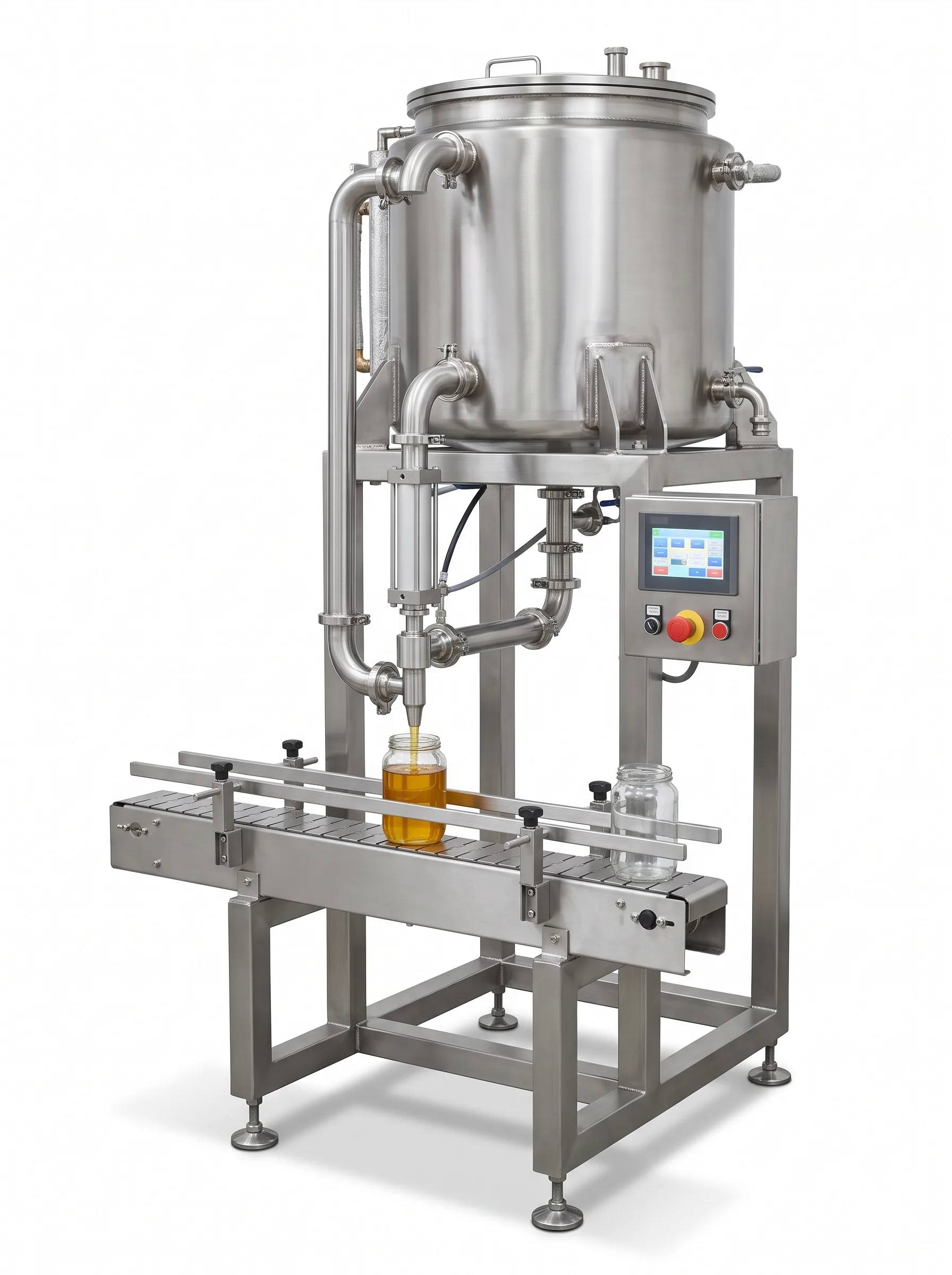
Selecting an edible oil filling machine in India requires matching oil shear resistance against positive-displacement pistons, rotary gear pumps, or gravimetric load cells. When comparing a piston vs gear pump oil filling machine for unheated winter production, mechanical displacement is vital to move heavy oil through the dosing chamber.
Pneumatic cylinders draw a fixed mechanical volume, but cold oil adds resistance against the piston head. If shop-floor air lines lose line pressure, pneumatic stroke completion lags. Servo-driven pistons eliminate this problem by driving the piston rod through a ground ball screw, forcing thick oil out at an unyielding, set travel rate. Positive-displacement external gear pumps push heavy oils smoothly, though cold, viscous oil can strain standard pump drive motors if inlet suction lines are too narrow. Gravimetric weigh-fillers bypass viscous drag entirely by measuring product mass directly on digital scale platforms.
Advanced multi-head systems feature oil viscosity temperature compensation filling routines that adjust cylinder stroke timing as ambient oil temperatures rise throughout the day. For an engineering comparison of dynamic pump principles, read our piston vs gear pump vs flow meter guide.
Swipe or scroll horizontally to view all columns
| Dosing Technology | Standard Pack Range | Accuracy Class (Class-Typical) | Winter Behaviour & Viscosity Impact |
|---|---|---|---|
| Volumetric Pneumatic Piston | 200 ml – 1 Litre | Class-typical ±0.5% to ±1.0% | Stroke action slows under thick oil backpressure; needs steady 6.0 bar air pressure to finish its mechanical travel stroke. |
| Servo-Driven Linear Piston | 500 ml – 5 Litres | Class-typical ±0.25% to ±0.5% | Ball-screw drive pushes viscous fluid cleanly; programmable speeds stop splashing and neck-frothing during cold runs. |
| Positive Displacement Gear Pump | 1 Litre – 5 Litres | Class-typical ±0.5% to ±1.0% | Moves thick oil reliably; needs wide suction plumbing to prevent pump cavitation on cold morning start-ups. |
| Gravimetric Load Cell (Weighmetric) | 5 Litres – 15 kg Tin | Class-typical ±10 g to ±20 g (gross/net) | Immune to oil thickness and ambient contraction; weighs true liquid mass straight into the container. |
Note: Data reflects typical industrial performance across North and Central Indian bottling plants during winter operations (8°C to 18°C ambient), observed November 2025 to February 2026. Accuracy classes are indicative operational benchmarks; equipment is built to help meet these performance levels rather than guarantee statutory compliance.
How Do LMPC Volume and Mass Declarations Apply to Seasonal Filling Drift?
Legal Metrology (Packaged Commodities) Rules require dual quantity declarations on retail edible oils using a baseline specific gravity of approximately 0.91 g/ml at 30°C. Standard edible vegetable oils exhibit a specific gravity of approximately 0.91 g/ml at 30°C, establishing an exact reference mass of 910 grams per 1,000 ml volume (indicative physical standard).
Using this standard reference ratio, legal pack conversions correspond to exact target weights:
- 500 ml corresponds to approximately 455 g
- 1 Litre corresponds to approximately 910 g
- 5 Litres corresponds to approximately 4,550 g
Maintaining mustard oil filling machine accuracy across seasonal weather shifts demands a firm grasp of liquid thermal contraction. Edible oils expand as they heat and shrink as they cool, shifting roughly 0.0007 to 0.0008 g/ml per degree Celsius. If an operator sets a volumetric cylinder to dispense 1,000 ml at 10°C, that dense cold volume weighs nearly 918 to 920 grams on a platform scale. Conversely, dispensing exactly 910 grams of oil into a PET bottle on a cold morning leaves a low liquid fill line that contracts visibly until the bottle reaches warm retail shelves.
Factory fill limits are enforced per LMPC tolerances according to pack size categories. Packaging lines must hit both declared millilitres and declared grams without exceeding allowable error margins. For a detailed review of statutory container limits, consult our edible oil standard pack sizes guide.
How Can Packaging Lines Eliminate Drip and Micro-Foaming in Cold Weather?
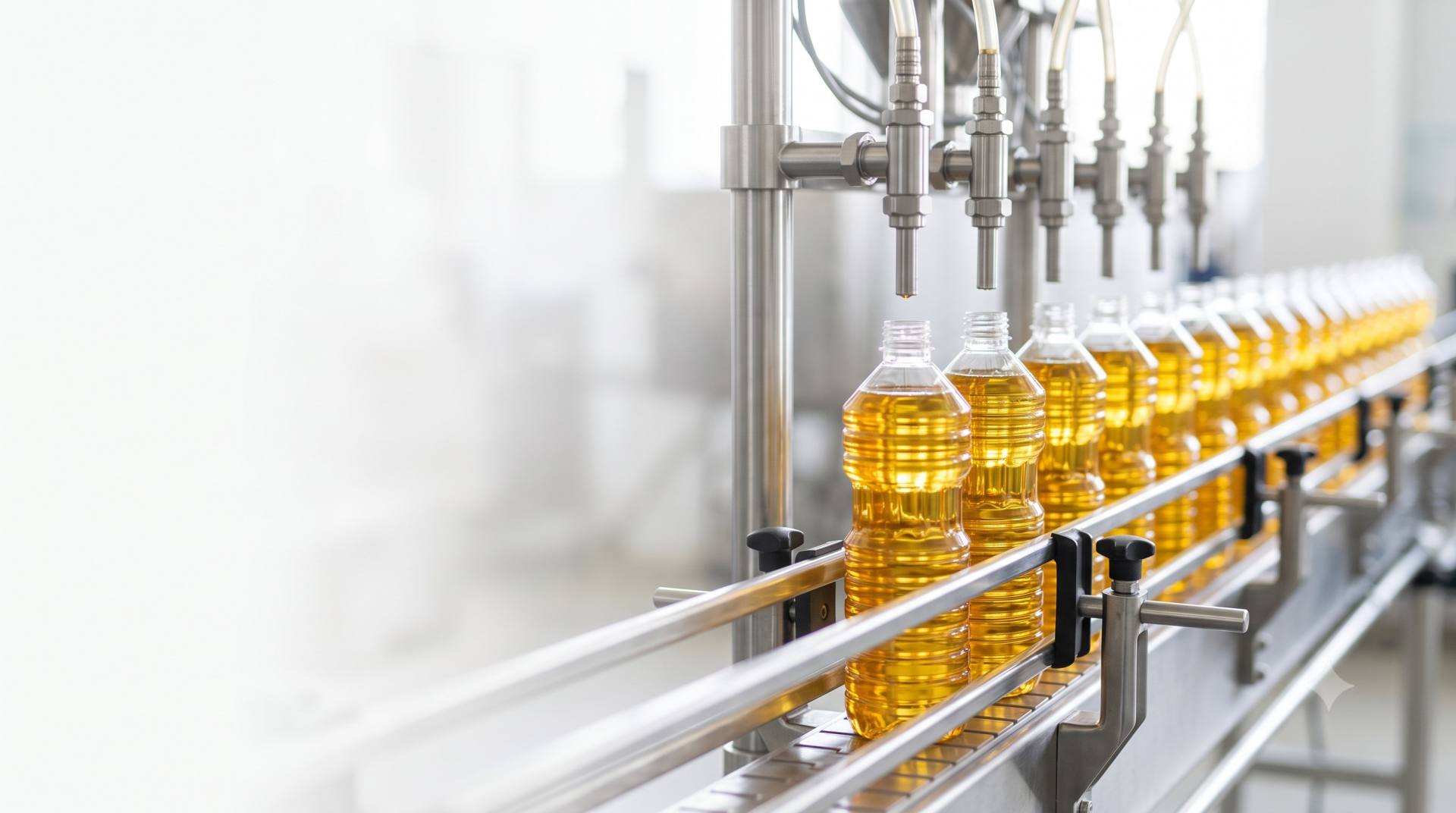
Eliminating foaming and nozzle drip in cold vegetable oils requires diving nozzles with programmable bottom-up velocity profiles alongside pneumatic suck-back cut-off valves operating at 6.0 bar regulated air pressure. Viscous oil clings stubbornly to stainless steel nozzle tips, creating stringy droplets that hang and smear across bottle necks between indexing conveyor cycles.
Thick vegetable oil also traps ambient air during rapid discharge. Cold oil jets smashing directly into the base of empty PET bottles generate microscopic air bubbles that struggle to surface through viscous liquid, building a dense froth layer that triggers early level sensors or spills down the neck.
Diving nozzles prevent this churning by plunging directly to the bottle floor before product flow starts, rising steadily just below the liquid surface as the bottle fills. At cycle completion, an internal pneumatic suck-back valve draws fluid meniscus 2 mm upward into the nozzle orifice, breaking liquid stringing immediately. Note that liquid splashing across container heat seals is primarily a pouch packaging problem; on rigid bottle lines, nozzle drip fouls outer sidewalls, prevents paper label adhesion, and softens secondary corrugated cartons.
What Line Configuration Matches Your Daily Packaging Output?
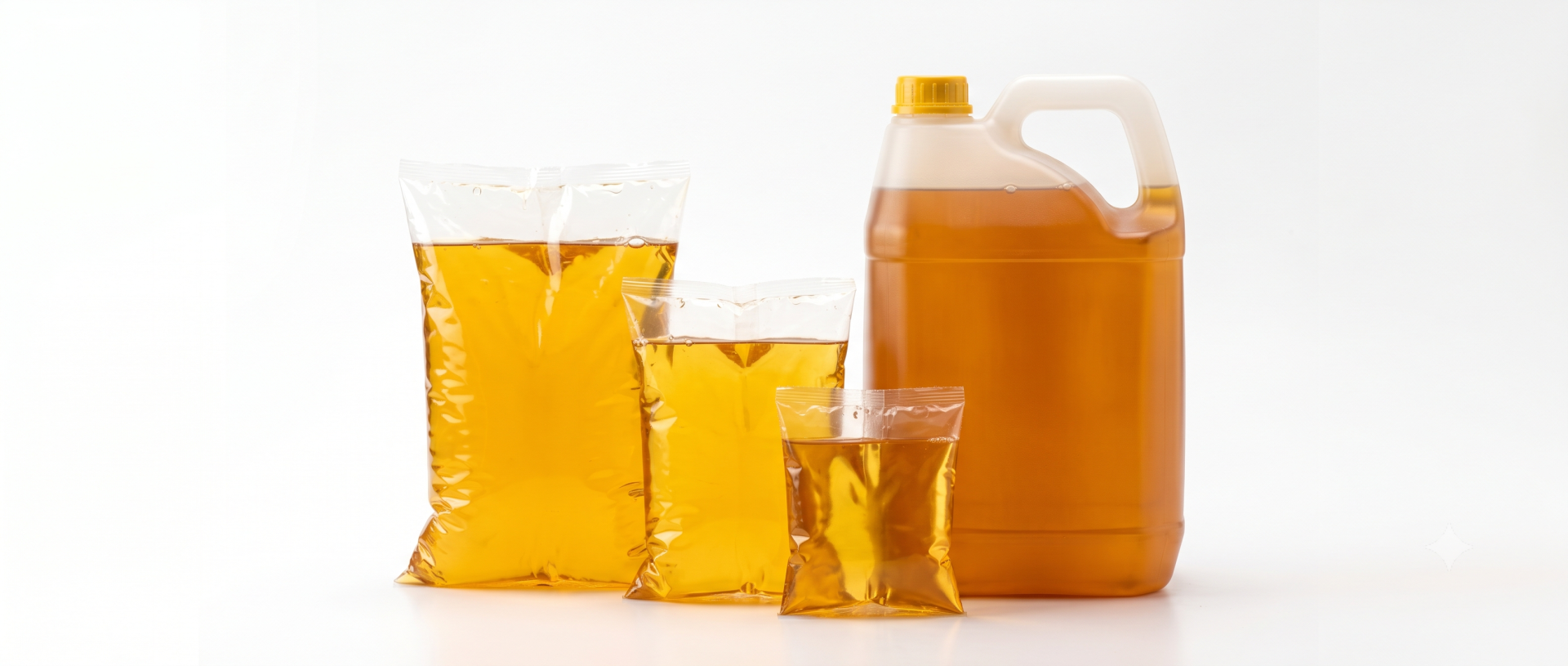
Matching an edible oil filling machine in India to plant throughput requires grouping production into three container classes: retail bottles up to 1 litre, jars from 1 to 5 litres, and 15 kg bulk tins. Operating an edible oil filling machine in India across these diverse packaging profiles requires matching valve mechanics to pack rigidity:
Retail Bottles (200 ml to 1 Litre): Automated lines run 4-head to 12-head linear pneumatic or servo-driven piston arrays, achieving typically 20 to 60 bottles per minute on standard vegetable oils without product aeration.
Intermediate Jars (1 Litre to 5 Litres): When configuring a 1 litre to 5 litre oil bottle filling machine, servo-driven linear pistons handle broad neck variations and eliminate oil sloshing in wide-mouth 5-litre HDPE containers.
Bulk Metal Packs (15 kg Square Tins & 15 Litre Jerry Cans): Packaging bulk edible oil into square metal cans using a 15 kg tin oil filling machine with load cell eliminates volumetric density errors entirely. Two-stage filling valves open wide for high-flow bulk filling, then throttle down to a fine dribble flow for precise final gram cut-off.
Operating pneumatic diving nozzles and suck-back cutoff assemblies requires a dedicated compressed air supply typically rated between 10 and 25 CFM at 6.0 bar line pressure, depending on multi-head machine configuration (typical pneumatic machinery specification). Air supplies must route through dual moisture separators and lubricator units to keep pneumatic valves responsive in unheated plants.
Limits and Assumptions
Operating parameters in this guide apply to unheated packaging plants across North and Central India running liquid vegetable oils between 8°C and 38°C ambient. The fluid models cover commercial edible oils including raw and filtered mustard oil, expeller groundnut oil, refined soyabean oil, and refined sunflower oil. Solid fats, hydrogenated shortening (vanaspati), and coconut oil require continuous line heating and are excluded from unheated ambient flow metrics. Accuracy ranges describe typical machinery capability; equipment is built to help meet legal trade standards when calibrated properly on site, but cannot guarantee compliance without routine gravimetric verification. Pneumatic ratings assume dry, regulated air at 6.0 bar line pressure.
Field Troubleshooting: Four Winter Packaging Defects and Direct Fixes
Winter filling line faults stem from increased fluid shear resistance, ambient pneumatic pressure drops, and cold liquid aeration across filling nozzles.
1. Winter Under-Fills on Volumetric Stations
Root Cause: Cold, viscous oil restricts fluid intake and creates heavy backpressure against the cylinder piston, causing incomplete chamber discharge before the valve cycles shut.
Line Fix: Raise pneumatic regulator line pressure to 6.2–6.5 bar at the machine inlet, check stroke sensor positioning, and lower the piston forward speed by 15% on the HMI to allow complete fluid displacement.
2. Severe Foam Formation in Narrow-Neck PET Bottles
Root Cause: Dispensing cold oil from overhead nozzles traps atmospheric air that cannot escape quickly due to elevated fluid viscosity, creating a dense foam head that causes premature cutoff.
Line Fix: Adjust bottom-up diving nozzle stroke profiles so nozzle tips remain 5 mm to 10 mm submerged beneath the rising oil level throughout the fill cycle.
3. Persistent Stringing and Nozzle Drip Between Cycles
Root Cause: Nozzle dripping occurs when heightened surface tension slows droplet break-off at the orifice, compounded by stiffened pneumatic suck-back seals in unheated plants.
Line Fix: Extend the pneumatic suck-back cylinder stroke limiter to pull more liquid back into the tip, clean debris off internal valve seats, and shield filling nozzles from cold shop floor drafts.
4. Weight-vs-Volume Mismatch on Retail Labels
Root Cause: Calibrating volumetric stroke volume on a cold morning yields excess net weight because cold vegetable oil contracts, increasing mass density above the 30°C reference baseline.
Line Fix: Check-weigh sample bottles on a calibrated digital scale every two hours; trim cylinder volumetric stroke length to match standard gram requirements (910 g per litre for typical edible oil at 30°C equivalent).
On cold mornings, calibrate by weight, not volume: weigh the first 10 bottles against the 910 g-per-litre reference before starting the run, and re-check every two hours as the plant warms up.
Frequently Asked Questions
Which pump type is best for viscous edible oil in winter?
Positive-displacement rotary gear pumps and servo-driven piston cylinders handle cold, viscous edible oils far better than gravity or impeller systems because both mechanisms physically force fluid through the manifold regardless of line backpressure. Gear pumps deliver smooth continuous feed for bulk volumes, while servo pistons give tighter dosing control on retail bottles under 5 litres.
How much does 1 litre of mustard oil weigh in grams?
One litre of commercial mustard oil weighs approximately 910 grams at the standard reference temperature of 30°C based on a specific gravity of 0.91 g/ml. In unheated winter plants at 12°C, thermal liquid contraction increases physical density, meaning a 1,000 ml volumetric measure will register roughly 918–920 grams on a calibrated platform scale (indicative thermal-contraction estimate).
Why does edible oil foam inside bottles during winter filling?
Edible oil foams heavily in winter because high fluid viscosity resists surface deaeration, trapping air bubbles churned up when high-velocity streams strike the bottle base. The dense oil film prevents air bubbles from rising and popping quickly. Eliminating foam requires bottom-up diving nozzles that dispense product beneath the rising oil level during fill cycles.
Should you choose a piston or load-cell system for 5L and 15 kg packs?
Load-cell systems are preferred for 15 kg tins and bulk jars because gravimetric measurement bypasses temperature-driven density swings, whereas servo-driven pistons provide faster fill cycles on high-speed lines running rigid 5-litre containers. Load cells verify net product mass directly on the platform, while pistons rely on physical chamber volume, requiring temperature recalibration during seasonal shifts.
Contact New Vision Machines to evaluate filling valve assemblies, diving nozzle retrofits, or load-cell platforms for your winter packaging operations: call +91-9981604279 or visit our engineering works at Lasudia Mori, Indore, Madhya Pradesh. Our technical team can review your seasonal oil viscosity curves and plant air supply to configure a dependable, winter-ready filling line.