Run a multihead weigher above 40 pouches per minute for sub-gram snack accuracy; choose a linear weigher below 35 PPM to keep dry-run dosing hardware capex under ₹2 lakh ex-works.
How do linear vibration weighers and combination weighers dose product?
Linear weighers feed product sequentially along vibrating pans into a single weigh hopper until a target cut-off is met, whereas multihead combination weighers disperse product across 10 to 14 radial weigh buckets simultaneously, using an onboard computer to calculate and discharge the optimal combination of partial weights in milliseconds.
The dosing mechanics dictate how each machine handles product in motion. A linear weigher mounts an electromagnetic drive coil underneath a stepped sheet-metal tray. Product flows out of an overhead hopper into a primary bulk channel and a narrower fine-feed channel. The controller fires the bulk tray at full vibration amplitude to dump roughly 85% of the batch into a weigh bucket hung on an S-type or single-point strain gauge. Once the bucket hits that threshold, the bulk pan shuts down and the fine-feed pan hums at a dialed-back frequency, dropping individual pieces to top off the remaining mass.
Linear Weigher Flow (Single Channel):
[Overhead Surge Hopper] → [Coarse/Fine Pan] → (In-Flight Stream) → [Single Weigh Bucket] → [VFFS Collar]

Multihead Combination Weigher Flow (Radial):
          [Infeed Dispersion Cone]
         /          |            \
[Radial Pan 1] [Radial Pan 2] [Radial Pan N]
      |              |              |
[Pool Gate 1]  [Pool Gate 2]  [Pool Gate N]
      |              |              |
[Weigh Bucket 1][Weigh Bucket 2][Weigh Bucket N]
         \           |            /
   [DSP Selects 3 to 5 Matched Buckets]
                  |
          [Collating Chute]
                  |
            [VFFS Collar]
The physical failure point on a linear pan is the in-flight product column. Between the moment the fine pan cuts off and the gate drops, material is already in mid-air. If bulk density shifts — say a fresh batch of roasted chana has larger kernels or higher moisture — that falling column overshoots the target. The machine cannot pull airborne product back.
A multihead combination weigher removes the in-flight variable by taking static measurements. Bulk material dumps onto a conical top dispersion cone fitted with an optical or inductive level sensor. Electromagnetic radial troughs push material outwards into an upper ring of staging buckets (pool hoppers). These pool hoppers drop charges into a lower ring of 10 or 14 independent weigh buckets.
Each weigh bucket rests on its own strain-gauge load cell. The central digital signal processor (DSP) waits for the mechanical vibration to settle, reads every bucket weight simultaneously, and computes a mathematical permutation. If you are packing a 100 g namkeen pouch, the processor queries all active buckets and selects three or four whose combined sum equals 100.1 g. It fires those stepper-motor gates together, dumping the product into a steep funnel pointed down the packaging machine's forming collar.
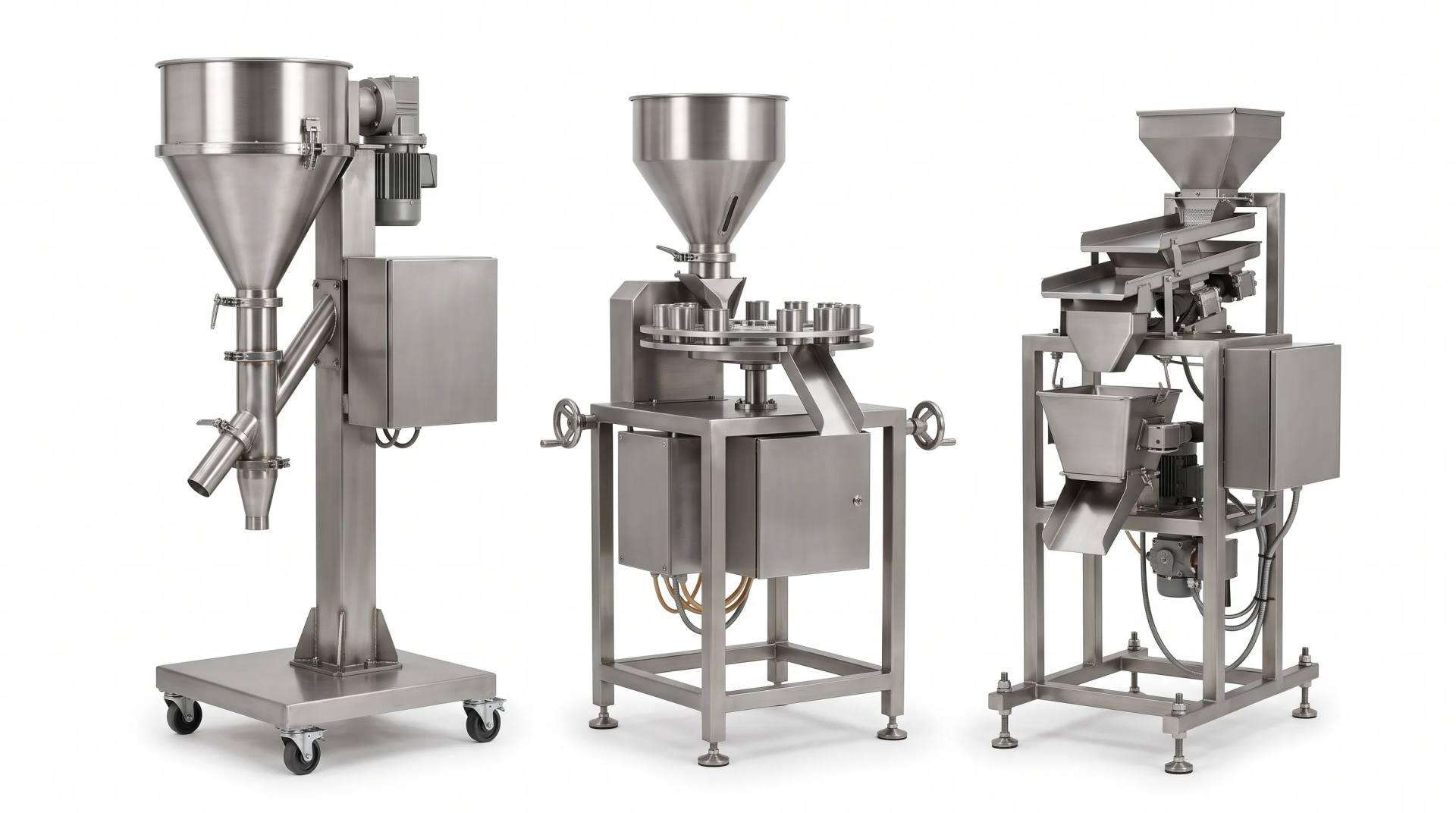
These gravimetric principles apply only to free-flowing pieces. If your line handles non-free-flowing powders — such as turmeric, besan, or chemical blends that aerate and cling to metal — vibratory pans fail entirely, requiring a dedicated powder packing machine driven by positive-displacement servo augers.
Multihead vs linear weigher: speed, accuracy, and price compared
Linear and combination units occupy distinct production tiers on the plant floor. Throughput demands, weight variance allowances, and available machinery budgets determine the correct choice.
Swipe or scroll horizontally to view all columns
| Heads | Mechanism | Indicative PPM class | Accuracy class | Indicative India price band | NVM anchor |
|---|---|---|---|---|---|
| 2-Head Linear | 2 independent bulk + fine vibratory pans feeding 2 strain-gauge buckets | 10–20 PPM (typical for the class) | ±1.5–3.0 g (typical for the class) | ₹1.0–1.4 lakh (market observation) | Not cataloged (market band only) |
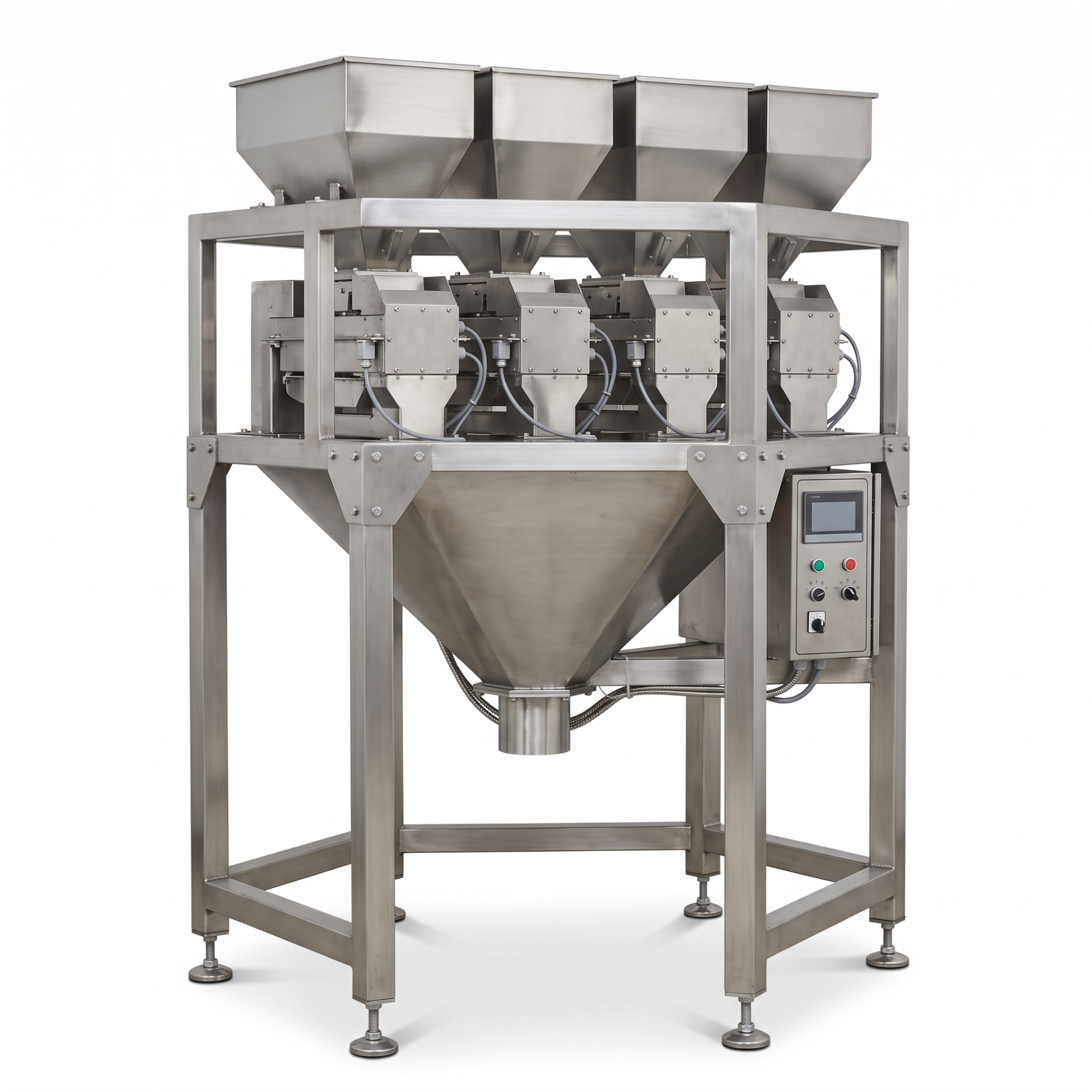
| 4-Head Linear | 4 parallel vibratory lanes feeding 4 weigh buckets with staggered dumps | 20–35 PPM (typical for the class) | ±1.0–2.5 g (typical for the class) | ₹1.5–2.2 lakh (market observation) | New Vision Machines Four Head Weigh Filler 1000g at ₹1,69,000 ex-works Indore (MRP ₹2,03,000; GST extra) |
| 10-Head Multihead | Radial dispersion cone, 10 pool + 10 weigh buckets, DSP combinatorial selection | 60–80 PPM (typical for the class) | ±0.5–1.5 g (typical for the class) | ₹7.8–11.7 lakh (indicative market band for 10-head VFFS lines) | Not cataloged (market band only) |
| 14-Head Multihead | Radial dispersion cone, 14 pool + 14 weigh buckets, double-door high-speed dump | 80–110 PPM (typical for the class) | ±0.2–1.0 g (typical for the class) | ~₹9.9 lakh (indicative market band for weigher alone; market observation) | Not cataloged (market band only) |
Linear weighers hit a mechanical speed barrier at roughly 7 to 9 dumps per minute per head. Push the vibratory controller harder, and the product leaps forward in uncontrolled clumps, ruining accuracy. A 4-head linear weigher pouch packing machine runs four lanes in parallel to reach 25 to 35 packs per minute on whole pulses, dry spices, or tea.
Beyond 40 PPM, a linear line cannot keep pace without multiplying floor footprints. A 10-head multihead weigher handles 60 to 80 PPM because buckets fill and weigh in parallel while other buckets are dumping.
On 14-head systems, the mathematical matrix broadens: the processor evaluates thousands of candidate bucket combinations per cycle and hits the target weight within a fraction of a gram on virtually every dump. High-speed 14 head multihead weigher specs allow lines to run up to 110 PPM without starving the vertical bagger's seal jaws.
The capital expenditure reflects this mechanical complexity. A standalone 10 head multihead weigher price in india generally sits in the ₹7.8 lakh to ₹11.7 lakh range for complete automated bagging lines (indicative market band, not an NVM quote).
For packers processing whole pulses or small-batch whole spices, an industrial four-head linear unit like the New Vision Machines Four Head Weigh Filler 1000g — priced at ₹1,69,000 ex-works Indore (MRP ₹2,03,000, GST extra) — delivers reliable gravimetric automation at a fraction of the capital investment.
How much giveaway does a high-variance weigher cost per day?
Packaging lines in India must satisfy the Legal Metrology (Packaged Commodities) Rules 2011 Schedule I, which enforces strict maximum allowable variations (such as 9% on 50–100 g packs and 4.5% on 100–200 g packs; confirm exact limits with your legal metrology consultant).
Because inspectors levy penalties for underweight retail pouches, plant supervisors never set the machine cutoff at nominal weight. If a linear weigher shows a field variance of ±3.0 g, the operator sets the target offset to +3.0 g. Every pouch leaves the floor weighing between 250.0 g and 256.0 g.
By contrast, a combination weigher holding ±0.8 g requires only a +0.8 g target bias. The 2.2 g difference represents raw, paid-for ingredient mass given away for free.
Worked example: high-value dry fruit packaging
The following numbers illustrate a worked engineering calculation using stated operating assumptions to evaluate capital payback.
Stated assumptions: premium cashew kernels (W240/W320 grade); ingredient value ₹600 per kg (₹0.60 per gram); declared pack net weight 250 g; production schedule 2 shifts per day, 8 hours per shift (16 operating hours total); operating speed 50 finished pouches per minute net average; daily unit production = 50 pouches/min × 60 min/hr × 16 hr = 48,000 pouches/day; linear weigher variance ±3.0 g (target setpoint 253.0 g); multihead weigher variance ±0.8 g (target setpoint 250.8 g).
Mathematical derivation: product giveaway differential per pouch = 3.0 g − 0.8 g = 2.2 g saved per pouch. Daily physical mass saved = 48,000 pouches/day × 2.2 g = 105.6 kg/day. Daily financial recovery = 105.6 kg/day × ₹600/kg = ₹63,360 per day. Monthly financial recovery (25 production days) = ₹15,84,000 per month.
Equipment payback timeline: assuming an incremental capital cost of roughly ₹9,00,000 to step up from a basic linear unit to an automated multihead combination weigher VFFS line (market observation band), payback ≈ 14.2 working days.
Even for smaller operations running a single 8-hour shift at 30 PPM (14,400 pouches daily), the recovered mass equals 31.68 kg per day — ₹19,008 per day at ₹600/kg. Across a standard 25-day working month, the plant recovers ₹4,75,200, amortizing the cost difference in roughly two months. Imprecise weighing directly drains margin on high-value products.
Which product physics match which hopper design?
Product rheology — oiliness, free-fall fragility, surface dust, and grain friction — dictates the necessary hopper geometry and sheet-metal finish.
Swipe or scroll horizontally to view all columns
| Product type | Physical characteristic | Required hopper specification |
|---|---|---|
| Fried namkeen / bhujia | Topical oil, loose masala | Dimpled (rigidized) SS304; steep 60° chutes |
| Whole pulses / chana | Free-flowing, hard, dry | Mirror-polished smooth SS304 sheet |
| Potato chips / fryums | Brittle, fragile, bulky | Collating curtains, rubber-buffered chutes |
| Blended whole spices | Variable piece sizes | Independent linear amplitude controls |
Load cell mounts and signal damping
Linear weighers mount their strain-gauge load cells directly underneath the main support bracket of the weigh hopper. Because the electromagnetic vibrators sit on the same chassis, mechanical hum can bleed into the load cell's micro-volt wheatstone bridge.
Multihead systems mount each load cell inside a sealed central enclosure, with buckets hanging externally from cantilevered hooks — physically separating the electronic load cell from the damp product zone and ambient plant floor dust.
Breakage control on fried namkeen
Fried snacks such as sev, aloo bhujia, and banana chips crack when dropped onto hard metal faces. A straight 1.5-meter vertical drop shatters thin potato wafers into crumbs that settle at the bottom of the pouch, ruining buyer presentation and coating the horizontal seal jaws with burnt oil dust.
While a standard granule filling machine or linear filler works well for robust seeds, grains, and whole black pepper, a dedicated combination weigher for namkeen uses low-angle collating chutes (typically 50° to 60°), polyurethane buffer pads, and timing hoppers that catch the fall in stages to preserve piece integrity.
Dimpled SS304 vs smooth stainless sheet
Fried Indian namkeen releases surface oil mixed with fine spice powder (chilli, salt, amchur). On smooth, mirror-finish stainless steel, oil creates a vacuum seal via capillary action, gluing flat snack flakes to the metal. Over a long shift, this builds up a sticky grease layer that slows bucket discharge and skews tare weights.
Dimpled SS304 sheet metal breaks this surface tension. The golf-ball textured pattern reduces the physical contact area between snack pieces and hopper walls by more than 60%. Air pockets form in the recesses, preventing vacuum formation and allowing oily namkeen to drop cleanly. Smooth stainless sheet remains the standard for non-oily, free-flowing grains like moong, toor dal, and polished rice, where fine grains might otherwise sit in the dimple indentations.
What does a multihead weigher need on your shop floor?
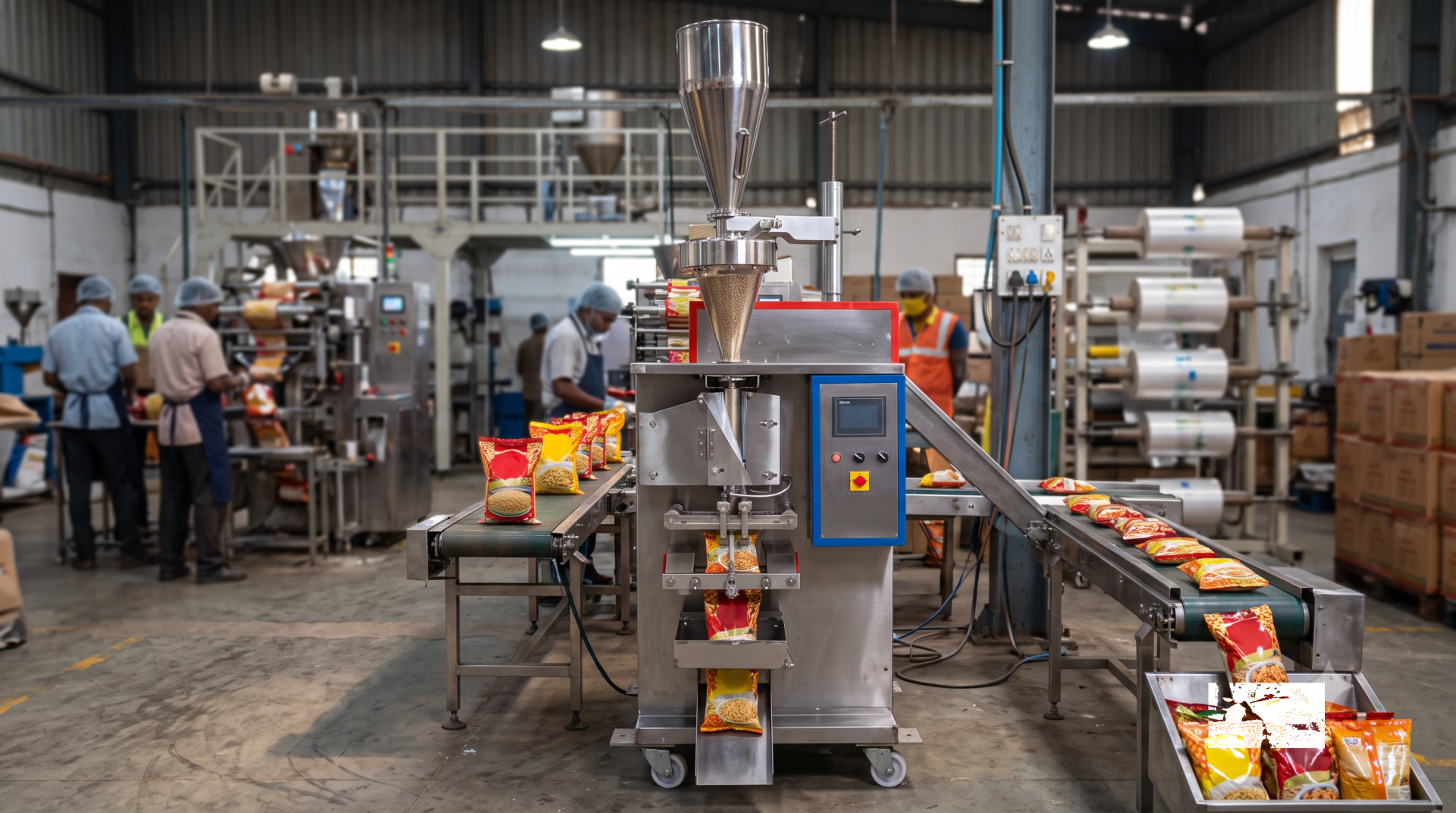
Adding a multihead combination weigher changes your floor layout from a single-machine footprint to a multi-level vertical packaging tower. The specifications below represent a typical installation.
Vertical Elevation Profile (Typical Multihead Line):
[Infeed Elevator Discharge & Magnet Trap (0.4 m)]   <- 3.8 to 4.2 m
[10/14-Head Multihead Combination Weigher (1.2-1.4 m)] <- 2.6 to 2.8 m
[Mezzanine Platform Deck Level (Operator Walkway)]   <- 2.2 to 2.4 m
[Transition Funnel / Timing Shutter Hopper (0.4 m)]  <- 1.8 to 2.0 m
[VFFS Bagmaker Chassis]                              <- 0.0 m (Factory Floor)
Minimum factory roof truss height: ~4.5 m
1. Structural mezzanine gantry
A multihead combination weigher cannot hang directly from the packaging machine frame. It requires a heavy-gauge four-pillar steel mezzanine gantry with an anti-slip floor, perimeter kick-plates, and safety handrails.
Critical plant design requirement: the gantry must stand completely isolated from the VFFS chassis and the infeed elevator. If the bucket elevator frame bolts directly to the mezzanine beams, drive-chain vibration transfers into the weigher chassis. The load cells will pick up this mechanical noise, widening your standard deviation and driving up product giveaway.
2. Automated infeed elevators
With the weigher sitting 2.5 meters above the plant floor, manual feeding is impossible. The line requires an automated Z-bucket elevator fitted with food-grade polypropylene buckets or an inclined cleated belt conveyor.
An optical retro-reflective sensor or ultrasonic level monitor on the weigher's top cone must interlock directly with the elevator's variable frequency drive (VFD). When product depth drops on the cone, the elevator starts automatically; when the cone fills, it stops, preventing product from crushing under an overflowing feed stream.
3. Vertical clearances
A typical multihead installation demands a vertical ceiling clearance between 3.5 m and 4.2 m. If your facility has a low roof truss (below 3.2 m), a full vertical stack will not clear the ceiling.
In low-height sheds, line managers must use an offset split-mezzanine layout with an inclined transfer chute, or rely on ground-level linear weighers like the New Vision Machines Four Head Weigh Filler 1000g, which fit comfortably under standard 2.5-meter ceilings.
4. Plant floor utilities
Pneumatics: if the multihead uses pneumatic bucket gates, run a dedicated 25 mm airline from your compressor ring main. The air supply must pass through a local 5-micron filter-regulator-lubricator (FRL) unit delivering a steady 6.0 bar. Typical pneumatic consumption sits between 100 and 150 normal liters per minute (NL/min). Desiccant dryers are essential during wet monsoon months to stop water droplets from gumming up the pneumatic solenoid valves.
Power and grounding: the electronic controller requires a clean 220V single-phase or 415V three-phase 50 Hz supply. In industrial estates prone to brownouts or voltage swings, wire the weigher through a dedicated servo voltage stabilizer. Earth-to-neutral voltage must measure below 2.0V AC. Grounding spikes or harmonic noise from nearby sealing jaws will corrupt the low-voltage analog signals coming off the load cells.
Limits and assumptions
To maintain clear engineering standards, this post applies the following explicit boundaries:
- Market bands vs. verified pricing: capital investment figures for 10-head packaging lines (₹7.8–11.7 lakh) and standalone 14-head units (~₹9.9 lakh) represent broader Indian packaging market observations. They are not formal sales quotations from New Vision Machines. Verified NVM pricing applies strictly to the cataloged models specified in this text.
- Speed limits: operational ratings (15–35 PPM for linear; 60–110 PPM for multihead) are typical for the class. Real production speeds depend on pouch dimensions, laminate thickness, heat-seal dwell times, and operator staging.
- Accuracy tolerances: gravimetric variance figures (±1–3 g linear; ±0.2–1.5 g multihead) apply to free-flowing or semi-free-flowing dry goods in ambient conditions without air drafts.
- Statutory standards: mentions of the Legal Metrology (Packaged Commodities) Rules 2011 Schedule I Maximum Allowable Variations (MAV) serve solely as an engineering reference. Consult your certified legal metrology advisor for formal regulatory compliance.
Concrete field troubleshooting defects with fixes
1. Noisy load cell readings and weight hunting. Symptom: the digital HMI screen displays rapidly fluctuating weight values while buckets sit empty; the controller triggers persistent zero-point calibration errors and stops the machine. Root cause: mechanical vibration traveling through the mezzanine floor beams from an unbalanced bagger motor, or ground-loop electrical noise from load-cell data lines routed near 415V VFD motor cables. Concrete fix: install 60-durometer industrial neoprene vibration damping pads under each of the four mounting feet on the weigher chassis; route all load-cell signal wiring through grounded flexible steel conduit (FMC) with at least 300 mm separation from AC power lines; in the controller settings, increase the digital filter parameter from 3 cycles to 5 cycles to eliminate high-frequency signal flutter.
2. Product bridging and gate jamming in discharge buckets. Symptom: sticky material hangs up inside the bucket neck, failing to evacuate when the gate opens; the unemptied product throws off the next cycle's tare reading. Root cause: free oil or moisture from spicy namkeen sticking to plain SS304 sheet metal, compounded by inadequate gate clearance or short open-dwell durations. Concrete fix: swap smooth buckets for dimpled (rigidized) SS304 buckets to reduce surface contact; on the controller HMI, extend the gate open dwell time by 40 milliseconds; enable the "double-dump" or "gate-shake" function to tap the bucket doors against the stops during discharge, shaking loose stubborn product.
3. Tail-end vibration drift on linear weighers. Symptom: a linear weigher pouch packing machine fills accurately during the shift but begins overfilling bags as the supply hopper runs low. Root cause: falling head pressure in the overhead hopper alters the material depth on the vibratory pans; with less head pressure, the vibratory pan throws a thinner product stream, throwing off the controller's automated fine-feed cutoff calculation. Concrete fix: mount a capacitive level sensor inside the infeed surge hopper to automatically trigger the overhead infeed conveyor, holding product level within a consistent 65% to 85% band; readjust the two-stage cutoff thresholds — lower the bulk cut-off setpoint from 90% to 82% of target weight, and reduce the fine-feed vibration potentiometer output by 15% to maintain a thin, uniform single-layer stream during final dosing.
4. Speed and accuracy degradation at high PPM. Symptom: pushing combination weigher speeds above 65 PPM causes wide weight swings and leaves product trapped inside the bagger's horizontal seal jaws, causing leakers. Root cause: vertical stringing — as dump frequency rises, the product stream stretches into a long, loose vertical column that falls out of sync with the VFFS sealing cycle. Concrete fix: mount an automated collating timing hopper (shutter gate) at the bottom collection funnel discharge, directly above the bagger forming tube; the timing hopper catches each multihead dump, gathers the pieces into a tight, compact slug, and drops the entire batch into the bagger with a 30-millisecond advance trigger before the horizontal seal jaws close.
When erecting a mezzanine platform for a multihead weigher, never connect the operator staircase or access ladder directly to the vertical form-fill-seal machine or bucket elevator frame. Every time an operator climbs the stairs to inspect the top hopper, footfalls transmit mechanical shocks through the gantry. These shocks hit the load cells, throwing off tare weights and generating false giveaways. Always maintain a clean 25 mm physical air gap between the mezzanine steelwork and all adjacent machines.
What is the typical 10 head multihead weigher price in India?
In the Indian machinery market, a standard standalone 10-head combination weigher generally trades between ₹7.8 lakh and ₹11.7 lakh depending on bucket volume, drive motor type, and stainless steel grade. Complete turnkey lines including the VFFS bagmaker, mezzanine gantry, and infeed elevator typically command higher turnkey project pricing.
When should a factory choose a linear weigher pouch packing machine over a multihead?
A factory should choose a linear weigher pouch packing machine when packaging speeds stay below 35 pouches per minute on uniform, free-flowing products like whole pulses, grains, or dry hardware. Linear units keep capital costs below ₹2 lakh ex-works and operate in compact facilities with standard ceiling heights.
What determines VFFS weighing machine accuracy during continuous production?
VFFS weighing machine accuracy depends on load cell sampling speed, ambient plant floor vibration, product in-flight column height, and consistent bulk density. Multihead units improve accuracy by weighing static product charges inside sealed buckets, eliminating the in-flight falling stream errors common to linear vibratory pans.
Why is a combination weigher for namkeen preferred over a linear weigher?
A combination weigher for namkeen is preferred because its dimpled SS304 buckets prevent oily, spiced snacks from sticking to hopper surfaces. Its digital processor selects matching buckets to hit ±0.5 g accuracy across irregular piece weights without crushing fragile shapes like sev and bhujia on long vibratory channels.
What ceiling clearance and power requirements does a typical multihead VFFS line need?
A typical multihead VFFS line needs a ceiling clearance of 3.5 m to 4.2 m to house the bagmaker, gantry, weigher, and overhead infeed conveyor. Electrical requirements call for a clean 415V 3-phase line backed by a servo voltage stabilizer, alongside clean, dry compressed air at 6 bar.
For detailed plant layouts, line speed evaluations, or to run trial packaging runs with your bulk material, contact New Vision Machines at +91-9981604279. Works: Lasudia Mori, Indore, MP 452010.
New Vision Machines verified catalog
- Four Head Weigh Filler 1000g: ₹1,69,000 ex-works Indore (MRP ₹2,03,000). Four independent vibratory lanes, stainless steel construction, and digital load cell integration for free-flowing snacks, pulses, and dry confectionery up to 35 PPM.
- Auger Filler 15L: ₹1,27,000 ex-works Indore (MRP ₹1,59,000). Engineered for non-free-flowing powders, ground spices, and flours.
- Vertical Auger Servo FFS Powder Packing Machine: ₹4,55,000 ex-works Indore (MRP ₹5,99,000). High-precision fully automatic continuous bagging for food and industrial chemical powders.
All New Vision Machines prices are quoted ex-works Indore; GST is extra.