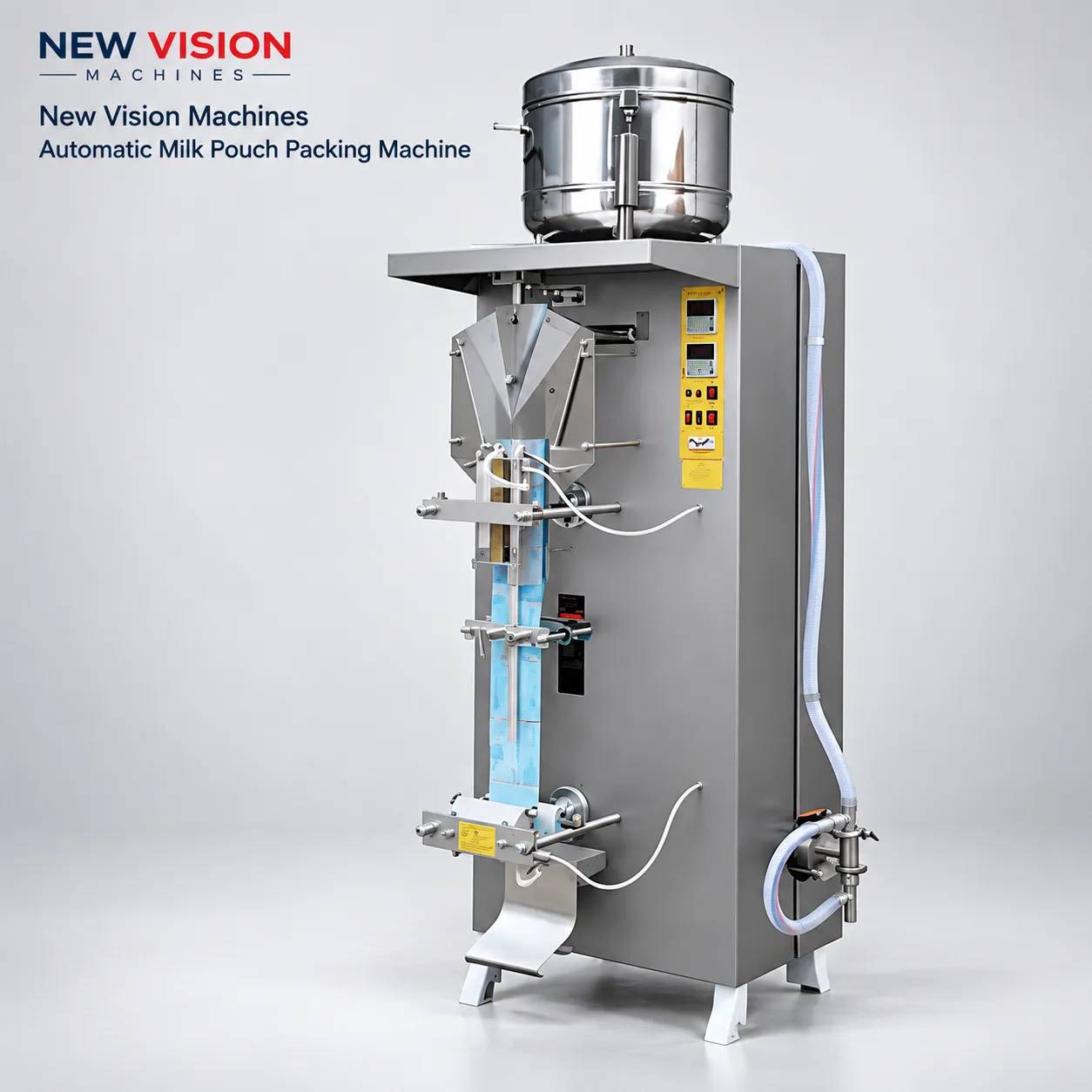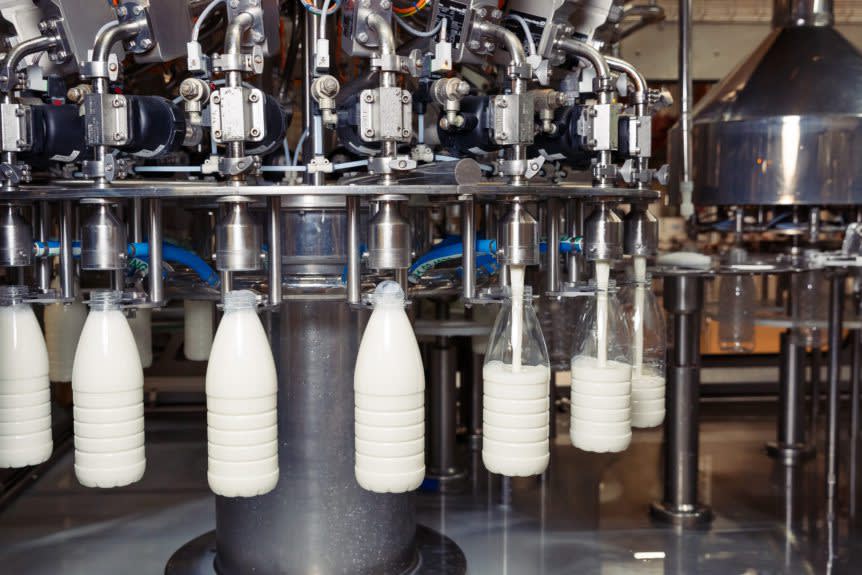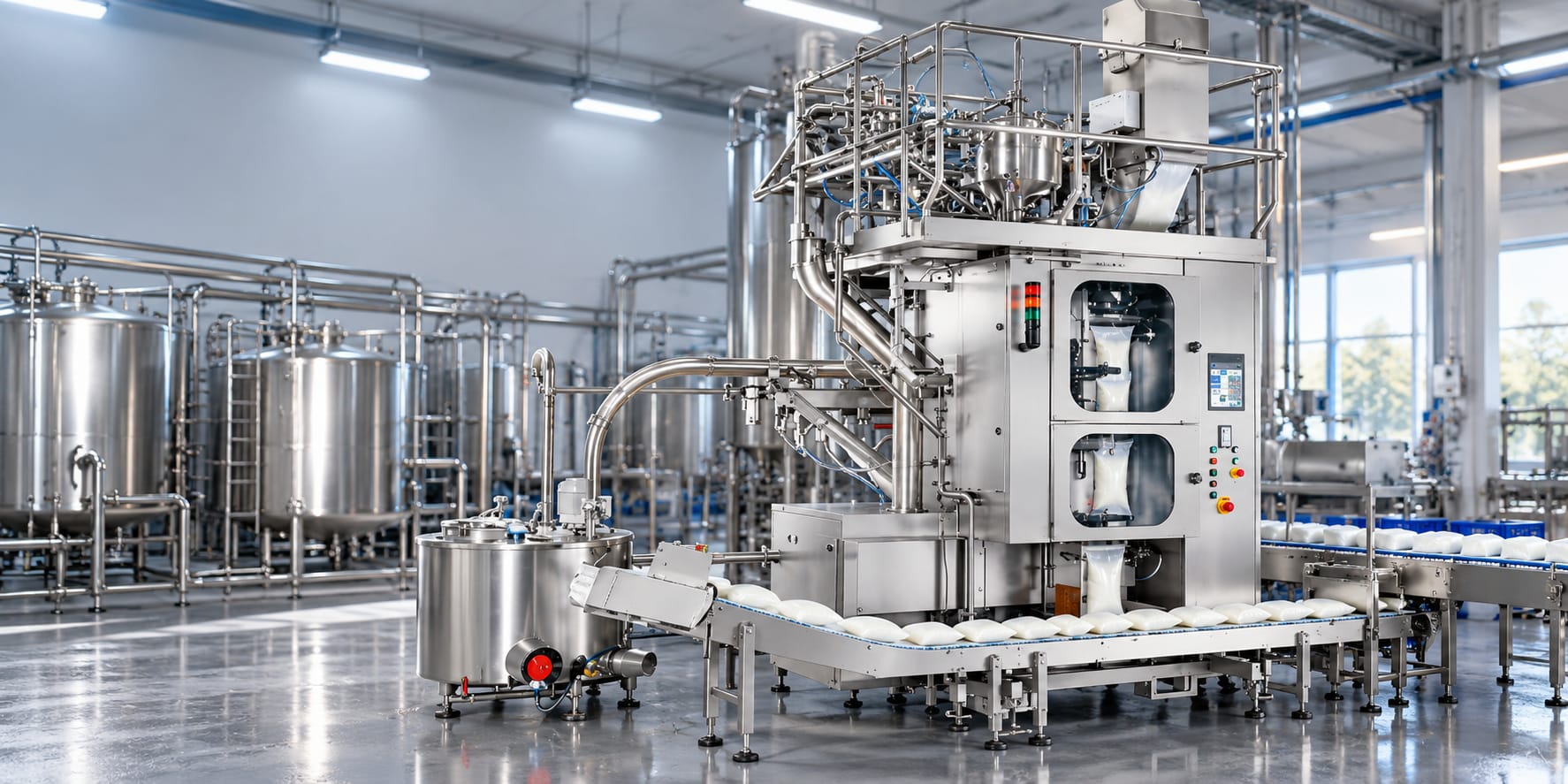
A milk pouch packing machine is a vertical form-fill-seal (VFFS) system built for one unforgiving product: liquid milk. It forms a film tube, seals the bottom, fills a precise volume of milk, then seals and cuts the top — producing sealed pillow pouches at 1,000 to 3,600 pouches per hour depending on the machine.
How it works: the milk VFFS cycle
1. Film forming. Flat film unwinds from a reel and wraps around a forming tube into a vertical cylinder.
2. Bottom seal. Horizontal sealing jaws clamp the tube bottom, creating the pouch's base seal.
3. Fill. Milk flows from an overhead balance tank into the pouch — by gravity or by pump — while the bottom seal holds.
4. Top seal and cut. The jaws clamp again above the fill line, sealing the top of the filled pouch and the bottom of the next one simultaneously, and a cutter separates them.
The cycle repeats continuously. The entire product path — tank, valve, filling nozzle, film contact surfaces — must be food-grade stainless steel (SS304) because milk is a bacterial growth medium at room temperature.
Why dairy packing is not generic pouch packing
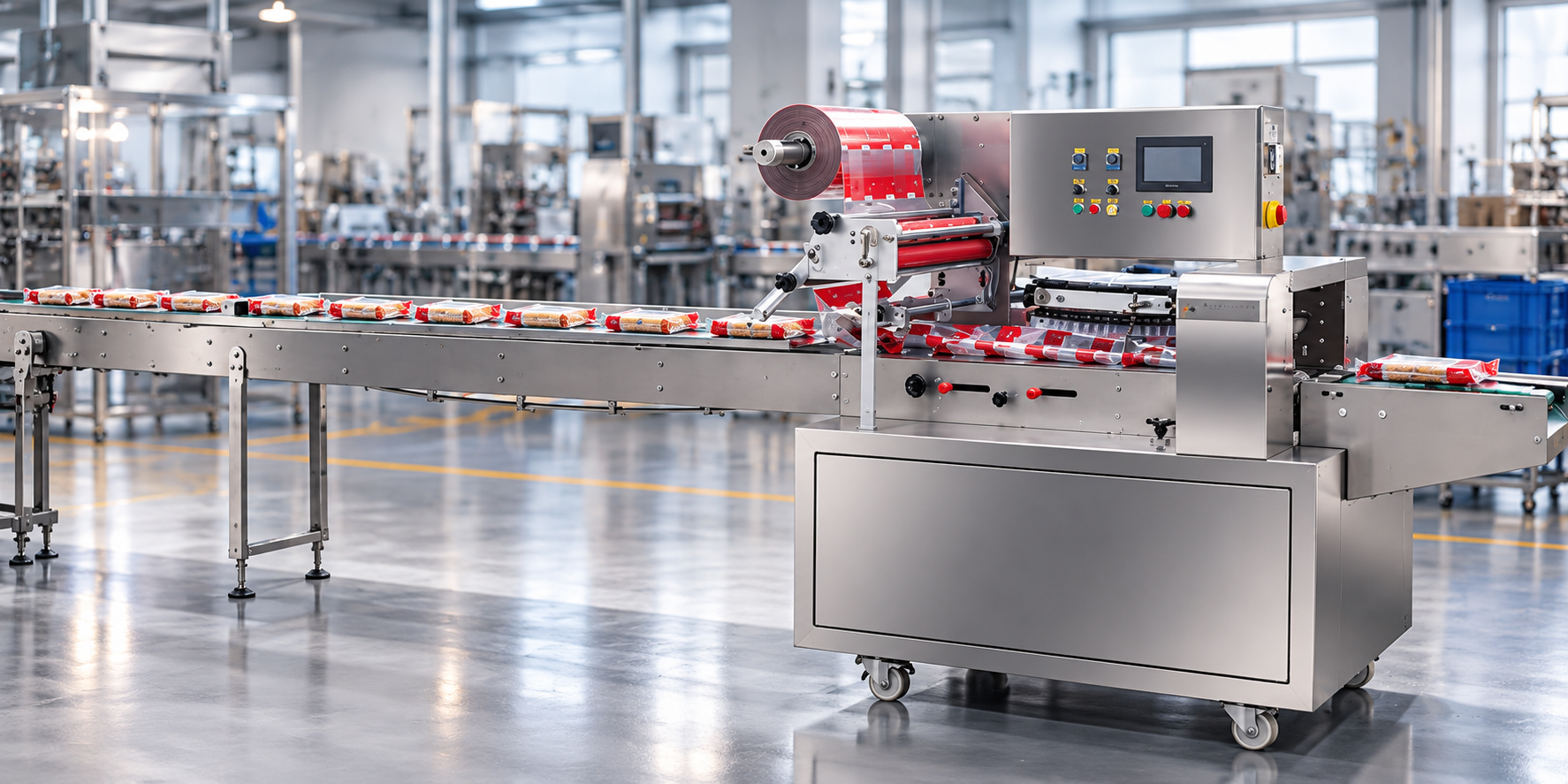
Packing biscuits and packing milk look similar on a spec sheet. In a dairy plant they are different engineering problems:
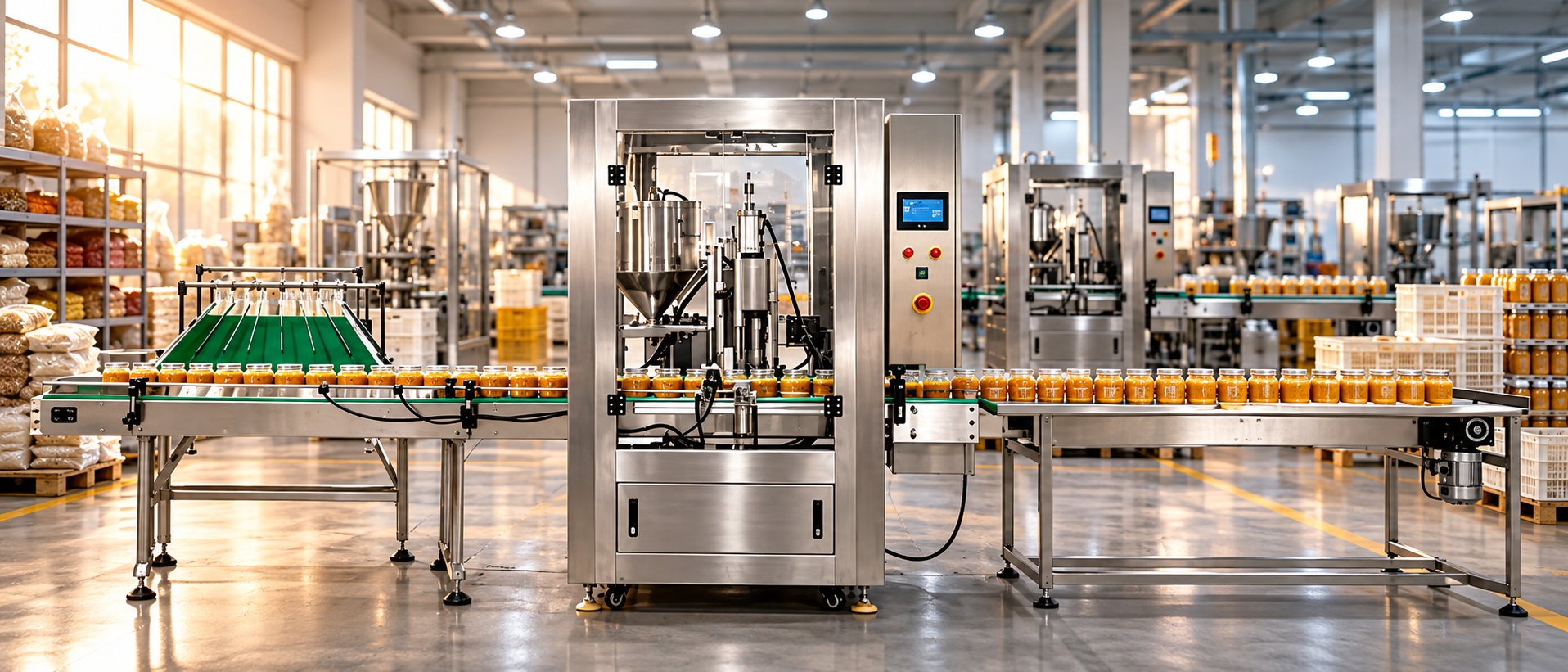
Hygiene by design. Milk residue feeds bacteria. Every surface the milk touches must be SS304, crevice-free, and reachable for daily washdown. This is why dairy plants prefer open-body machines — the frame leaves the filling and sealing zone accessible for cleaning instead of hiding it behind panels. Enclosed bodies look tidier; open bodies clean faster.
Seal contamination. Milk in the seal area is the number one cause of leakers. A biscuit packer can tolerate dust in the seal; a milk packer cannot tolerate milk film between the sealing jaws. The machine needs a filling system and jaw timing that keep the seal zone dry — this is a design question, not an operator skill question.
Cold discipline. Pouches leave the machine at ambient temperature and must move to cold storage quickly. The packing room layout matters as much as the machine: short distance from filler to chiller, no warm staging.
Filling accuracy is margin, not a spec line
Milk is sold by volume, and the machine decides how much extra you give away. Work the arithmetic on a typical line:
- Pouch size: 500 ml, machine accuracy ±2 ml - If the machine averages 2 ml overfill: 2 ml × 20,000 pouches/day × 300 days = 12,000 litres per year of unpaid milk - At ₹50/litre, that is roughly ₹6,00,000 per year — every year, for the life of the machine
A machine that costs ₹50,000 more but holds tighter accuracy pays for itself in months on a mid-size dairy line. When comparing milk pouch packing machines, ask for the accuracy figure in writing and test it with your milk, not water — viscosity changes everything.
Gravity flow vs pump filling
Gravity flow (float-balanced tank, magnetic valve): simple, no compressed air, fewer moving parts. Standard for 200–500 ml pouches at moderate speeds. Accuracy depends on consistent tank head pressure.
Pump filling (gear or lobe pump): handles higher viscosities (flavored milk, buttermilk, lassi) and larger pouches up to 1 litre with steadier accuracy. More parts to clean, but necessary when gravity can't keep up.
Match the filling system to your product range, not just today's bestselling SKU.
Film specification for milk
Milk pouches use co-extruded virgin polyethylene film, 65–85 microns thick, center-seal pillow style. The co-extruded layers give the seal strength and oxygen barrier that plain film lacks. Two checks: confirm the machine's sealing system is rated for your film thickness (impulse vs constant-heat jaws behave differently), and never switch film suppliers without revalidating seal strength — film variation is the quiet cause of most "sudden" leaker outbreaks.
What it costs in India: the real band
Current live listings from Indian manufacturers and marketplaces put automatic single-head milk pouch machines between ₹1.6 lakh and ₹2.7 lakh:
- Basic automatic units (35–45 pouches/min, 200–500 ml): around ₹1.6–₹1.9 lakh - Mid-range PLC units (1,200–3,600 pouches/hr, wider fill range): around ₹2.1–₹2.7 lakh
What moves a machine up the band: PLC controls, wider filling range (up to 1 litre), pump filling for viscous products, SS304 throughout vs partial, and build quality that survives daily washdown. The cheapest unit on a marketplace rarely includes the hygiene engineering a dairy plant actually needs — open-body access, proper drainage, food-grade welds. An automatic milk pouch packing machine built with dairy hygiene as the starting point sits above the band for that reason, and the accuracy math above is how you justify it.
Sizing: single head vs double head, and throughput
Required pouches/hour = Daily pouch target ÷ operating hours × 1.25
The 1.25 covers changeovers, cleaning breaks, and film roll changes — dairy lines stop for hygiene more often than dry lines. Example: 20,000 pouches over a 10-hour shift needs 20,000 ÷ 10 × 1.25 = 2,500 pouches/hr, which a single-head machine at 40–50 pouches/min (2,400–3,000/hr) covers.
Double-head machines exist for higher volumes, but two heads means twice the cleaning and twice the seal-jaw maintenance. Size one honest head correctly before adding a second.
Dairy buyer's verification checklist
1. SS304 everywhere milk touches — tank, valves, nozzle, and all film-contact surfaces. Ask, don't assume. 2. Open body for washdown — can your cleaning crew reach every milk-contact surface without tools? 3. Accuracy test with milk — run 100 pouches, weigh them, calculate the spread. Water tests flatter every machine. 4. Leaker test — squeeze-test sample pouches and check the seal zone for milk ingress under the seal. 5. Film range — confirm 65–85 micron co-extruded film compatibility in writing. 6. Cleaning routine — get the daily washdown procedure documented before installation, not after the first contamination scare. 7. After-sales in your region — sealing jaws and gaskets are wear items; confirm spare lead times.
Field troubleshooting: four dairy-specific defects
Leakers at the seal. Milk trapped between the jaws during sealing. Check fill timing (nozzle must stop before jaws close), jaw temperature, and product level control. If it started suddenly, suspect a film change first.
Volume drift through the shift. Tank head pressure dropping as the level falls (gravity systems), or pump wear. Top up the balance tank on schedule; log pouch weights hourly until the pattern is mapped.
Film tracking wander. Uneven tension or a misaligned forming tube. Re-center the reel and check tension rollers — then confirm the film width matches the former. Dairy plants running humid rooms should also check for moisture on the film affecting slip.
Seal jaw fouling. Milk protein bakes onto jaw faces over a shift, degrading every seal after it. Scheduled jaw cleaning with food-safe cleaner is maintenance, not optional housekeeping. If fouling accelerates, the jaw temperature is likely running hot.