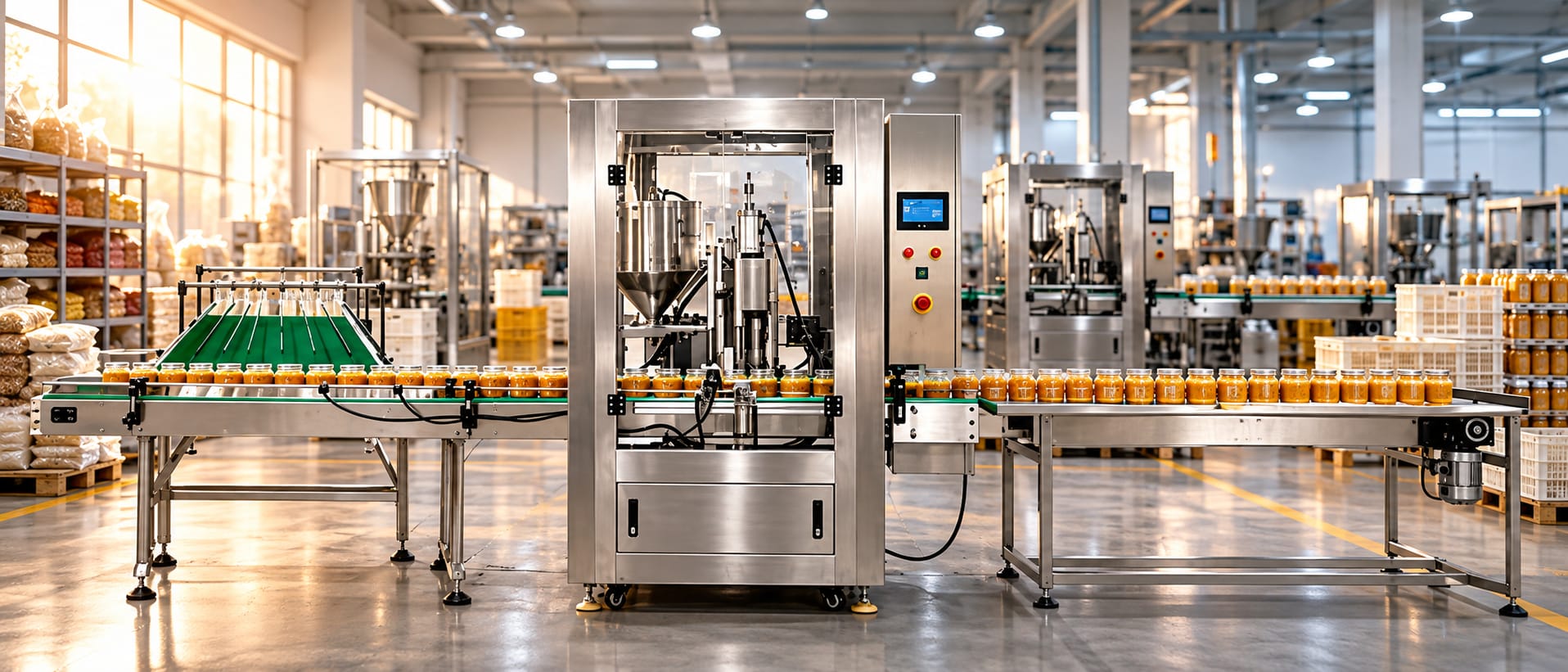
A paste filling machine doses thick, viscous products — chutneys, pickles, sauces, creams, adhesives, ghee — into bottles, jars and pouches without the dripping and inconsistency of manual filling. In India, prices run from about ₹25,000 for manual pneumatic units to ₹85,000–1.5 lakh for double-head semi-automatic machines, with servo-driven units at the top of that band.
Paste filling machine prices in India by class
| Machine class | Typical price (India, 2026) | Throughput | Best for |
|---|---|---|---|
| Manual / pneumatic (single head) | ₹25,000 – 45,000 | 300–600 bottles/hr | Startups, home brands, pilot batches |
| Semi-auto piston (single head) | ₹55,000 – 85,000 | 600–1,400 bottles/hr | Growing food and cosmetic brands |
| Semi-auto (double head) | ₹85,000 – 1.5 lakh | 1,000–2,800 bottles/hr | Mid-size plants, contract packers |
| Semi-servo | ₹1.5 lakh | 2,000+ bottles/hr | High-viscosity, high-accuracy runs |
What is the price of a paste filling machine in India?
A semi-automatic paste filling machine costs ₹55,000–85,000 for a single-head piston unit and ₹85,000–1.5 lakh for a double-head unit in India in 2026. Manual pneumatic fillers start around ₹25,000. Your product's viscosity decides which class you actually need — buying on price alone is the most common expensive mistake in this category.
Match the machine to your viscosity, not your budget
Viscosity is the real selector. Thin liquids (oils, syrups) fill fine on gravity or pneumatic machines. Viscous pastes (chutney, pickle, cream, sauce) need a piston filler — the piston positively displaces the product so each dose is consistent regardless of how thick the batch is. Very thick or particulate products (pickle with pieces, thick adhesives) need larger-bore pistons or auger feed; a standard piston machine will struggle and wear fast. Tell the vendor your product's exact viscosity behaviour — better, send a sample — and size the machine to the thickest product you will ever run, not the average one.
Double-head throughput: do the math honestly
A double-head machine does not simply double a single head's output. Realistic throughput for a double-head semi-automatic paste filler is 1,000–2,800 bottles per hour depending on fill volume, viscosity, and how fast your operator swaps containers. The machine is rarely the bottleneck — container handling is. If your line cannot present 2,000 containers an hour to the machine, a double head buys you nothing over a single head. Size the machine to your actual container-handling rate.
What should I check before buying a paste filling machine in India?
Run this checklist: (1) contact parts in SS316 for food/pharma/cosmetic products (SS304 minimum otherwise) — ask for the material certificate, not just the claim; (2) fill-volume range and accuracy in writing, tested on YOUR product's viscosity; (3) nozzle type — anti-drip nozzles matter enormously for sticky pastes; (4) changeover: how long to switch bottle sizes, and what tooling costs; (5) air requirement for pneumatic machines — do you have a compressor with the needed CFM, or is that another purchase?; (6) GST invoice, 1-year warranty in writing, and spare-parts delivery time to your city.