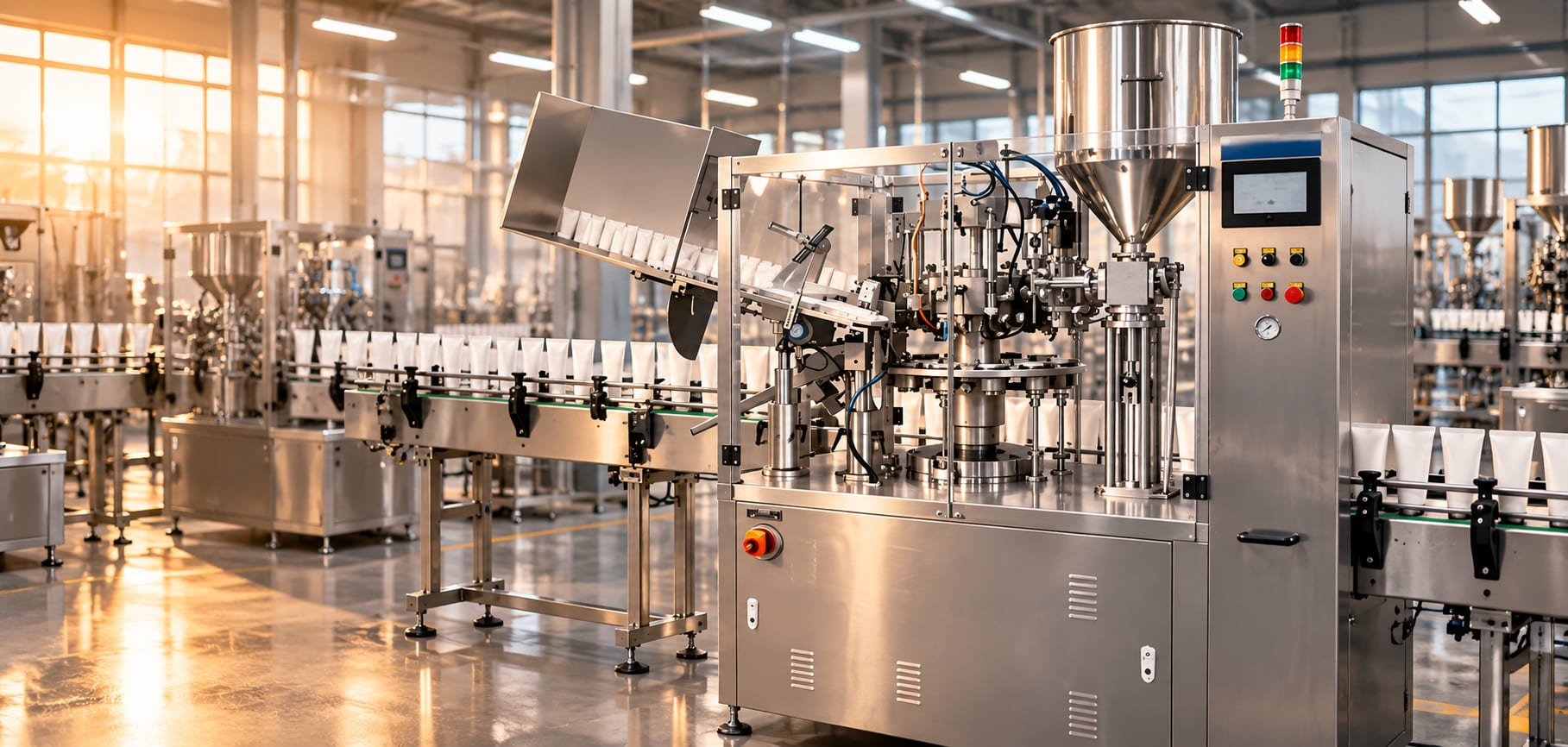
A tube filling and sealing machine fills squeezable tubes — toothpaste, creams, ointments, adhesives — and hermetically seals the open end in one continuous cycle. In India, prices run from about ₹1.9 lakh for semi-automatic units to ₹4.4–6.5 lakh for standard automatic machines, with GMP-grade pharma lines at ₹8 lakh and above.
Tube filling and sealing machine prices in India by class
| Machine class | Typical price (India, 2026) | Speed | Best for |
|---|---|---|---|
| Semi-automatic (double-head linear) | ₹1.9 – 2.5 lakh | 20–30 tubes/min | Startups, contract packers, low volumes |
| Automatic (standard) | ₹4.4 – 6.5 lakh | 40–60 tubes/min | Cosmetic and pharma brands scaling up |
| Automatic (premium) | ₹8 lakh | 60–80 tubes/min | High-speed cosmetic lines |
| GMP automatic lines | ₹12 – 26 lakh | 80+ tubes/min | Regulated pharma manufacturing |
GST treatment varies by seller, so confirm whether quoted prices are ex-works or GST-inclusive.
What drives the price of a tube filling machine?
Three things move the price more than anything else: automation level, tube compatibility, and sealing technology. A semi-automatic machine needs an operator to load each tube; a fully automatic machine takes tubes from a hopper, orients, fills, seals, trims, and ejects them at 40–60 tubes per minute with one operator supervising.
Tube compatibility is the spec buyers underestimate. Plastic tubes (PE), laminated tubes (ABL/PBL for pharma and cosmetics), and metal tubes (aluminium) each need different sealing: hot-air sealing for plastic and laminated tubes, jaw or ultrasonic sealing where the laminate structure demands it. A machine quoted for "plastic tubes" may not seal laminated pharma tubes without different sealing jaws — ask before you buy, not after delivery.
What is the price of an automatic tube filling and sealing machine in India?
A standard automatic tube filling and sealing machine costs ₹4.4–6.5 lakh in India in 2026. At this price you get 40–60 tubes per minute, automatic tube loading and orientation, volumetric filling with ±0.5–1% accuracy, and hot-air sealing with trim and ejection. Machines below ₹4 lakh are typically semi-automatic; above ₹8 lakh you are paying for GMP documentation, servo drives, and higher speeds.
Manual vs semi-automatic vs automatic: which class fits you?
Buy manual or semi-automatic if you fill fewer than 5,000 tubes a day, run multiple SKUs with frequent changeovers, or are a startup validating a product. The ₹1.9–2.5 lakh semi-auto class pays for itself when labour cost or fill inconsistency becomes the bottleneck. Buy automatic when you cross roughly 10,000 tubes a day or supply retailers who audit fill accuracy — at 40–60 tubes per minute, one automatic machine replaces 4–6 manual operators and the fill variance drops visibly.
What should I check before buying a tube filling machine in India?
Run this checklist with every vendor: (1) tube-diameter range the machine handles without new tooling — your current and next year's tube sizes; (2) fill-volume accuracy in writing (±1% is standard; ask how it is measured); (3) sealing-jaw changeover time and cost for switching between plastic and laminated tubes; (4) contact-part material — SS316 for pharma/cosmetic, SS304 minimum for the rest; (5) GST invoice, 1-year warranty terms in writing, and spare-parts delivery time to your city; (6) a demo fill-and-seal run on YOUR tube and YOUR product — viscosity changes everything, and a machine tuned for toothpaste may struggle with a thin lotion.
Hot-air vs ultrasonic sealing — does it matter?
For most plastic and laminated tubes, hot-air sealing is the standard and the most economical. Ultrasonic sealing matters when the tube laminate is heat-sensitive or when you need a cleaner seal line on premium cosmetic tubes. It adds cost. If your tubes are standard PE or ABL laminates, hot-air does the job — spend the difference on a better filling system instead.