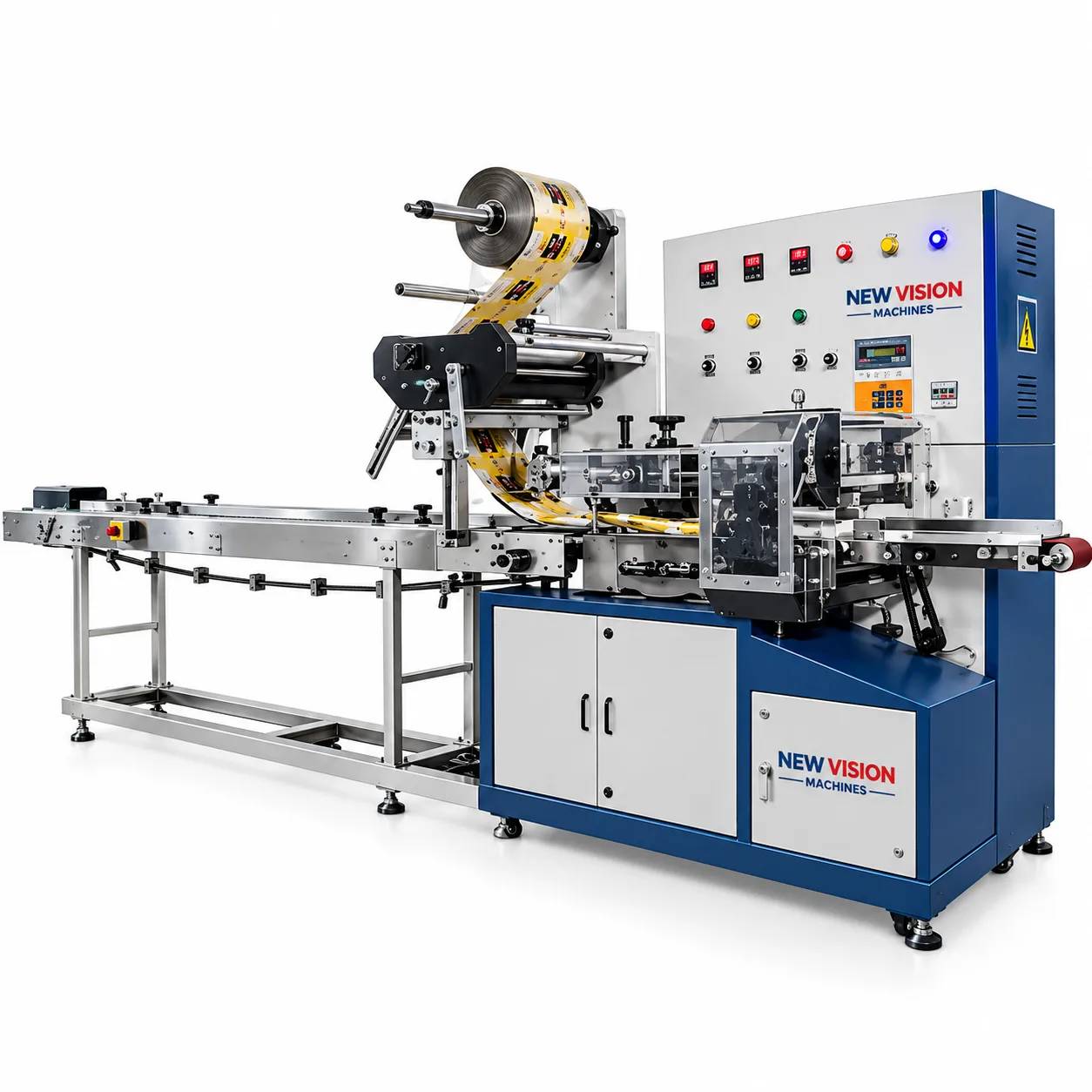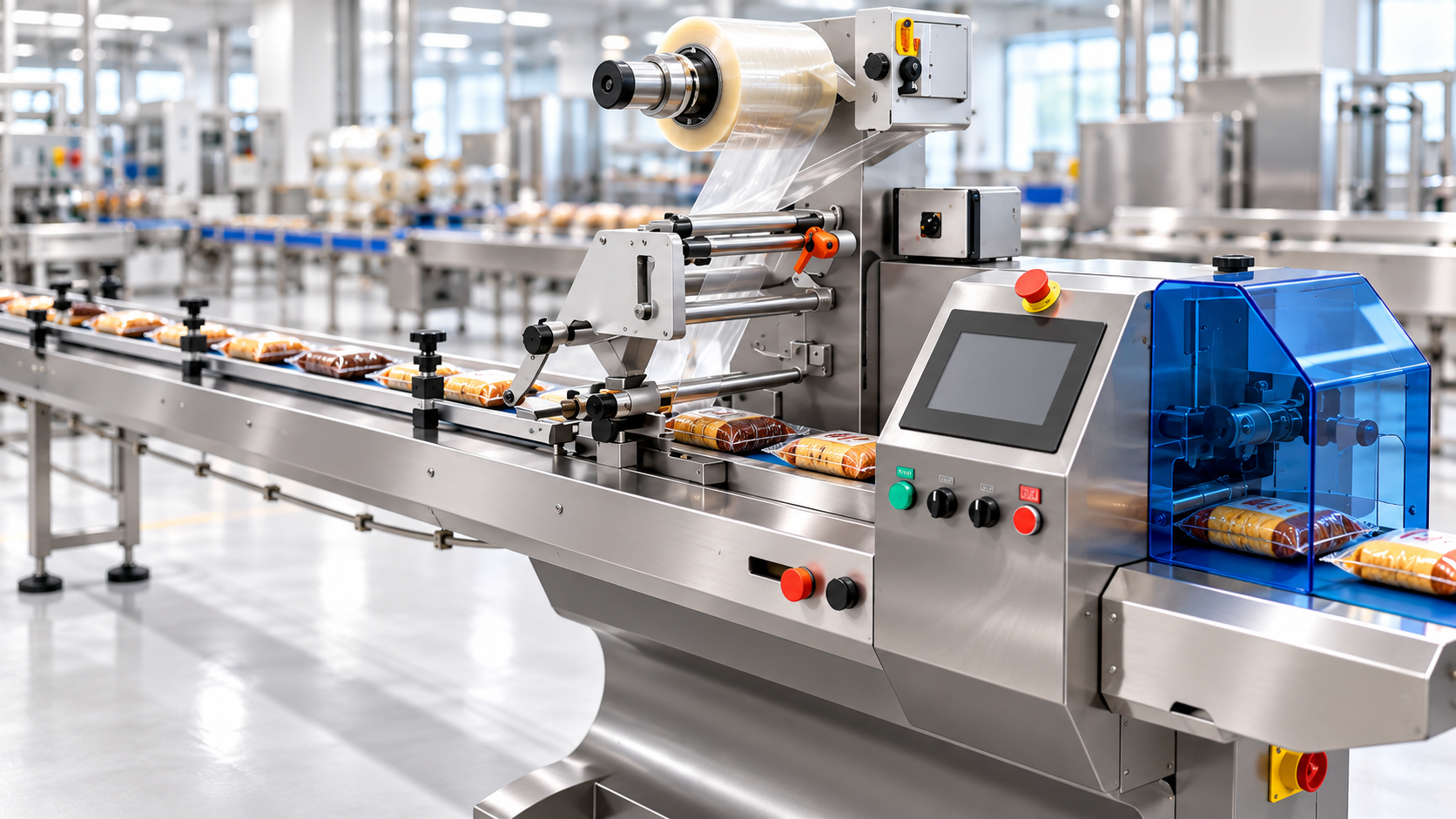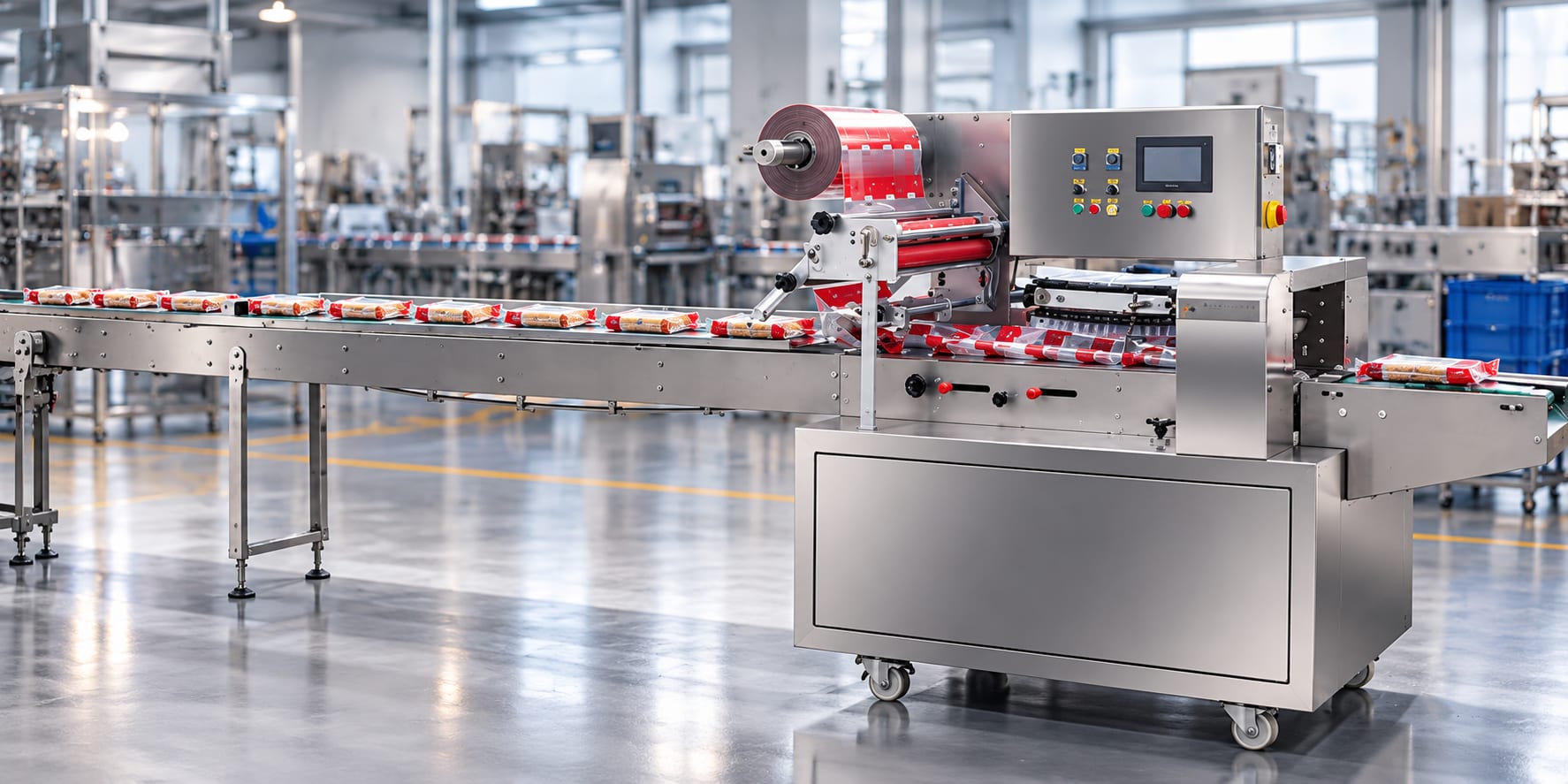
A horizontal flow wrap machine takes individual solid products — biscuits, soap bars, chocolate bars, bakery items — and seals each one in a pillow pack with a fin seal underneath and end seals front and back. It does this continuously: product in, wrapped pack out, with no batch stops.
How it actually works: three stations
1. Infeed and film forming. Products travel on an infeed conveyor, spaced by pusher lugs. Simultaneously, flat film is pulled off a reel and folded around a forming box into a tube around the product line.
2. Fin (longitudinal) seal. Heated rollers press the overlapping film edges together along the underside of the tube, forming a continuous sealed tube with the product inside.
3. End seal and cut. Rotary sealing jaws clamp across the tube at intervals, sealing the trailing end of one pack and the leading end of the next, while a cutter separates them. A photoelectric sensor reads printed eye-marks on the film so each cut lands in the right place on printed packaging.
The whole cycle is continuous — that is the core advantage over intermittent pouch machines for solid products.
What it packs — and what it doesn't
Flow wrap suits regular-shaped solid products that can travel horizontally: biscuits, cookies, bakery items, chocolate and protein bars, soap bars, medical disposables (syringes, bandages), hardware fittings, stationery.
It does not pack powders, granules, or liquids — those need a vertical form-fill-seal (VFFS) machine where product drops down into the pouch. If your product flows, you are looking at the wrong machine category.
Servo vs mechanical drive: the main engineering fork
Swipe or scroll horizontally to view all columns
| Mechanical drive | Servo drive | |
|---|---|---|
| Speed range | 40–120 packs/min typical | Up to 200+ packs/min |
| Changeover | Manual adjustments, slower | Recipe-based, faster |
| Cut-length accuracy | Good, drifts with wear | Tight, consistent |
| Maintenance | Simple, widely understood | Needs trained technicians |
| Price position | Lower end of the band | Upper end of the band |
Mechanical machines are honest workhorses for single-product, long-run packing. Servo machines earn their premium on frequent changeovers and printed-film accuracy, where every misregistered cut is wasted film and a rejected pack.
Film: the consumable that decides seal quality
Heat-sealable films only — BOPP and laminated films (PET, CPP laminates) are standard. Two things matter: the film must seal at your product's safe temperature, and printed film needs a clear eye-mark for the registration sensor. Cheap film with inconsistent thickness is the most common cause of leaky seals on an otherwise good machine — a point worth remembering when a supplier blames the machine for what the film caused.
What it costs in India: the real band
Based on current live listings from Indian manufacturers and marketplaces, automatic horizontal flow wrap machines trade between ₹2.6 lakh and ₹6 lakh:
- Entry automatic units (50–70 packs/min, basic controls): around ₹2.6–₹3.5 lakh - Mid-range PLC-controlled units (60–150 packs/min, photo-eye registration): around ₹3.5–₹5 lakh - High-speed servo units and fully automatic lines: ₹5 lakh and above
What moves a machine up the band: servo drives, higher speed rating, stainless-steel product-contact parts instead of mild steel, PLC with touch HMI, and line-integration options (auto-feeders, coders, nitrogen flushing). A machine quoted far below the band usually gives up one of these — most often build quality and after-sales depth. For context, automatic horizontal flow wrap machines with registration control and configurable sealing sit at the engineered end of this spectrum.
Sizing it: the one formula that matters
Do not buy speed you will never use, and do not buy a machine that caps your growth in year two.
Required packs/min = Daily pack target ÷ (operating hours × 60 × 0.75)
The 0.75 is real-world efficiency — changeovers, film roll changes, and minor stops. Example: 50,000 packs per day over an 8-hour shift needs 50,000 ÷ (8 × 60 × 0.75) ≈ 139 packs/min, so you size for the 150 packs/min class, not the 120.
Also size the pack dimensions, not just speed: check the machine's film width range and product length/height limits against your largest SKU, not your average one. When comparing horizontal flow wrap machines for your product line, confirm the pack-size envelope in writing — brochure maximums are measured under ideal conditions.
What to verify before buying
1. Run your product on it. Film behavior with your exact product shape and weight cannot be judged from a brochure. 2. Seal integrity test. Ask for a burst/leak test on sample packs, not just a visual check. 3. Changeover procedure. Time a format change yourself if you run multiple SKUs. 4. Film compatibility. Confirm your film type and thickness range work with the sealing system. 5. After-sales reality. Sealing jaws, cutters, and sensors are wear items — confirm spare availability and response time in your region before price becomes the deciding factor.
Field troubleshooting: four common defects
Leaky end seals. Usually jaw temperature, pressure, or dwell time — not the film. Verify with a thermometer strip on the jaw face; controllers lie, physics doesn't. Also check for product debris on the seal face.
Film wandering off-center. Forming collar misalignment or uneven film tension. Re-center the reel, check tension rollers for wear, and confirm the film width matches the former size.
Print misregistration. Photo-eye sensitivity or poor eye-mark contrast on the film. Clean the sensor lens first — dust is the cheapest fix — then adjust sensitivity and confirm eye-mark print density with the film supplier.
Inconsistent pack length. On mechanical machines: check for drive belt slip or worn chains. On servo machines: encoder or parameter drift. Either way, verify against actual measured packs, not the HMI display.