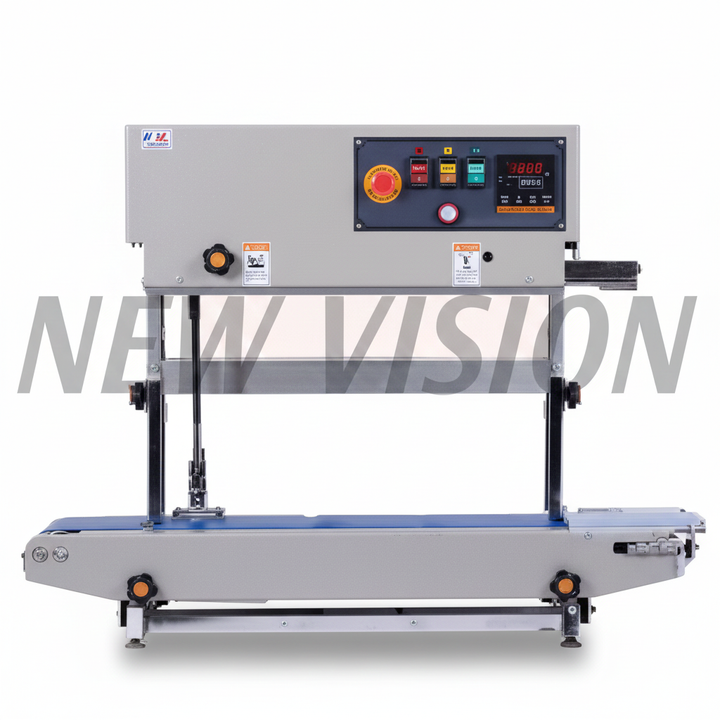
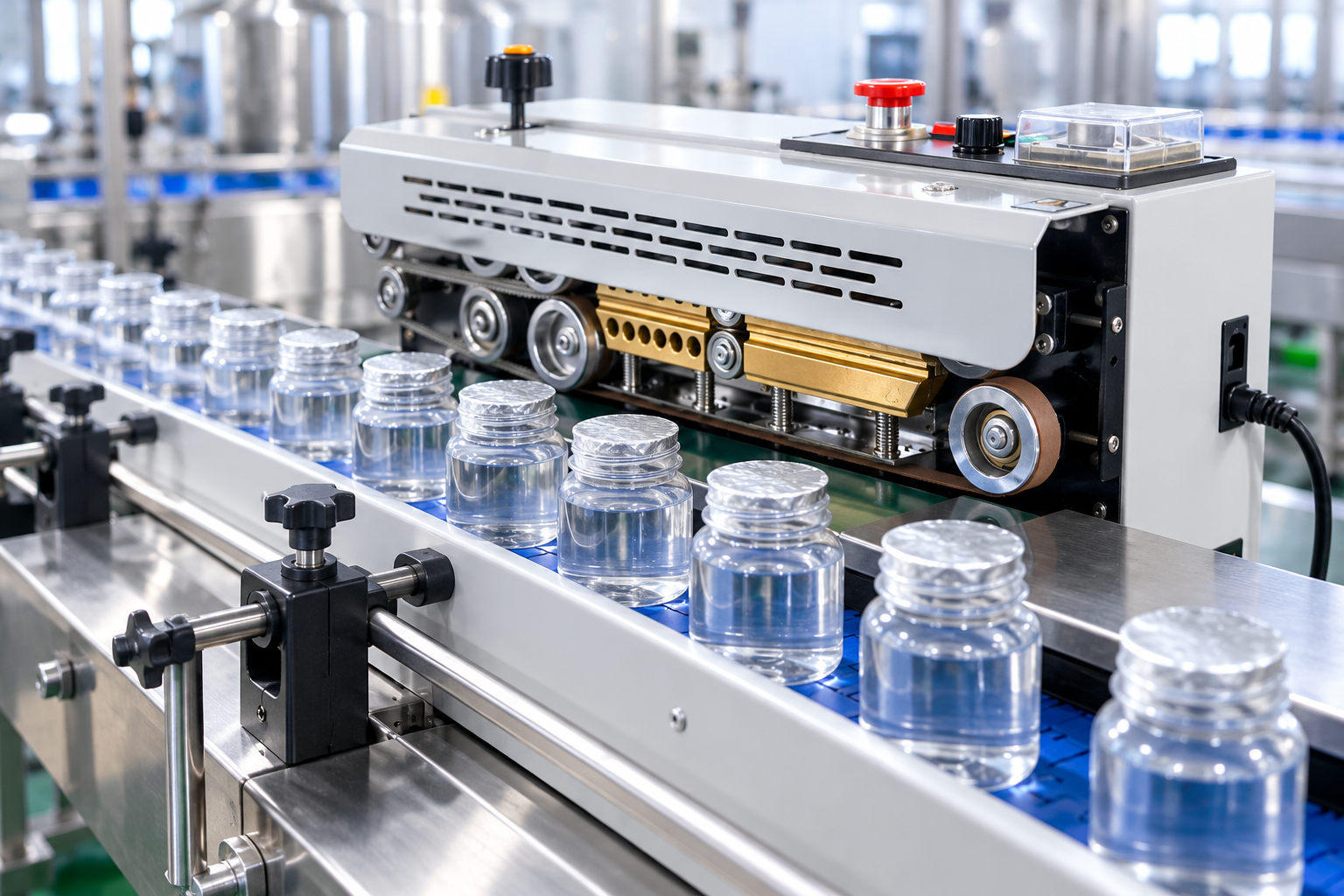
Manual heat sealing is limiting output on Indian food packaging lines — creating inconsistent seals, halting throughput, and capping FMCG brands at a volume their markets already demand. A continuous band sealer removes the stop-start cycle entirely: bags move through a conveyor-driven heating and cooling assembly at a consistent, adjustable speed, with no per-bag operator intervention. This guide quantifies the upgrade, explains the seal-quality engineering, and maps the configuration decision for Indian lines.
The Production Bottleneck: Why Manual Sealing Fails Modern FMCG Lines
A manual impulse sealer resets completely for every single bag — position, press, wait, release — and that pause accumulates into a measurable production deficit. In a high-volume snack, spice, or dry-goods facility running thousands of units per shift, operator fatigue then introduces seal pressure variations, inconsistent dwell times, and alignment errors at exactly the point where consumer trust is decided.
Packaging now does far more than present a product — it governs shelf life, food safety, and consumer trust on the retail shelf. A failed or weak seal is not a cosmetic defect; it is a potential food safety issue that exposes brands to returns, spoilage claims, and retailer penalties. And with organised retail penetration, quick-commerce fulfilment, and regulatory standards all raising the bar in India, facilities that relied on manual methods at modest volumes are hitting throughput ceilings those methods cannot break.
Quantifying the Efficiency: Throughput and Operational ROI
The physics of the advantage is simple: in a continuous band sealer, transport and sealing happen simultaneously, so the machine never resets. The conveyor belt, heating elements, and cooling section operate as one coordinated system — the seal forms while the next bag is already entering the feed zone. Commercial units seal continuously at belt speeds commonly specified in the 15–30 feet-per-minute range, so effective throughput scales with belt speed and bag geometry rather than with operator cycle time.
Labour reallocation compounds the gain. Manual lines typically tie one or two operators to positioning and aligning bags at the seal point — a repetitive task that also introduces placement errors. Automated feeding redirects that labour toward quality checks and downstream tasks that need human judgment, a shift with direct per-unit cost impact as skilled wages rise across Indian manufacturing centres.
Market signals point the same direction: independent trackers project steady multi-year growth for band sealing machine demand through the early 2030s, driven by food, pharmaceutical, and consumer goods adoption — evidence that plants running the ROI numbers keep reaching the same conclusion.
Extending Shelf Life with Nitrogen Flushing and Hermetic Seals
In India's high-humidity, temperature-variable climate, a hermetic seal is the difference between a product that reaches the consumer intact and one that spoils on the shelf. Modern continuous band sealers integrate nitrogen flushing directly into the sealing process: inert nitrogen is introduced into the package cavity immediately before the seal closes, displacing the residual oxygen that drives oxidation, moisture absorption, and microbial growth in snacks, namkeen, and perishable FMCG products.
The shelf-life impact is documented, not theoretical. Industry gas specialists report packaged dried foods moving from roughly six months to one to two years of shelf life under nitrogen flushing, and peer-reviewed research on seasoned snacks confirms gas flushing significantly increases product stability. For a mid-size snack brand distributing across states with inconsistent cold-chain infrastructure, that margin converts directly into fewer returns, lower spoilage write-offs, and more predictable inventory cycles — provided the hermetic seal holds, which is what locks the nitrogen environment in place.
Digital temperature control is what makes hermetic quality repeatable across films. Indian FMCG films run from thin polyethylene around 0.02 mm to heavy laminated foils of 0.6 mm and more; each thickness needs a calibrated sealing temperature. Digital controls let operators set and hold exact temperatures per SKU, removing the guesswork that shifts seal quality between operators and shifts.
Choosing Your Configuration: Horizontal vs Vertical Band Sealers
Match machine geometry to product behaviour — horizontal for stable dry goods, vertical for anything that spills. Biscuits, namkeen, and roasted seeds travel flat through a horizontal sealer without migrating toward the seal zone. Vertical band sealers hold the bag upright and are the practical default for liquids, powders, and loose grains — including edible oil pouches — where gravity would otherwise push product into the seal area and cause weak or failed seals.
Material compatibility is the next filter. Common substrates across Indian food categories:
- Polyethylene (PE) films — economical and widely used for snacks, pulses, and bakery items
- Mylar (BoPET) foil laminates — preferred for moisture-sensitive products needing high oxygen and light barriers
- Gusseted bags — bulk commodities and expanded-volume formats
Adjustable conveyor speed ties it together. Thicker laminates need slower passes for adequate heat penetration; lightweight PE seals cleanly at higher speeds. Specify conveyor speed range as a core procurement parameter — mismatched dwell time is one of the most common causes of seal inconsistency in mixed-SKU operations.
Industrial Grade vs Entry-Level: The Cure for Packaging Failures
The difference between an industrial-grade band sealer and an entry-level unit is the difference between a seal that holds and one that fails mid-shipment. Packaging failures on Indian food lines trace back to one overlooked variable: thermal inconsistency during the sealing cycle. Industrial band sealers use dedicated cooling zones that set the seal under pressure immediately after heating — without that block, you get a bond that looks sealed but delaminates under transit stress, humidity, and stack pressure.
Digital PID control is the second differentiator. A PID controller continuously adjusts heater output to hold a precise target temperature as ambient conditions shift — standard practice in Indian production environments where afternoon and night temperatures diverge widely. Entry-level dial thermostats leave temperature drifting well outside a safe seal window, which is unacceptable for premium basmati rice, cold-pressed oils, or export spice batches.
Duty-cycle rating decides survival. Entry-level sealers are rated for intermittent use; running them across continuous industrial shifts degrades heating elements and band tension until seal width varies batch to batch. Industrial machines — including vertical band sealing machines built for sustained throughput — pair heavy-duty drive motors, reinforced conveyor bands, and thermally rated components engineered for peak-season duty.
Choosing a Continuous Band Sealer: The Bottom Line for Indian Manufacturers
Four factors are non-negotiable when specifying a continuous band sealer for an Indian food line:
- Throughput architecture — continuous motion instead of stop-start cycles, with belt speed matched to your mixed-SKU film range
- Nitrogen flushing capability — integrated flushing plus a genuinely hermetic seal for shelf-life gains
- Correct configuration — horizontal for dry goods, vertical for liquids and powders
- Supported sourcing — a one-year manufacturer warranty backed by local spares and on-site technicians
A machine sourced from a local manufacturer that stocks spares and understands Indian voltage and humidity conditions returns to uptime faster than an imported unit on a six-week parts lead time — and that difference compounds every time the line stops.
Why Factory-Direct Support Matters
Selecting the machine is half the decision; the partner behind it decides whether the upgrade compounds value or stalls at the first technical hurdle. Sourcing without local support hides a cost the purchase quote never shows: when a heating element or conveyor belt fails mid-shift, a three-to-six-week overseas parts lead time converts directly into lost production days.
Operator training is the performance multiplier. Sealing lines need operators who understand temperature calibration, belt tension, and seal integrity checks; without structured onboarding from the manufacturer, teams default to trial-and-error adjustments that accelerate wear and raise rejection rates. Indore-based manufacturing adds a logistical edge for the central India FMCG corridor — faster delivery, same-week service visits, and regionally stocked parts across Maharashtra, Gujarat, Rajasthan, and Madhya Pradesh.
Talk to New Vision Machines for a technical consultation to match configuration to your line speed and packaging format — and pair it with integrated edible oil filling lines when liquids run on the same floor.