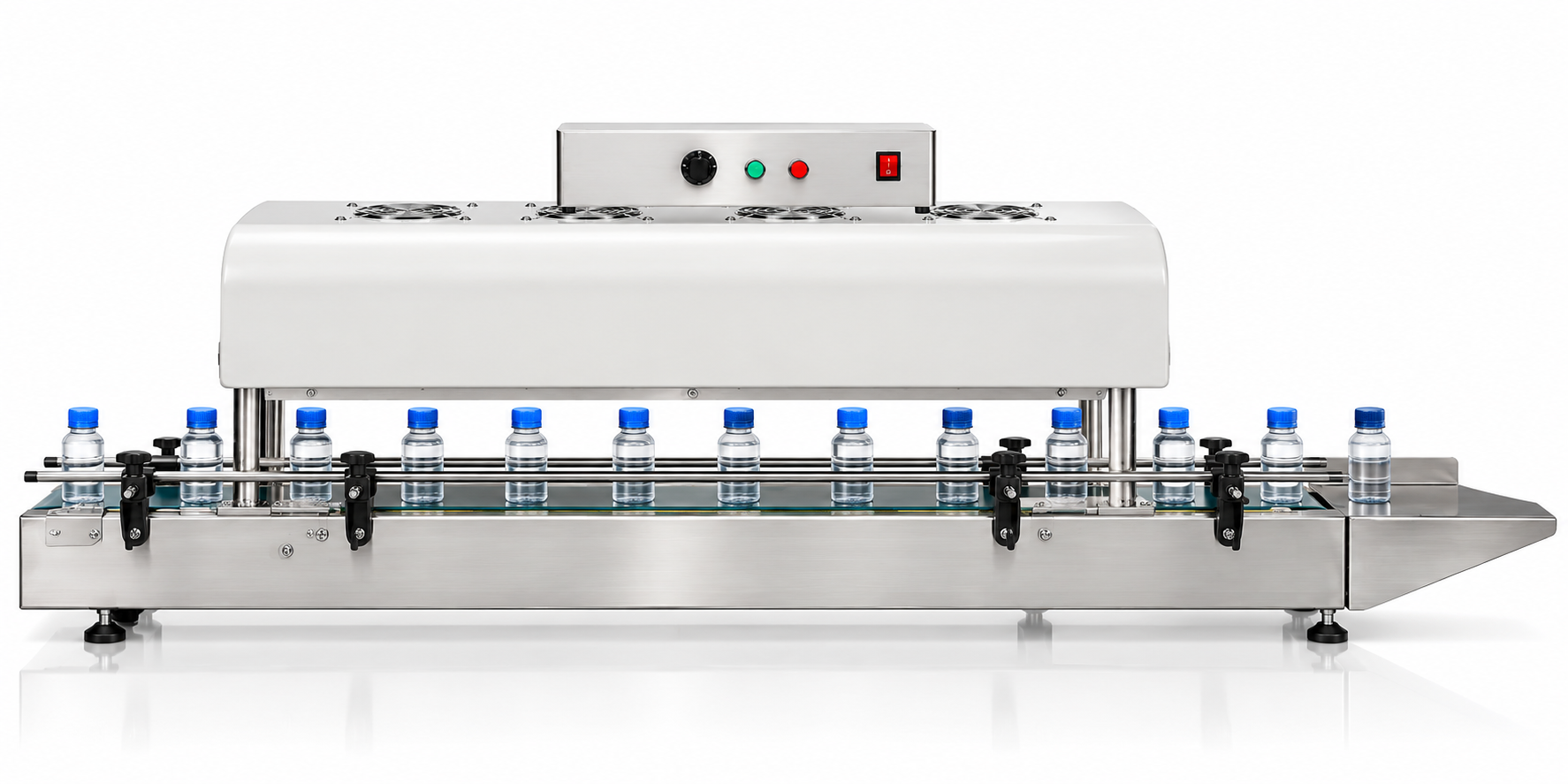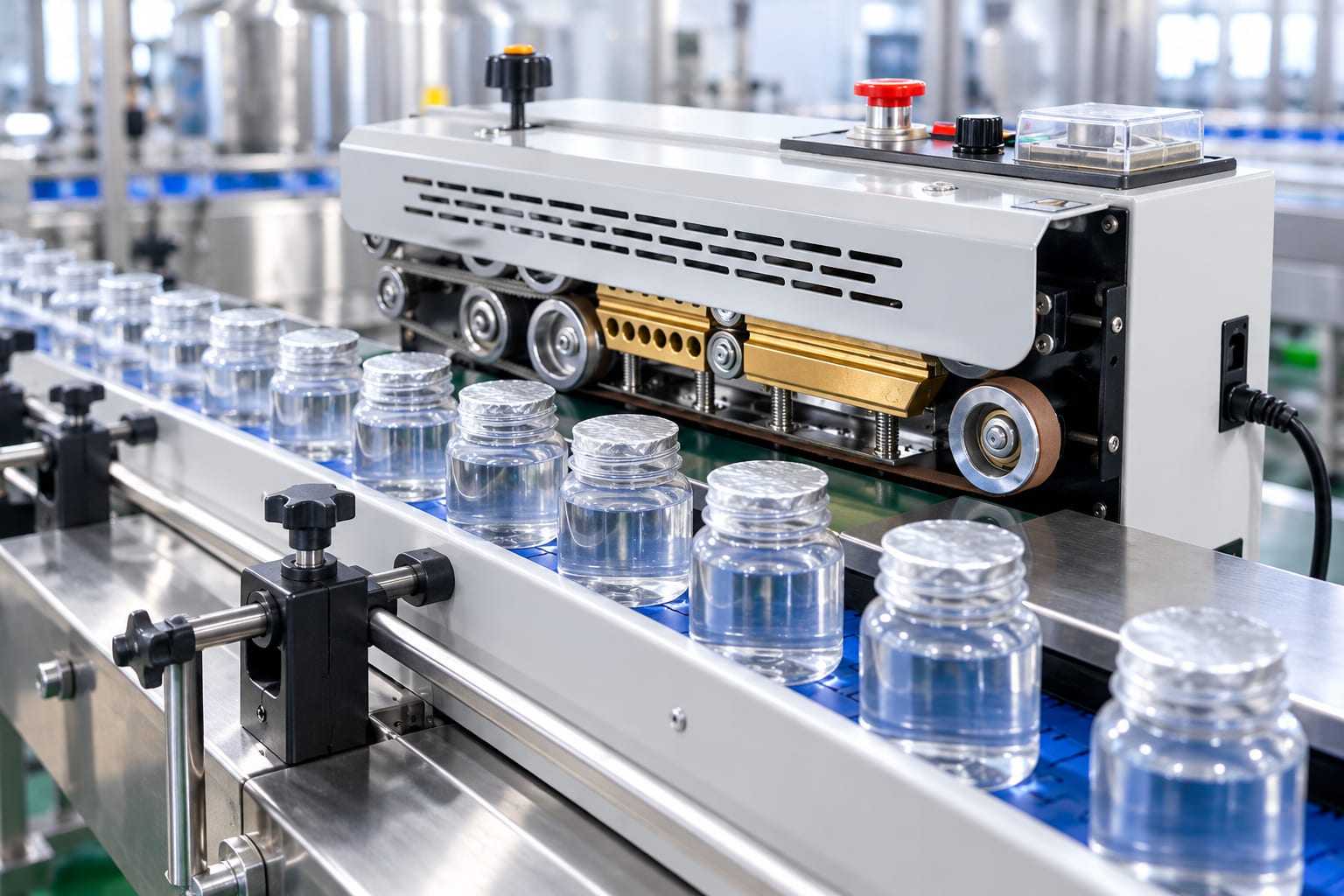
The right sealing machine depends on the pack: impulse for small batches, continuous band for pouches, L sealer for shrink multipacks, induction for bottle caps, and vacuum/gas-flush for oxygen-sensitive products.
Which sealing machine should an Indian factory buy?
Start with the pack format, not the machine. Then check throughput, film, seal width, power requirement, gas requirement and the space available on the shop floor.
Swipe or scroll horizontally to view all columns
| Technology | Best for | Price band INR | Watch out for |
|---|---|---|---|
| Handheld/tabletop impulse sealer | Small-batch pouches and intermittent packing | ₹778–₹1,685 | Low throughput compared with continuous systems |
| Foot-operated impulse sealer | Higher-volume manual pouch sealing | ₹12,000–₹22,300 | Still operator-dependent |
| Continuous band sealer — MS | Dry-goods pouches and regular production | ₹12,500–₹20,000 | Film compatibility and seal consistency |
| Continuous band sealer — SS | Food, pharma and cleaner production areas | ₹22,500–₹35,000 | Higher capital cost |
| Continuous band sealer — vertical/heavy | Heavy or liquid-oriented packs | Around ₹2,11,000 | Substantially higher investment |
| Continuous band sealer with air/nitrogen gas-flush | Products needing reduced oxygen exposure | ₹29,500–₹35,000 | Requires gas supply and process control |
| L sealer — manual | Low-volume shrink-wrapped multipacks/cartons | Around ₹37,300 | Manual handling |
| L sealer — semi-automatic | Regular shrink packaging with moderate output | ₹61,360–₹84,500 | Requires more floor space |
| L sealer — automatic | Higher-volume shrink multipacks/cartons | ₹2,30,000–₹6,49,000 | Capital cost and line integration |
| Induction cap sealer — handheld/portable | Small-batch tamper-evident bottles | ₹6,999–₹18,000 | Operator-dependent |
| Induction cap sealer — semi-auto/auto inline | Bottle production lines | ₹1,80,000–₹3,25,000 | Cap, liner and container compatibility |
| Vacuum/gas-flush chamber | Oxygen-sensitive products and suitable liquid/solid packs | ₹80,000–₹1,25,000 | Chamber size and cycle time limit output |
These are Indian market listing bands checked on October 3, 2026. Actual purchase cost will vary with construction, automation level, configuration and supplier specification.
What is the sealing machine price in India for each technology?
The sealing machine price in India starts at about ₹778 for a basic tabletop impulse sealer and goes up to ₹6,49,000 for an automatic L-sealing system.
When should a factory choose an impulse sealer?
Go with an impulse sealer when the production is intermittent, volumes are modest and an operator can handle the sealing operation.
Handheld and tabletop 8–12 inch impulse sealers are listed around ₹778–₹1,685. Foot-operated pedal models are approximately ₹12,000–₹22,300.
For a small unit starting pouch packing without a continuous production requirement, this is the lowest-cost entry point among the listed technologies. The compromise is straightforward: more operator involvement and lower throughput.
When is a continuous band sealer the correct choice?
A continuous band sealer makes sense for dry-goods pouches when the line needs repeatable production rather than one pouch being sealed at a time.
MS-body continuous band sealers are listed around ₹12,500–₹20,000, while SS-body versions are approximately ₹22,500–₹35,000.
In food and other cleaner production areas, the SS range needs to be considered separately from the lower-cost MS category. Heavy vertical configurations can reach around ₹2,11,000.
For standard pouch-packing applications, see the horizontal continuous band sealer.
When should a buyer select an L sealer?
An L sealer is the relevant choice when products are being shrink-wrapped as multipacks, cartons or grouped retail units.
Manual L sealers are around ₹37,300. Semi-automatic machines fall around ₹61,360–₹84,500, while automatic systems range from approximately ₹2,30,000 to ₹6,49,000.
That is a wide price spread, but the reason is mainly the level of automation. A factory doing regular shrink-packaging work should look at labour requirements and required output before comparing machine prices.
For automated shrink-packaging applications, see the automatic L sealer machine.
When is an induction cap sealer the right purchase?
Choose an induction cap sealer when bottles require tamper-evident sealing and the cap and liner combination is compatible with the process.
Handheld or portable induction cap sealers are listed around ₹6,999–₹18,000. Semi-automatic and automatic inline systems are approximately ₹1,80,000–₹3,25,000.
New Vision Machines lists an online induction cap sealing machine at ₹1,13,160. That gives buyers a useful market price point between portable equipment and higher-capacity inline systems.
For production-line applications, see the online induction cap sealing machine.
When should a factory use vacuum or gas-flush sealing?
Vacuum/gas-flush chamber equipment is worth considering when oxygen exposure needs to be controlled and the product and pack format are suitable for chamber processing.
The reference Indian price band is approximately ₹80,000–₹1,25,000.
For oxygen-sensitive products, gas-flush should be treated as a process requirement, not simply an extra machine feature. Continuous band sealers with air/nitrogen gas-flush are listed around ₹29,500–₹35,000 and may suit applications where the pouch format and production process allow continuous operation.
How should packaging format determine the machine?
The pack format gives you the first shortlist: dry-goods pouches generally point to continuous band sealing, shrink-wrapped multipacks to L sealing, bottles with tamper-evident caps to induction sealing, and oxygen-sensitive products to gas-flush or vacuum systems.
Dry-goods pouches → Continuous band sealer
For regular pouch production, start with the continuous band category. Then compare MS and SS construction based on the production environment.
Shrink-wrapped multipacks or cartons → L sealer
For grouped products requiring shrink packaging, compare manual, semi-automatic and automatic L sealers against production volume and labour requirements.
Tamper-evident bottle caps → Induction cap sealer
For bottle closures requiring an induction seal, compare portable equipment with semi-automatic or inline systems.
Oxygen-sensitive products → Gas-flush or vacuum system
Where oxygen exposure is a packaging concern, evaluate a gas-flush band sealer or vacuum/gas-flush chamber machine against the product's pack format and required output.
Liquids → Vertical band sealer or vacuum/gas-flush
For liquid-oriented packaging, consider a vertical configuration or suitable vacuum/gas-flush system rather than automatically selecting a horizontal pouch configuration.
What should a purchase manager check before comparing prices?
Before comparing quotations, lock down six things: film type and thickness, required throughput, seal width, power supply, gas-flush requirement and available floor space.
Film type and thickness
Confirm the film construction and thickness before approving the machine. The sealing material has to be compatible with the equipment and its operating conditions.
Required throughput
Give the supplier a measurable production requirement—pouches per minute or bottles per minute—instead of asking for a "high-speed" machine.
For planning, use:
Daily Output = pouches per minute × 60 × operating hours × 0.75 OEE
For example, a machine running at 30 pouches/minute for 8 hours gives:
30 × 60 × 8 × 0.75 = 10,800 pouches/day
The 0.75 factor is a practical planning assumption for the stated OEE calculation. Rated machine speed should not be treated as actual daily production.
Seal width
Match the required seal width with the machine configuration before comparing quotations. A low machine price is of little use if the sealing arrangement does not meet the pack specification.
Power supply
Confirm the electrical requirement with the supplier before purchase. The intended installation point should also be checked for the required supply.
Gas-flush requirement
If nitrogen or another gas-flush process is required, confirm that the selected configuration supports it. The required gas supply should be included in the installation plan.
Floor space
Measure the installation area before moving to semi-automatic or automatic equipment. Footprint, operator access and product movement all matter once the machine reaches the shop floor.
What does the sealing machine price in India really tell you?
The sealing machine price in India tells you something about the technology and automation level, but price alone does not tell you whether the machine fits the job.
A ₹1,000 impulse sealer and a ₹3 lakh inline induction system are designed for fundamentally different packaging requirements. Putting them into the same price comparison does not help the purchase decision.
The useful comparison is:
Package format → required output → sealing requirement → machine configuration → total purchase cost.
For continuous pouch sealing, New Vision Machines also offers a vertical continuous band sealer for applications where a vertical configuration is appropriate.
How do you troubleshoot common sealing defects?
The four common defects are weak or leaking seals, burnt film, wrinkled seals and inconsistent sealing on a band sealer; the fix starts with checking the actual sealing conditions rather than simply turning the temperature up.
Why are seals weak or leaking?
For weak or leaking seals, check sealing temperature, pressure/contact, dwell time and film compatibility before changing settings.
First confirm that the film is suitable for the selected sealing temperature and that the sealing surfaces are clean. Adjust the relevant temperature or sealing parameters gradually, then test the finished seal.
Why is the film burning?
Burnt film generally points to excessive heat or an unsuitable sealing setting for the material.
Reduce the sealing temperature or exposure setting incrementally and test several consecutive packs. Do not respond to every weak seal by continuously increasing temperature; excessive heat can damage the film and create another defect.
Why are seals wrinkled?
For wrinkled seals, check film alignment, tension and how the pouch enters the sealing area.
Look at the film path and pouch presentation first. Correct alignment before making major temperature changes. Otherwise, the mechanical problem remains while the process settings keep moving.
Why is sealing inconsistent on a band sealer?
Inconsistent band-sealer results call for checks on temperature stability, conveyor movement, film tracking and product presentation.
Run consecutive empty-film or controlled test packs and compare the seals. If results vary from pack to pack, check whether the film is entering consistently and whether the machine settings remain stable during operation.
Is a cheaper sealing machine always the better purchase?
A cheaper sealing machine is the right purchase only when its technology, throughput and packaging compatibility match the production requirement.
For a small intermittent operation, ₹778–₹1,685 for a tabletop impulse sealer may be sufficient. For continuous pouch production, the relevant comparison moves to the ₹12,500–₹35,000 continuous band-sealer range. For automated shrink packaging, the investment can extend to ₹6,49,000.
The sensible basis for comparison is the process requirement, not simply the lowest quotation.