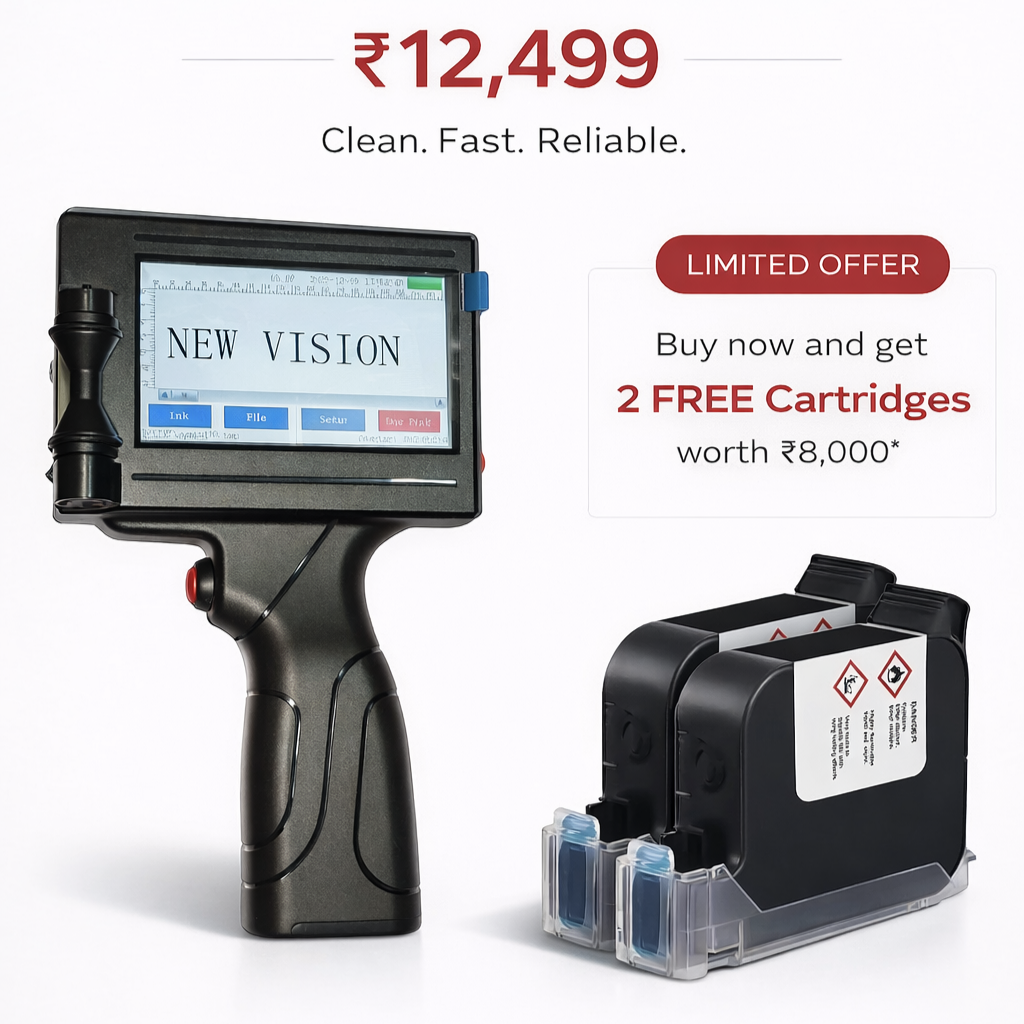
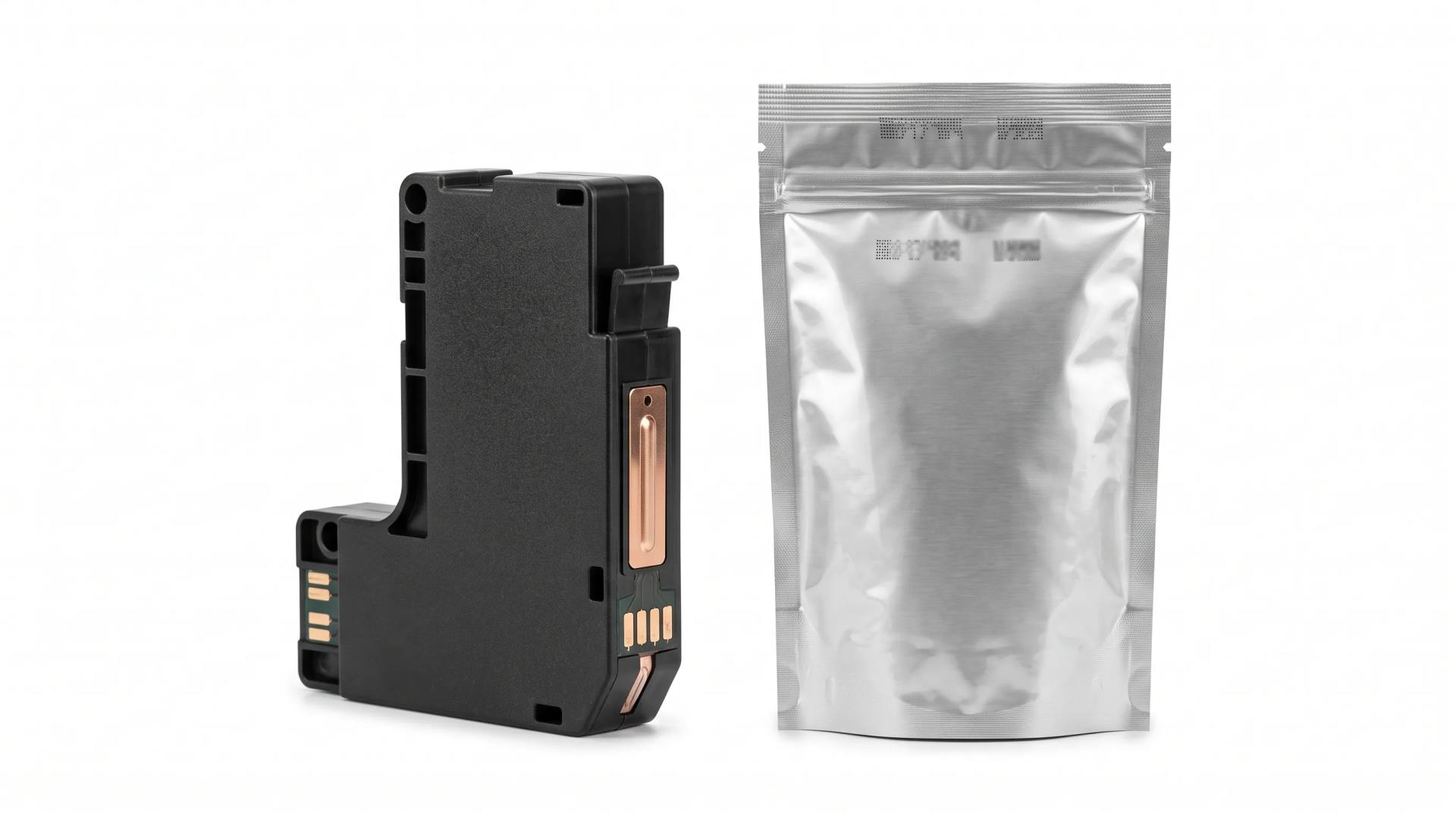
Fit mandatory unit sale price printing on pouches india using a 12.7mm TIJ printer by mapping batch details into a side-by-side, two-column layout at 300 DPI to keep statutory characters legible inside the 12.7-millimetre print window.
- Mandated since 1 April 2022 under the Legal Metrology (Packaged Commodities) Amendment Rules, Unit Sale Price (USP) must be declared in rupees per g, kg, ml, litre, or unit, rounded to two decimals.
- A 12.7 mm TIJ printhead gives a 12.7 mm vertical window — split the message into two columns to fit batch, dates, MRP and USP without crushing characters.
- Department of Consumer Affairs SOP dated 6 June 2026 mandates dual volume and weight declarations across 9 edible-oil pack sizes, enforced from 6 September 2026.
- Rule 7 mandates that character width must equal at least one-third of character height (excluding numeral 1 and letters i, I, and l).
What Does the Legal Metrology USP Format Require Across Pack Sizes?
Legal Metrology rules require the Unit Sale Price (USP) in Indian Rupees rounded to two decimal places per gram or millilitre for packs under 1 kg or 1 litre, and per kilogram or litre above those thresholds.
The rule became law on 1 April 2022 under the Legal Metrology (Packaged Commodities) Amendment Rules, GSR 779(E) dated 2 November 2021. Every pre-packaged commodity packed or imported into India must display the USP alongside the Maximum Retail Price (MRP). Unit sale price helps meet the transparency requirement the Department of Consumer Affairs enforces on packaged-goods labelling.
You skip it only when retail price equals unit price — a single hardware item sold by number, or an exact 1 kg pack where the total price is already the per-kilo rate. For everything else, packagers use an inline coder or a 12.7mm handheld TIJ printer to stamp both values onto the film. Dialling in a compliant legal metrology unit sale price format TIJ printer setup keeps inspectors from flagging overlapping or truncated text on your lines.
Swipe or scroll horizontally to view all columns
| Net pack size | Pack classification | Mandated USP unit |
|---|---|---|
| Below 1 kg / 1 litre | Small pack | Per gram (Rs/g) or per millilitre (Rs/ml) |
| Above 1 kg / 1 litre | Standard pack | Per kilogram (Rs/kg) or per litre (Rs/l) |
| Sold by number | Count pack | Per piece / per unit (Rs/unit) |
Under the Legal Metrology (Packaged Commodities) Amendment Rules (GSR 779(E), 2 November 2021), every pre-packaged commodity packed on or after 1 April 2022 in India must display the unit sale price unless the retail sale price equals the unit sale price (Source: Ministry of Consumer Affairs, Food and Public Distribution, Government of India).
Plant crews running an MRP and per gram price coding machine on continuous band sealers or vertical form-fill-seal (VFFS) collars cannot afford messy ink bleed. Clear, correctly-proportioned characters keep lines moving and inspections uneventful.
How to Configure Unit Sale Price Printing on Pouches India Within a 12.7mm TIJ Print Window?
Fitting batch, dates, MRP and USP into a 12.7 mm TIJ window works best as two parallel columns — stacking five full lines vertically leaves too little room for statutory character heights.
A standard 12.7 mm TIJ cartridge fires from a fixed micro-nozzle array about 12.7 mm tall at up to 300 DPI. A pouch line typically needs five production fields:
- Batch Number
- Manufacturing Date (MFD)
- Expiry Date (EXP)
- Maximum Retail Price (MRP)
- Unit Sale Price (USP)
Stack all five vertically and each line shrinks below comfortable legibility. Legal Metrology Rule 7 requires numeral and letter heights to follow Table I, and character width must be at least one-third of the height (exempting numeral "1" and letters i, I, and l). Crushing five lines flat breaks those proportions. The practical fix is a two-column message block:
+---------------------------------------------------------+
|                  12.7 mm PRINT WINDOW                   |
|  COLUMN 1 (Left)              COLUMN 2 (Right)          |
|  BATCH                        MRP                       |
|  MFD                          USP                       |
|  EXP                          (incl. of all taxes)      |
+---------------------------------------------------------+
Before buying larger equipment, read our 12.7mm vs 25.4mm TIJ guide to verify print clearances. Splitting unit sale price printing on pouches india into two horizontal blocks saves money: it avoids an expensive 12.7mm vs 25.4mm TIJ for 4 line batch code upgrade, keeps letter proportions within the statutory limits, and prints cleanly at normal line speeds.
How Should Operators Configure Controllers for Dynamic USP and Dual Declarations?
Configure Batch, MFD, and EXP as automated dynamic fields, while MRP and the calculated USP string stay locked in as protected message templates per SKU.
Basic TIJ controllers do not run internal division formulas. Setting up a dynamic USP calculation batch coding machine on standalone equipment means pre-loading a message preset for every net pack weight. Plants running variable-weight pouches can wire the controller to a checkweigher through an RS-232 serial link so the scale transmits computed USP strings in real time — confirm the arithmetic capability against your controller's firmware before relying on it.
Compliance benchmarks shifted under legal metrology packaged commodities rules 2026 coding. On 6 June 2026, the Department of Consumer Affairs amended its Standard Operating Procedure (PIB Delhi) to standardise 9 pack sizes for edible oils: 200 ml/g, 500 ml/g, 1 litre/kg, 2, 3, 4, 5, 15, and 20 litre/kg. The rule mandates dual declaration — whenever quantity is printed in volume, the net weight equivalent must sit right beside it in the exact same font size. After a three-month phase-in, full enforcement took effect on 6 September 2026 for domestic refiners and importers.
Match these adjustments with current FSSAI batch coding requirements. FSSAI's Food Safety and Standards (Labelling and Display) First Amendment Regulations, 2026 were notified on 24 March 2026 (F. No. STD/SP-08/A1.2022/N-01) and take effect on 1 July 2027. Keep enough controller memory free to hold the dual declaration fields without rebuilding message files mid-shift.
The Department of Consumer Affairs' amended Standard Operating Procedure notified on 6 June 2026 mandates 9 standardised net quantity sizes for domestic and imported edible oils with identical font sizes for volume and weight declarations (Source: Press Information Bureau Delhi, Government of India).
What Is the Ink Cost Impact of Adding a USP Line?
Every extra character on a TIJ message burns additional ink droplets, so adding a USP line raises per-pouch ink consumption. The increase scales with message length and print resolution.
Flexible laminates like PET/poly, metalized foils, and LDPE need fast-drying solvent-based inks — typically ethanol or MEK formulations — to set quickly and resist smudging on the line. A longer statutory message simply fires more nozzles per pouch, shortening the number of impressions each cartridge delivers.
Keep overheads down while running unit sale price printing on pouches india with these practices:
- Lower horizontal DPI where the controller allows it: dropping resolution on the travel axis keeps text readable at normal conveyor speeds while firing fewer droplets per character.
- Stick to stroke fonts: solid block-letter fonts consume noticeably more ink than simple outline or stroke typefaces, which still print clearly on pouch films.
- Cap the head during line stops: solvent inks flash off quickly in warm packing halls. A capped cartridge survives tea breaks and shift changes without nozzle crusting and recovery purges.
Field Troubleshooting for TIJ Pouch Coding
Fixing illegible pouch codes comes down to four physical factors: nozzle health, pouch flatness, throw distance, and print speed.
1. Ink Bleeding and Character Bridging Across Lines
Root Cause: Printhead sits too far from the pouch surface, or the controller is pushing too much ink volume onto slick film.
Plant-Floor Fix: Bring cartridge clearance close to the film — TIJ throw distance is only a couple of millimetres. Reduce controller ink density a step at a time until droplets stop bleeding on polyester and BOPP.
2. Clipped Bottom Line on 4-Line or 5-Line Messages
Root Cause: The text block height exceeds the 12.7 mm nozzle array.
Plant-Floor Fix: Stop stacking five lines vertically. Rebuild the file as a combined-entry message or split it into two columns, and reduce line spacing in the controller settings.
3. Faded Text or Missing Horizontal Strokes After Breaks
Root Cause: Carrier solvent evaporated inside the nozzle orifice plate while the line was idle.
Plant-Floor Fix: Fire an automatic purge cycle from the control panel. Wipe the nozzle plate firmly downward using a lint-free wipe soaked in industrial isopropyl alcohol.
4. Code Misalignment and Stretched Text Along the Pouch Edge
Root Cause: Pouches flutter past the sensor, or conveyor velocity slips out of sync with print firing.
Plant-Floor Fix: Fit a stainless-steel guide arm or leaf spring above the conveyor to hold pouches flat at the trigger eye. A rotary encoder on the drive shaft syncs print firing with line speed.
Operating Limits and Production Assumptions
Batch coding reliability changes with factory temperatures, mechanical tolerances, and packaging material chemistry.
Throw Distance Limits: TIJ cartridges do not blast ink across wide gaps like CIJ systems. Keep the nozzle within a couple of millimetres of the pouch — wider gaps cause ink misting, rough letter edges, and unreadable decimal points.
Substrate Surface Tension: Untreated LDPE films have low surface energy, and water-based inks smudge on them. Use quick-drying solvent formulations suited to low-dyne plastics.
Gusseted Pouch Irregularities: Pouches with thick bottom gussets or heavy fin seals do not rest flat. If the printhead crosses an uneven seal seam, the sudden distance change blurs the USP string. Aim the print target at the flat panel of the pouch.
Lock the USP string as a protected preset per SKU and loupe-check the first three pouches of every run — most failed Legal Metrology inspections trace back to a retyped rate, not the printer.
When is a unit sale price declaration exempt under Legal Metrology rules?
Unit sale price declarations are exempt when the total retail price equals the unit sale price. This covers single items sold by loose count and standard 1 kg or 1 litre packs where the retail price already matches the unit rate exactly. For every other pre-packaged commodity, both MRP and USP must appear on the pack.
Can a 12.7mm TIJ printer handle dual volume and weight declarations for edible oils?
Yes. A 12.7 mm TIJ printer handles dual declarations with a side-by-side or two-row layout that prints weight and volume in identical font heights and weights. That layout helps meet the dual-declaration requirement the Department of Consumer Affairs enforces on edible oils from 6 September 2026, without moving to a wider printhead.
How does Legal Metrology Rule 7 affect font selection on TIJ controllers?
Rule 7 requires character width to equal at least one-third of character height, except for numeral "1" and letters i, I, and l. Vertically compressed message blocks break that ratio, so choose proportional stroke fonts, keep enough line height, and consolidate message rows into columns rather than squeezing five lines into the 12.7 mm window.
Is an upgrade to a 25.4mm printhead necessary for 5-line batch codes?
No. Splitting the message block into two columns inside the standard 12.7 mm window fits batch, dates, MRP and USP while keeping statutory character proportions. A 25.4 mm head only becomes necessary for tall brand logos or oversized primary display text that cannot fit the smaller window.
How does ink dry time differ on plastic and laminated pouches?
Solvent inks set in seconds on laminated PET, aluminium barrier pouches, and BOPP films through fast solvent evaporation. Plain LDPE takes longer depending on slip additives, film coatings, and packing-hall humidity. Always trial the actual pouch film before fixing line speed, since additives change dry behaviour.
New Vision Machines builds field-proven packaging and batch coding machinery engineered for demanding factory floors. Bring your production pouches to our plant for live print trials, or get in touch for current ex-works pricing on 12.7 mm coding heads. Visit our facility at Lasudia Mori, Indore, MP 452010, or call our engineering desk directly at +91-9981604279.