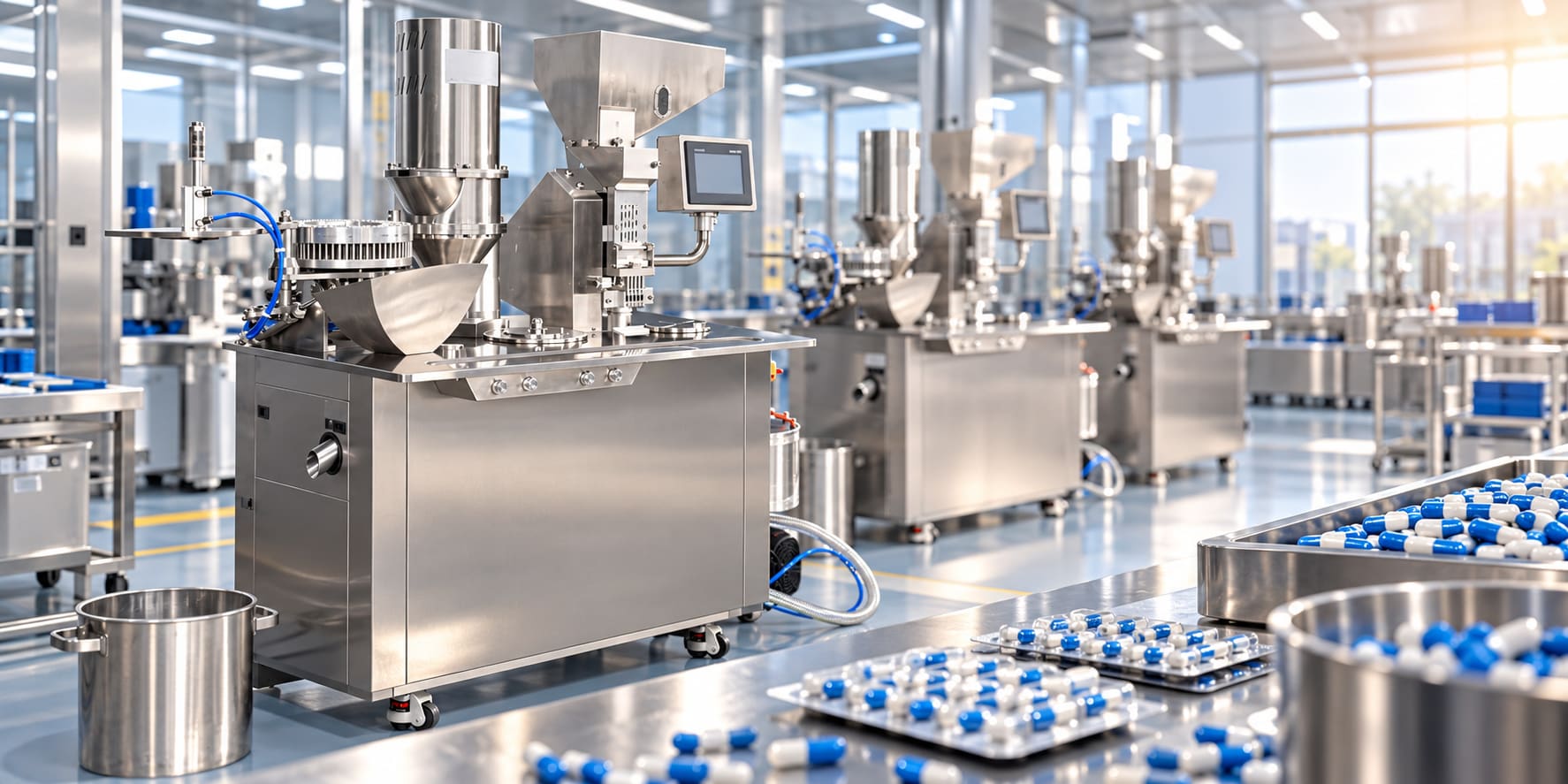
A semi automatic capsule filling machine in India costs roughly ₹45,000 to ₹8,50,000, depending on whether it is a basic 50-hole machine or a PLC-controlled system.
That range is wide for a reason. "Semi-automatic" covers machines at very different levels of automation and control. A ₹45,000 basic 50-hole machine is not the same purchase proposition as a ₹8,50,000 PLC-controlled machine.
For a purchase manager, the useful question is not simply the capsule filling machine price in india. Start with daily production. Then look at labour, operating hours, required control and the amount of automation the plant actually needs.
Capsule filling machine price in India: the 2026 landscape
Capsule filling equipment in India ranges from ₹35,000 manual plates to ₹6,95,000+ fully automatic lines, with semi-automatic machines occupying the middle ground.
Swipe or scroll horizontally to view all columns
| Type | Output | Labour | Indicative price (INR) | Best for |
|---|---|---|---|---|
| Manual capsule plate | ~1,500–3,000 capsules/day | 2 operators | ₹35,000–₹65,000 | Small-volume production |
| Semi-automatic, basic | Up to ~3,000 capsules/hour | Operator-assisted | ~₹45,000 | Entry-level semi-automatic production |
| Semi-automatic, PLC-controlled | Up to ~3,000 capsules/hour | Operator-assisted | ₹7,50,000–₹8,50,000 | Higher-control production |
| New Vision semi-automatic | Up to ~3,000 capsules/hour | Operator-assisted | ₹5,00,000 ex-works | Indian pharma/nutraceutical units |
| Fully automatic line | ~30,000–70,000 capsules/hour | Lower operator dependence | ₹6,95,000+ | High-volume production |
Manual capsule filling machine price in India
A manual capsule plate costs ₹35,000–₹65,000 and is suited to production below about 5,000 capsules per day.
The economics are straightforward. A manual plate can produce approximately 1,500–3,000 capsules per day with two operators. For a small unit with limited daily demand, the low initial investment can outweigh the extra labour involved.
The limitation is production time. Once the requirement moves well beyond this range, the operator-hours required to keep up with demand become a bigger part of the calculation.
Semi-automatic capsule filling machine price in India
A semi-automatic machine ranges from about ₹45,000 for a basic 50-hole machine to ₹7,50,000–₹8,50,000 for PLC-controlled equipment.
This is where price comparisons often become misleading. Two machines can both be called semi-automatic while offering very different levels of control and automation.
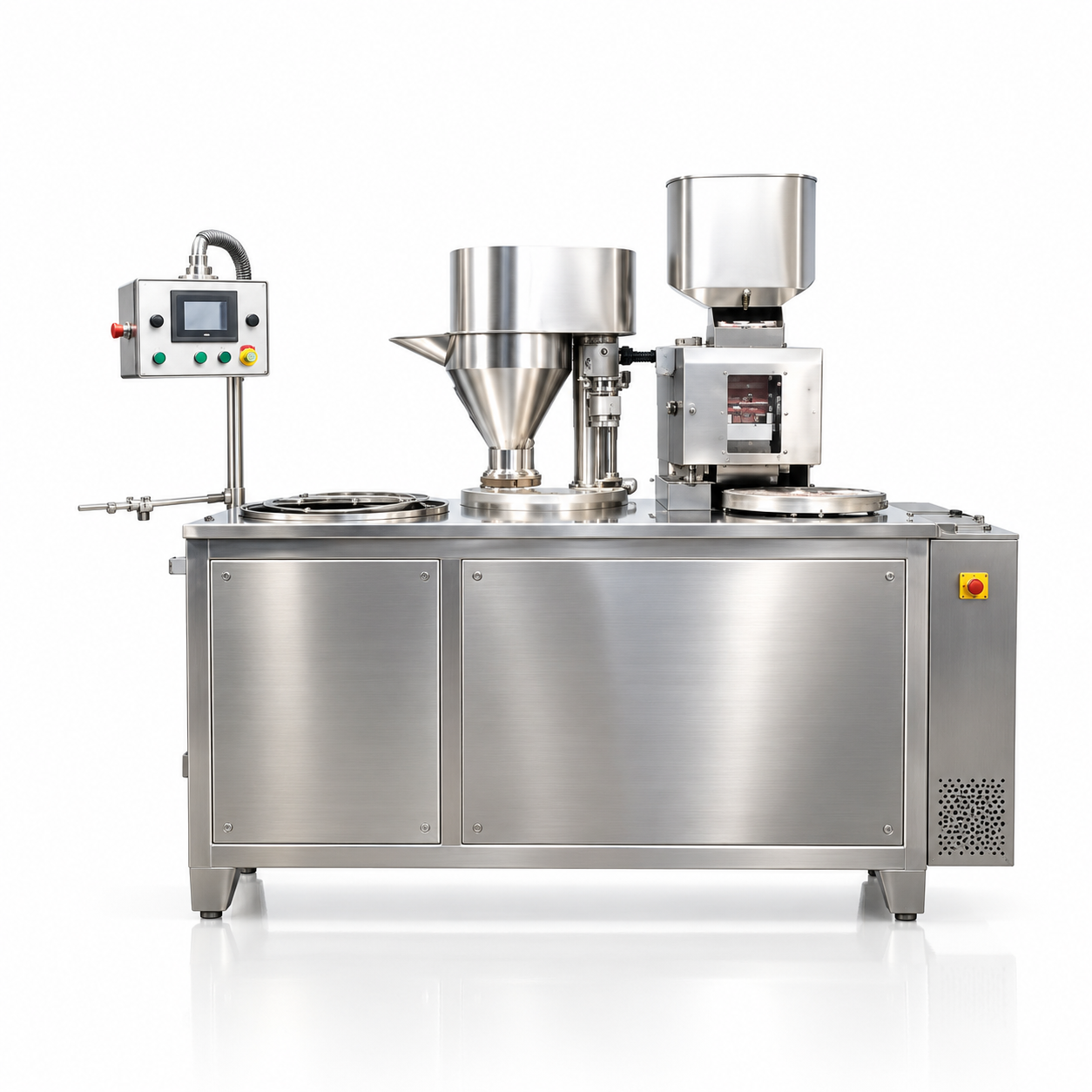
New Vision Machines' Semi Automatic Capsule Filling Machine is priced at ₹5,00,000 ex-works. It is intended for Indian pharmaceutical and nutraceutical units that need more production capability than a basic plate, but do not necessarily want to move straight to the ₹7.5 lakh-plus range of PLC-controlled semi-automatic equipment.
The stated capacity is up to approximately 3,000 capsules per hour.
Automatic capsule filling machine price in India
Fully automatic capsule filling lines start at ₹6,95,000+ and can deliver approximately 30,000–70,000 capsules per hour.
At this level, the purchase decision is driven primarily by production volume. A plant requiring tens of thousands of capsules per shift needs to examine throughput and operator dependence rather than simply choosing the lowest purchase price.
For production above 50,000 capsules per day, automatic equipment is the category worth evaluating.
How to choose between manual, semi-automatic and automatic
For production below 5,000 capsules per day, manual equipment is generally suitable; 5,000–50,000 capsules per day points toward semi-automatic equipment; above 50,000 capsules per day points toward automatic production.
The starting point is the daily requirement:
Below 5,000 capsules/day: manual plate
5,000–50,000 capsules/day: semi-automatic
Above 50,000 capsules/day: automatic
Then check the available production hours. A plant running one eight-hour shift has a different requirement from one running multiple shifts.
There is also a practical question about operator involvement. Manual filling requires two operators at the stated production level. Semi-automatic equipment reduces the amount of manual handling while keeping the capital requirement below the higher-volume automatic category.
Plant math: calculate the real daily output
Daily output is calculated as capsules/hour × operating hours × 0.75 OEE.
For example:
2,500 capsules/hour × 8 hours × 0.75 = 15,000 capsules/day
The 0.75 OEE factor prevents the calculation from assuming that the machine will deliver its rated hourly output continuously for the entire shift.
That distinction matters when comparing machines. A machine rated at 3,000 capsules per hour does not mean the plant will automatically produce 24,000 capsules during an eight-hour shift. Loading, adjustments, cleaning and normal production interruptions affect the usable output.
Capsule sizes that matter in Indian production
Capsule sizes 00, 0 and 1 cover most common SKUs in India, while size 000 is relatively rare.
That makes capsule size an important point to settle before purchasing. If the plant handles several SKUs, confirm the required sizes and the corresponding machine configuration before placing the order.
There is little value in buying capacity or tooling that will sit unused. The machine should match the capsules the plant actually fills.
Four field defects and practical fixes
Capsule separation failure
Capsule separation failure is usually addressed by checking capsule seating, the separation mechanism and the operating condition used to separate cap and body.
Start at the capsule position. The capsule needs to be seated correctly before separation. If positioning is correct, check the separation mechanism and its operating condition. Incorrect presentation or inconsistent separation can interrupt the next filling step.
Powder bridging in the hopper
Powder bridging in the hopper is addressed by checking powder flow, hopper loading and material accumulation around the powder-contact surfaces.
The machine cannot maintain consistent filling if the powder does not reach the filling mechanism consistently. Check whether material is accumulating inside the hopper and whether the powder feed is becoming intermittent. The powder's flow behaviour matters as much as the machine setting.
Weight variation
Weight variation is addressed by checking powder flow, filling settings and the consistency of powder reaching the filling mechanism.
Do not immediately assume that increasing or reducing machine speed will solve the problem. If powder reaches the filling mechanism inconsistently, capsule weights can vary even when the machine settings have not changed.
Check the powder feed first, then verify the filling settings and the consistency of the material entering the filling cycle.
Cap-body mismatch
Cap-body mismatch is addressed by checking capsule orientation, seating and alignment through the capsule handling mechanism.
A capsule that is not correctly oriented or seated can fail during closing. Check the capsule path from positioning through closing before making unnecessary changes to production settings.
Final buying view
The lowest purchase price is not automatically the lowest production cost.
A unit producing fewer than 5,000 capsules per day may have little reason to move beyond a manual plate. Between 5,000 and 50,000 capsules per day, semi-automatic equipment deserves a closer calculation of output, labour and operating hours. Above 50,000 capsules per day, automatic production becomes the logical category to evaluate.
For Indian pharma and nutraceutical units looking for the middle ground, New Vision Machines, Indore offers its Semi Automatic Capsule Filling Machine at ₹5,00,000 ex-works.
New Vision Machines Lasudia Mori, Indore, MP 452010 +91-9981604279
For automatic tablet and capsule counting and filling equipment, see: https://www.newvisionmachines.com/shop/automatic-tablet-capsule-counting-and-filling-machine