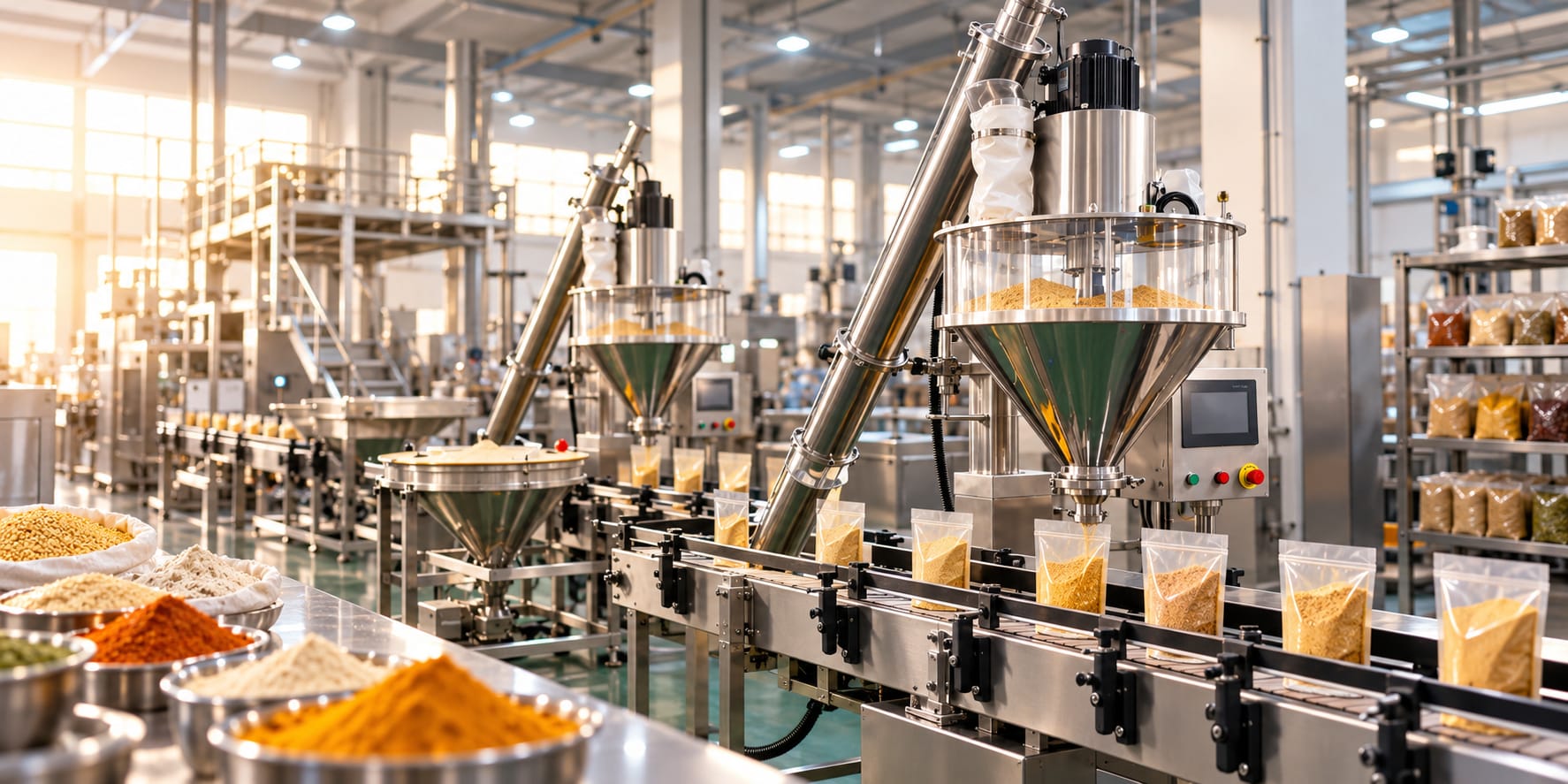
A semi-automatic powder filling machine in India typically costs ₹55,350–₹62,000 for a 10–1000 g machine, while FFS and auger systems can move to ₹2 lakh and ₹3.6 lakh respectively.
What does a semi-automatic powder filling machine cost in India?
A semi-automatic powder filler costs about ₹55,350–₹62,000 for a 10–1000 g range, depending on configuration, while higher-cost FFS and auger systems serve different production requirements.
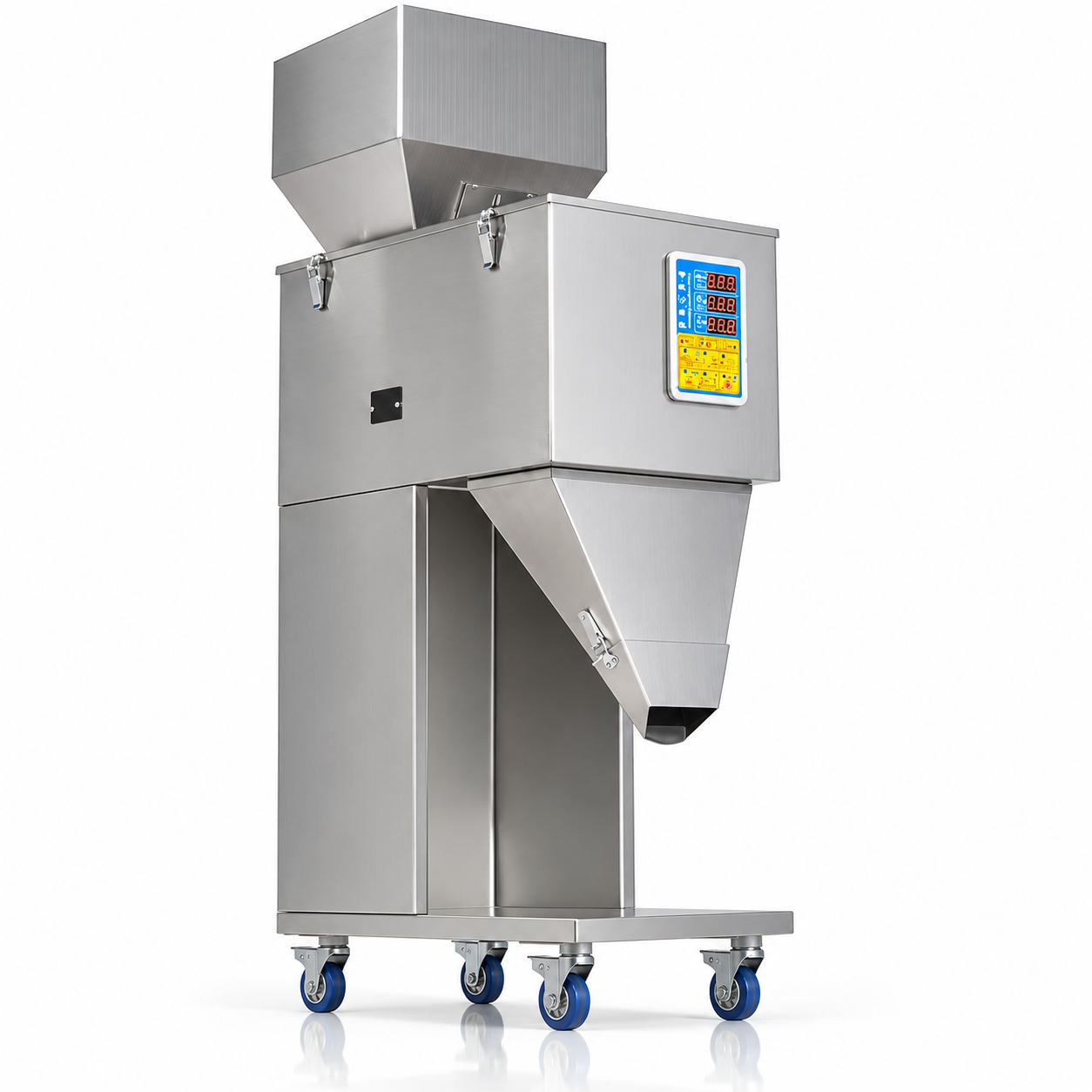
For a 1000 g powder filler, a practical market reference is around ₹62,000. New Vision Machines lists its semi-automatic 1000 g powder filling machine at ₹55,350, with a 10–1000 g range, 6–12 fills/min and stated accuracy of ±3 g.
Semi-auto 1000 g powder filling machine
The important point is that price should be compared against the material, required accuracy, pouch format and production rate. A cheaper machine can be the wrong machine if the powder bridges, the granules damage the dosing system, or the output is too low for the plant requirement.
Auger vs weigh-filler vs FFS
Auger fillers suit fine cohesive powders, weigh or cup fillers suit free-flowing granules, and FFS machines suit higher-speed pouch forming and filling.
Swipe or scroll horizontally to view all columns
| Filler type | Best material | Accuracy | Indicative price (INR) | Best for |
|---|---|---|---|---|
| Semi-auto powder filler | Powders | ±3 g at stated configuration | ₹55,350–₹62,000 | Small and medium powder production |
| Auger filler | Fine cohesive powders | ±1–3 g at 500 g | ~₹3,60,000 | Spices, pharma powder, protein |
| Semi-auto weigh/cup filler | Rice, pulses, seeds | ±1–2% | ₹45,000–₹72,000 | Free-flowing granules |
| Telescopic semi-auto filler | Granular products | Configuration dependent | ₹3,83,500 incl. GST | Larger semi-automatic applications |
| FFS | Powder or suitable granular products | Configuration dependent | ~₹2,00,000 | Pouch forming with higher output |
| Automatic cup filler | Free-flowing granules | Configuration dependent | ₹5,50,000 | Automatic granule filling |
The price gap is substantial because these machines solve different production problems.
When should you choose an auger filler?
An auger filler is the better choice for fine, cohesive powders such as spices, pharmaceutical powders and protein products, with indicative pricing around ₹3,60,000 for a 100–1000 g configuration in Indore.
Auger dosing controls product volume through a rotating screw. This makes it suitable when the material does not flow consistently under gravity.
At 500 g, an auger system may work around ±1–3 g depending on the material and setup. That range matters when product giveaway directly affects margin.
The keyword buyers commonly search is auger filling machine price in India, but the useful question is whether the powder actually requires auger dosing.
When should you choose a weigh or cup filler?
A weigh or cup filler is the practical choice for free-flowing granules such as rice, pulses and seeds, with semi-automatic single-head machines commonly around ₹45,000–₹72,000.
The dosing principle is different from an auger. The machine measures a defined quantity of free-flowing material rather than forcing cohesive powder through a screw.
New Vision Machines lists a semi-automatic 500 g granule filler at ₹30,750, with filling up to 500 g, stated accuracy of ±1–2% and 10–20 fills/min.
Semi-automatic 500 g granule filler
For buyers comparing granule filling machine price in India, material behaviour should come before machine price.
When does FFS make financial sense?
FFS becomes relevant when the requirement is approximately ₹2,00,000 for a 1000 g system and the plant needs pouch forming and filling in one process.
Form-Fill-Seal equipment combines pouch formation, filling and sealing rather than relying on a separate premade pouch operation.
That makes it fundamentally different from a basic semi-automatic filler. The additional investment only makes sense when the production workflow benefits from integrated pouch handling and higher output.
Powder filling machine 1000 gram price in India
A 1000 g powder filling machine is available around ₹55,350–₹62,000 in the semi-automatic category, while an auger configuration can be around ₹3,60,000.
The lower-priced semi-automatic machines make sense for factories where an operator can handle pouch positioning and the required production rate remains moderate.
New Vision Machines' 10–1000 g semi-automatic powder filler is listed at ₹55,350, with 6–12 fills/min and ±3 g stated accuracy.
The purchase decision should therefore separate capacity range from dosing technology. A machine capable of filling 1000 g does not automatically mean it is the right choice for every powder.
Granule filling machine price in India
A semi-automatic single-head granule filler is around ₹45,000–₹72,000, while higher-capacity telescopic and automatic systems can reach ₹3,83,500 and ₹5,50,000 respectively.
The difference comes from automation level and handling requirements.
For buyers working with rice, pulses or seeds, a basic semi-automatic weigh or cup filler can be enough when an operator is already available for pouch handling.
New Vision Machines also provides a 1000 g granule filling option for buyers whose pack size goes beyond the 500 g range.
1000 g granule filling machine
Plant math: 1 tonne/day in 500 g pouches
Producing 1 tonne/day in 500 g pouches requires 2,000 pouches, and at 12 fills/min the filling time is approximately 2.8 hours.
Formula:
Number of pouches = Daily production ÷ Pouch weight
= 1,000 kg ÷ 0.5 kg
= 2,000 pouches
At 12 fills/min:
2,000 ÷ 12 = 166.7 minutes
166.7 ÷ 60 ≈ 2.8 hours
This is the theoretical filling time. It does not mean the complete plant will finish in 2.8 hours because loading, pouch handling, weighing checks, material replenishment, sealing and stoppages consume additional time.
Why accuracy affects machine economics
A 2 g overfill on each 500 g pouch creates 4 kg of product giveaway when 2,000 pouches are produced.
Formula:
Overfill per pouch × Number of pouches
= 2 g × 2,000
= 4,000 g
= 4 kg/day
At that scale, dosing accuracy is not a cosmetic specification. It directly affects material consumption.
Four field defects and practical fixes
Powder bridging in the hopper
Powder bridging occurs when cohesive material forms a stable mass above the dosing point instead of feeding consistently.
Fix: Check the powder's flow behaviour and ensure the hopper and dosing arrangement are suitable for the material. Fine cohesive powders generally require auger-based dosing rather than a simple gravity-fed arrangement.
Underweight or overweight pouches
Weight variation usually comes from inconsistent product flow, incorrect machine adjustment or unsuitable dosing technology for the material.
Fix: First check whether the product is free-flowing or cohesive. For powders, verify auger settings and product feed consistency. For granules, check the weighing or cup arrangement and recalibrate before increasing speed.
Granules getting damaged during filling
Granule damage can occur when the product is handled through an unsuitable dosing mechanism or excessive mechanical action.
Fix: Use a weigh or cup-based system for free-flowing granules such as rice, pulses and seeds where appropriate. Check the product path before selecting the machine rather than choosing solely by pack size.
Output below the planned rate
A machine rated for a certain number of fills per minute can still deliver lower practical output because of manual pouch handling, product feeding and stoppages.
Fix: Calculate production from actual fills/min and pouch weight. For 500 g packs, 12 fills/min gives a theoretical 720 pouches/hour before handling losses and downtime.
How to choose between the three technologies
For fine cohesive powders, choose an auger filler because controlled screw dosing is better suited to materials such as spices, pharmaceutical powders and protein.
For free-flowing granules, choose a weigh or cup filler because products such as rice, pulses and seeds generally suit gravity-based dosing.
For integrated pouch forming and higher-speed production, consider FFS because the machine combines pouch formation, filling and sealing.
The machine should follow the material. Pack size alone is not enough to select the dosing technology.
Final buying view
For a small or growing Indian plant, a semi-automatic powder filler around ₹55,350–₹62,000 can be the sensible starting point when manual pouch handling is acceptable.
For free-flowing granules, the economics can be lower with a semi-automatic weigh or cup filler. For cohesive powders where dosing consistency matters more, an auger system is the appropriate technology even when its purchase price is substantially higher.
The correct purchase decision is therefore not the lowest semi automatic powder filling machine price. It is the lowest machine cost that can reliably handle the product, target weight, required accuracy and daily production.
For machine selection and pricing, contact New Vision Machines, Lasudia Mori, Indore, Madhya Pradesh 452010, at +91-9981604279.