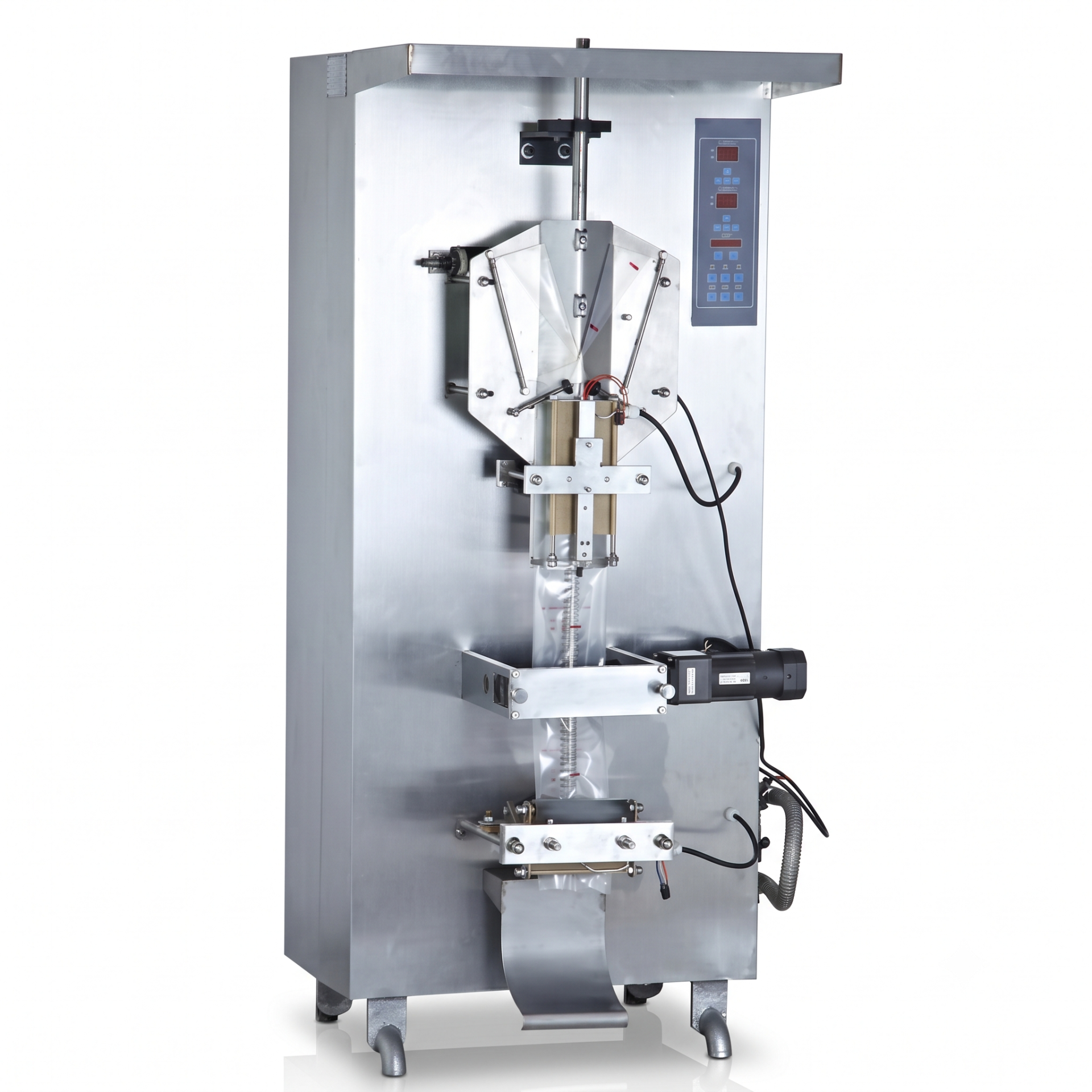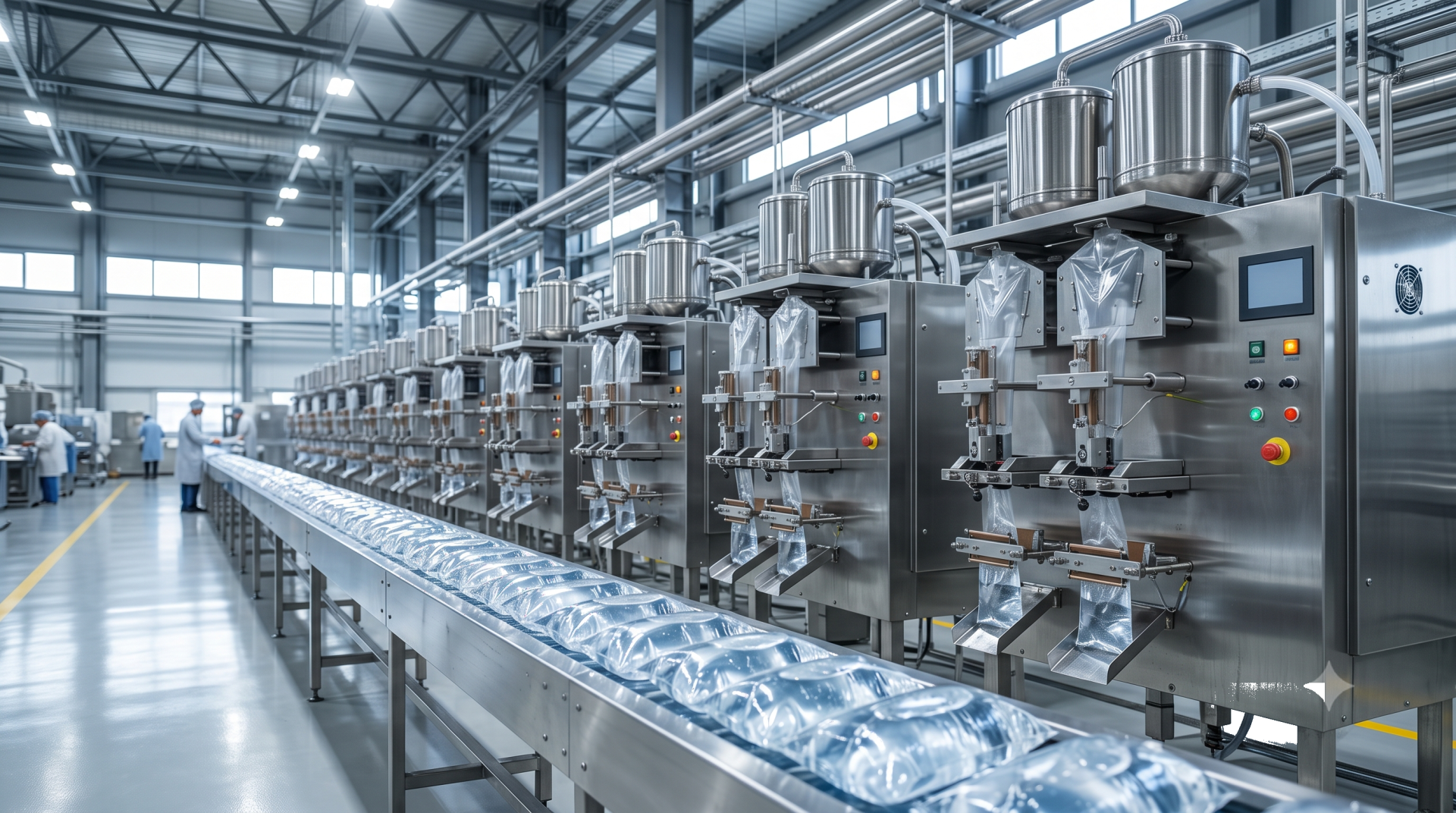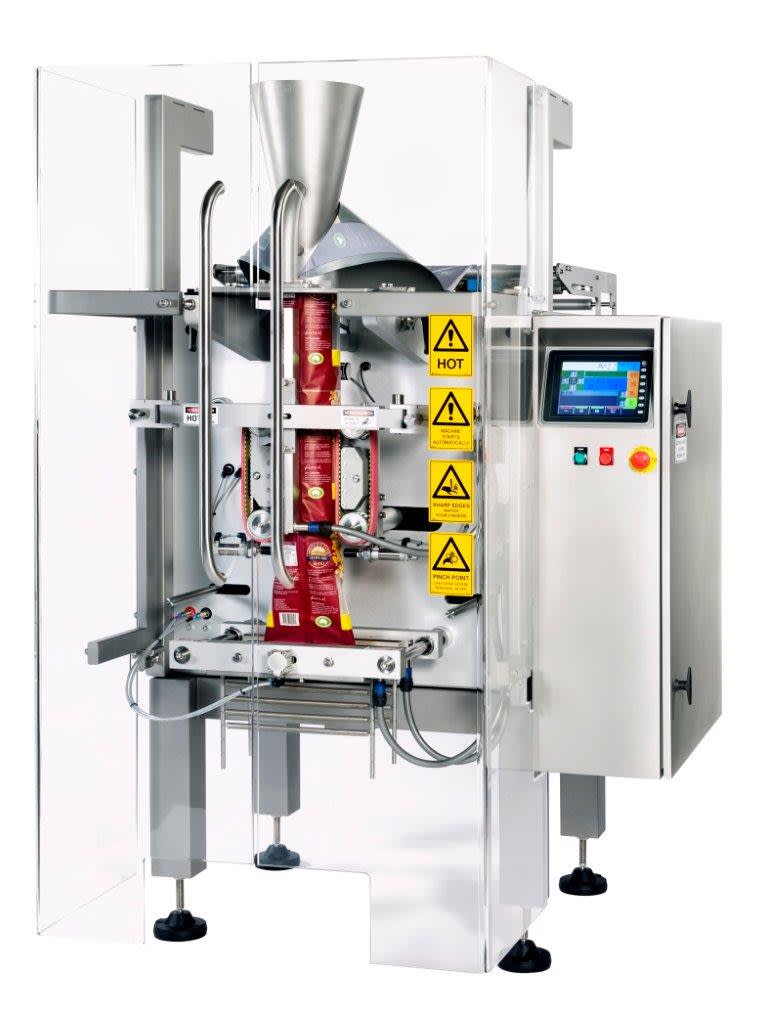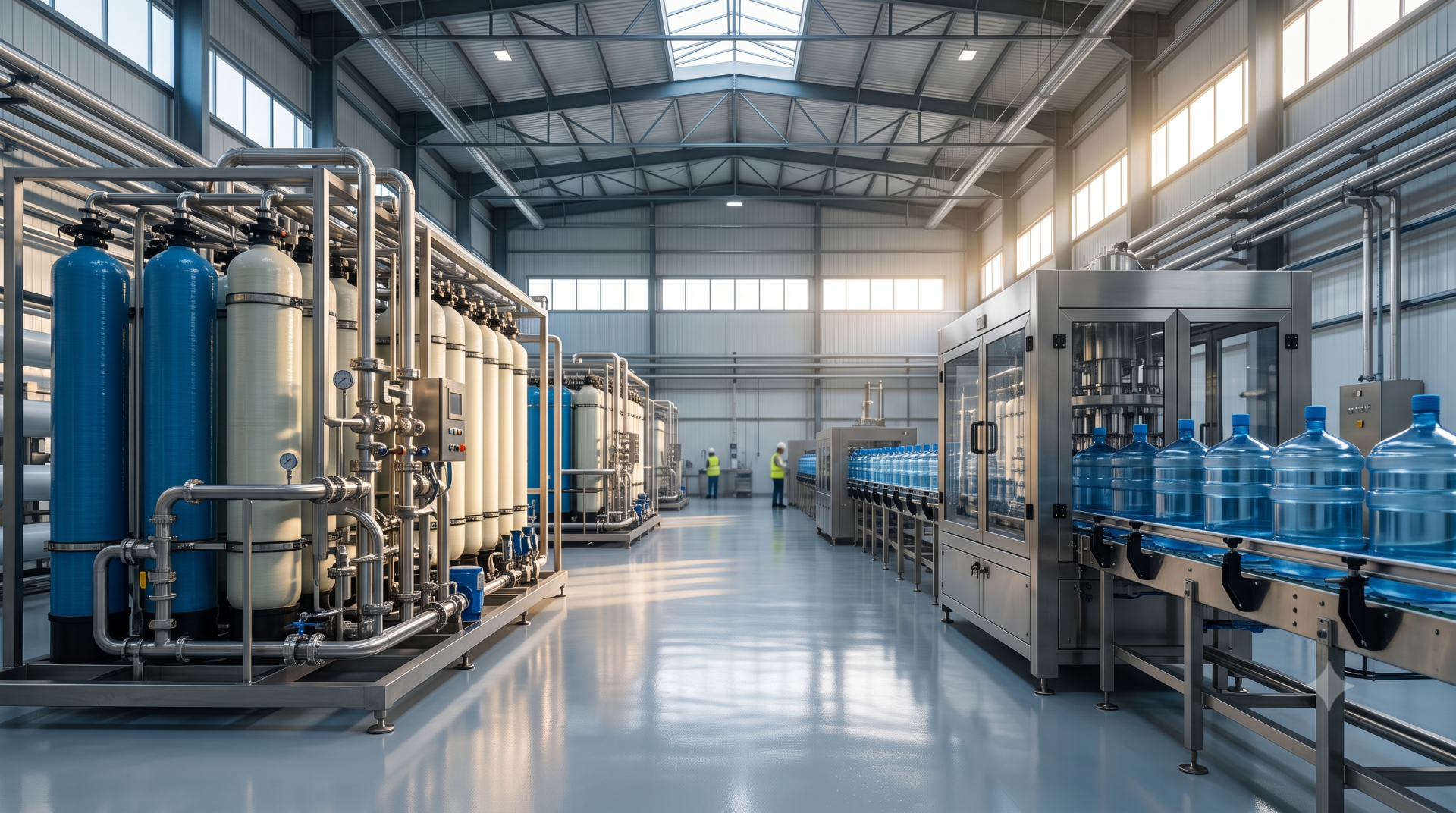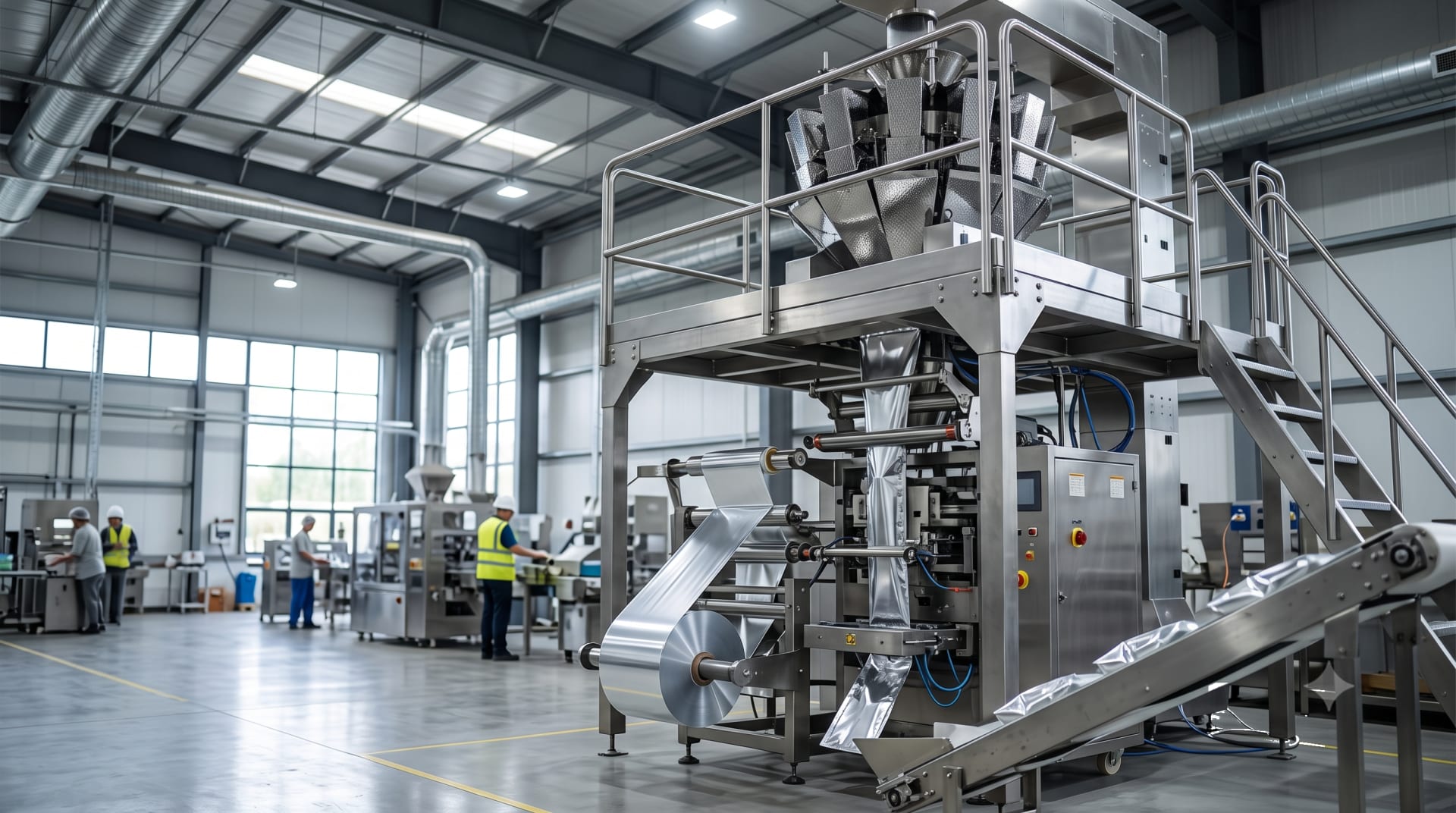
A vertical form-fill-seal machine forms, fills, and hermetically seals flexible pouches from rollstock. In India, the baseline vffs packaging machine price in India ranges from Rs 1.2 lakh to Rs 2.8 lakh for 500–3000 pouches/hour.
Key Takeaways
- Capital Cost Bands: Entry-level 500 PPH machines start near Rs 1.2 lakh, standard 1000 PPH units average Rs 1.7–1.8 lakh, and high-speed specialty lines run Rs 2.5–2.8 lakh.
- Reference Benchmark: A shop-proven automatic water pouch packing machine at Rs 1,70,000 packs 1000 pouches/hour across 100–200 ml volumes without an air compressor.
- Inline Mechanical Cycle: Rollstock feeds over a forming tube for vertical seam welding, volumetric dosing, horizontal sealing, and cutting in one synchronized flow.
- Floor Output Math: Daily output follows Daily Output = PPH x Hours x 0.75 OEE, delivering roughly 6,000 salable pouches per 8-hour shift on a 1000 PPH machine.
- Utility Footprint: A 450 kg mechanical chassis runs on 1750 W single-phase 220V power, packaging water, pasteurized milk, buttermilk, ghee, or edible oils.
Last updated: 9 October 2026
What is a VFFS pouch packing machine and how does it work?
A vertical form-fill-seal (VFFS) machine is an automated packaging system that pulls rollstock film over a forming tube, welds the vertical seam, doses product volumetrically, and cuts finished pouches in a continuous vertical sequence.
[Film Roll Reel]
       │
       ▼
[Forming Tube & Collar] ───► Forms flat film into vertical cylinder
       │
       ▼
[Vertical Sealing Jaw]  ───► Welds lengthwise overlap / fin seal
       │
       ▼
[Volumetric Dosing Head]───► Fills liquid, paste, or dry product inline
       │
       ▼
[Horizontal Jaws & Cut] ───► Welds top/bottom seams and severs finished pouch
The cycle starts at the unwind reel. Tensioned rollers pull printed, laminated multilayer film over a curved collar. This collar wraps the flat web around a vertical mandrel, shaping it into a continuous tube. Heated vertical jaws then close along the seam, welding the film edges into a longitudinal seal.
Once the tube is formed, product drops through the core of the mandrel directly into the open pouch cavity below. Heated horizontal jaws clamp together to seal the top of the filled pack while forming the bottom seam for the next one in line. An integrated shear blade cuts between these two weld lines, dropping a finished pillow pouch onto the takeaway chute. Operating a continuous automatic pouch packing machine removes manual bagging labor from the floor, maintaining tight fill weights and leak-free seals across every shift.
How Much Does the VFFS Packaging Machine Price in India Vary by Capacity?
Commercial vffs packaging machine price in India bands run from Rs 1.2 lakh up to Rs 2.8 lakh, corresponding directly to production speeds between 500 and 3000 pouches per hour. Mechanical drive designs, temperature controllers, and structural steel thickness determine where a unit lands on that pricing curve.
Budgeting for packaging machinery requires matching capital expenditure to real production targets. Going under-capacity creates immediate dispatch bottlenecks, while buying excess capacity ties up working capital on equipment running half-empty. Indian manufacturers price units across three distinct production tiers:
Entry-Level (500 PPH Class | ~Rs 1.2 Lakh): Targeted at small local processing units. These machines run simple eccentric cams, mechanical levers, fixed volumetric gravity cups, and analog dial temperature controls. They are built for basic pillow pouches running single-layer or simple laminated films.
Standard Industrial (1000 PPH Class | ~Rs 1.7–1.8 Lakh): The everyday workhorse for regional dairies, water plants, and oil repackers. These units incorporate microcontroller logic boards, inline hot-foil batch coders, UV film sanitizing tunnels, and heavy-duty crank linkages that run purely on electric motor drives without pneumatic air supplies.
High-Speed / Specialty (2000–3000 PPH Class | ~Rs 2.5–2.8 Lakh): Built for continuous multi-shift factories. These systems feature heavy channel-iron frames, dual motor pull-down belts, high-precision PID temperature controllers, and heavy-duty jaw assemblies engineered to seal thick multi-layer barrier laminates without thermal drift.
Reviewing current form fill seal machine price listings gives your engineering team a realistic basis for calculating cost per pouch. Compare these builds with wider pouch packing machine prices in India by type to see how mechanical drives shape the final vffs packaging machine price in India.
VFFS vs premade pouch vs sachet machines: which one do you need?
Machine choice hinges on packaging format: inline VFFS units seal high-volume pillow pouches from low-cost rollstock (Rs 1.2–2.8 lakh), multi-lane sachet units package small-dose packets across parallel lanes, and premade pouch machines handle stand-up zipper pouches from magazines.
Pillow Pouches (VFFS): The most cost-effective package for high-turnover consumer goods like drinking water, liquid milk, buttermilk, and edible oils. The machine forms each pack directly from printed film rolls, minimizing consumable packaging costs. Dairies filling milk into poly pouches need sanitary piston assemblies or positive displacement pumps; check milk pouch packing machines for dairies to evaluate food-grade fluid path options.
Stand-Up Pouches (Premade Pouch Machines): Best suited for premium retail shelving where packages need bottom gussets, press-to-close zippers, or pouring spouts. These systems pull pre-fabricated bags from a magazine rack, suction them open, dose the product, and heat-seal the top edge. Machine investment is significantly higher, and pre-formed pouches cost far more per unit than flat rollstock film.
Sachets (Multi-Lane Sachet Machines): Built specifically for single-use portions — a few millilitres to a few dozen grams — including shampoo, tomato paste, cosmetic creams, and oral rehydration powders. Multi-lane units draw an extra-wide film web slit across 4 to 10 parallel tracks simultaneously. They sacrifice changeover speed to deliver massive unit volumes.
Swipe or scroll horizontally to view all columns
| Machine type | Pouch type | Capacity | Price band (INR) |
|---|---|---|---|
| Entry-Level Mechanical VFFS | Pillow pouch | ~500 pouches/hour | ~Rs 1.2 lakh |
| Standard Commercial VFFS | Pillow pouch | ~1000 pouches/hour | ~Rs 1.7–1.8 lakh |
| High-Speed / Specialty VFFS | Pillow pouch | 2000–3000 pouches/hour | ~Rs 2.5–2.8 lakh |
| Multi-Lane Sachet Machine | 3-side / 4-side sachet | Multi-track high-volume | Application-specific |
| Premade Pouch Machine | Stand-up / zipper pouch | Form-factor dependent | Application-specific |
New Vision Machines manufactures and supplies vertical form-fill-seal milk pouch packing machines, edible oil pouch packing machines, multi-lane sachet machines, and premade pouch machines engineered for Indian production plants.
Reference machine specifications: the 1000 PPH liquid packaging benchmark
The benchmark mechanical liquid pouch packing machine delivers 1000 pouches per hour across 100–200 ml fill sizes, draws 1750 W on single-phase 220V/50Hz power, and costs Rs 1,70,000 ex-works.
For liquid packaging lines bottling or bagging more than 5,000 units a day, this 1000 PPH configuration represents the quickest capital payback point. The unit runs on a microcontroller-driven mechanical cam-and-crank assembly that cuts out pneumatic cylinders completely. That means you never deal with compressor breakdowns, moisture in the air lines, or sudden pressure drops halfway through a shift.
Swipe or scroll horizontally to view all columns
| Specification | Value | |
|---|---|---|
| Throughput Capacity | 1,000 pouches / hour | |
| Packaging Volume Range | 100 ml to 200 ml | |
| Finished Bag Dimensions | 50–210 mm (Length) x 50–170 mm (Width) | |
| Connected Electrical | 1,750 Watts | 220V AC, 50 Hz Single-Phase |
| Machine Dimensions | 1050 mm (L) x 850 mm (W) x 1920 mm (H) | |
| Machine Net Weight | 450 kg | |
| Compressor Dependency | None (100% mechanical cam & crank drive) | |
| Inline Hygiene & Coding | Inline UV sterilization -> Date printer -> Cut | |
| Compatible Viscosities | Water, milk, buttermilk, ghee, edible oil |
Film passes directly under an enclosed UV germicidal tube to neutralize surface bioburden before the product touches it. Right after sterilization, a mechanical stamping coder imprints batch codes, manufacturing dates, and MRP details onto the film web. The material then moves through the forming shoulder, receives its volumetric charge, and gets sealed and cut in one mechanical stroke.
Plant production math: how to calculate realistic daily pouch output
Realistic daily factory yield is calculated using the formula Daily Output = PPH x Hours x 0.75 OEE, adjusting the machine's nameplate speed for reel changes, cleaning, and thermal stabilization.
Multiplying rated speed directly by shift hours (1000 × 8 = 8,000) is a common purchasing mistake. In daily floor operation, workers must swap empty film rolls, reload ribbon rolls, refill supply balance tanks, and allow the sealing jaw elements to stabilize after stoppages. Real production floors operate around an average 75% Overall Equipment Effectiveness factor (0.75).
Worked Production Example (1000 PPH Rated Line)
Daily Output = PPH × Operating Hours × 0.75
Single 8-Hour Shift:
Daily Output = 1000 × 8 × 0.75 = 6,000 finished pouches
Double Shift (16 Operating Hours):
Daily Output = 1000 × 16 × 0.75 = 12,000 finished pouches
Planning around 6,000 salable packs per shift gives your warehouse manager an accurate count for corrugated shipping cartons, daily rollstock film inventory, and dispatch labor. Calculating your operational yield against the initial vffs packaging machine price in India ensures clear payback timelines before machinery arrives on your factory floor.
Field troubleshooting guide: 4 concrete defects and operator fixes
Plant operators resolve pouch line defects by systematically isolating mechanical tension, temperature dwell, optical registration, and fluid valve seats across four failure points: leaky seals, film wander, misaligned codes, and volume drift.
1. Leaky Seals
Diagnosis: Hairline channels or micro-pinholes along vertical or cross seals cause liquid seepage under case stacking pressure.
Remediation: Check digital PID temperature readouts against your film converter's datasheet. Heavier barrier materials need longer dwell or higher temperatures. Peel back and examine the Teflon barrier tape over the nichrome heating jaws; carbonized or worn tape creates cold spots on the seam. Inspect the compression springs behind the horizontal jaws to ensure clamping pressure stays balanced across the entire width.
2. Film Tracking Wander
Diagnosis: The film web drifts sideways, creating uneven pouch side margins, collar creasing, or off-center vertical overlap.
Remediation: Re-center the roll core on the unwind shaft and lock the chuck collars down tight. Check the spring tension on the dancer arm roller to ensure smooth web travel during draw strokes. Clean the silicone film pull belts and rubber transport rollers with isopropyl alcohol to remove slippery product residue or wax dust. Make sure the forming shoulder brackets sit perfectly square to the center tube.
3. Misregistered Date Print
Diagnosis: Expiry dates, batch codes, or prices print at an angle, overlap artwork, or miss the unprinted eye-mark patch completely.
Remediation: Wipe dust and liquid splash off the photocell scanner eye. Adjust the background sensitivity potentiometer until the sensor's indicator LED triggers cleanly on the registration mark without false-firing on print background colors. Check the mechanical coder linkage timing against the film draw sequence, and tighten the friction clutch on the print ribbon spool to take up slack.
4. Inconsistent Fill Volume
Diagnosis: Finished packs show fluctuating fluid levels or fail net-content weight checks on the floor scale.
Remediation: Check the locknuts on the volumetric piston stroke adjuster; mechanical vibration can cause them to back off. Maintain consistent fluid head pressure by keeping the overhead balance tank at least half-full throughout the shift. Inspect the intake and discharge check valves for worn silicone seats or caught debris that lets product wash backward. Check the positive-shutoff nozzle seal at the tube base to prevent dripping onto open pouch seams.