Last updated: 10 October 2026
Key Takeaways
- Complete turnkey commissioning runs about Rs 18 lakh to Rs 25 lakh, with civil flooring, mandatory lab outfitting, and raw borewell quality driving most of the variance.
- Core processing and bottling machinery costs Rs 6.09 lakh ex-works from New Vision Machines, establishing a transparent equipment benchmark in an opaque market.
- Line automation anchors on an industrial 1000 LPH RO unit at Rs 1,19,000 paired with an automatic 100–150 JPH jar washing, filling, and capping system at Rs 4,90,000.
- At an illustrative operating margin of Rs 5 to Rs 8 per jar, plant owners recover their core mechanical investment within roughly 77 to 153 production days.
- The mineral water plant project cost India entrepreneurs must budget sits between about Rs 18 lakh and Rs 25 lakh total, with core processing and bottling machinery accounting for Rs 6.09 lakh ex-works.
What does the core machinery for a 20-litre jar line actually cost?
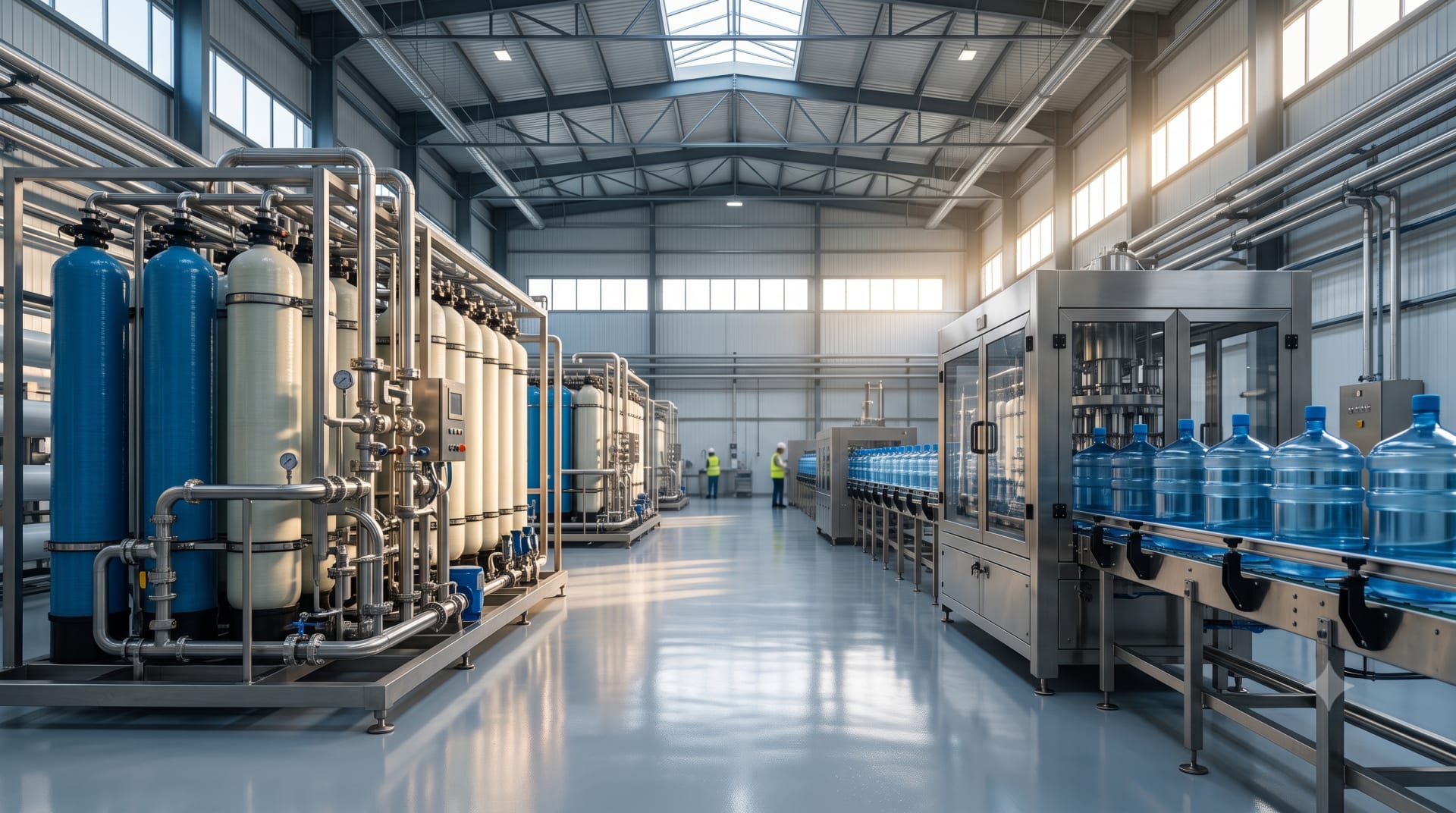
Core machinery for a standard 20-litre jar line totals Rs 6,09,000 ex-works, split between Rs 1,19,000 for water purification and Rs 4,90,000 for automatic jar rinsing, filling, and capping. Most equipment fabricators quote through back-channel sales calls and opaque proforma sheets. Strip away the sales pitches, and a reliable bottling hall relies on two mechanical workhorses running in tandem:
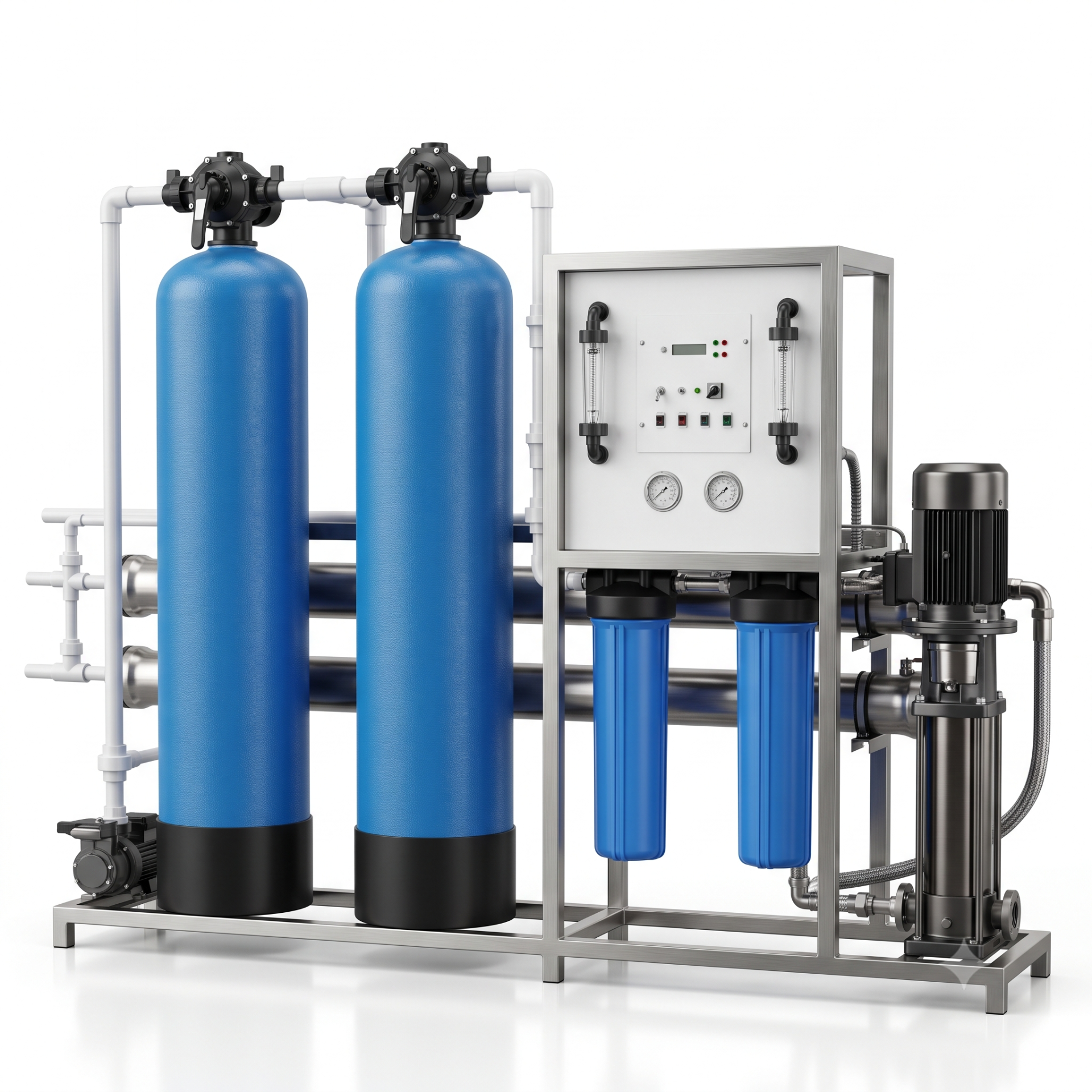
Industrial RO Plant 1000 LPH Automatic with TFC Membranes — Rs 1,19,000 (product page)
- Permeate delivery: 1,000 litres per hour.
- Membrane core: 4 thin-film composite (TFC) 8040 elements housed in 2 heavy-duty FRP pressure vessels.
- Pre-filtration: dual media columns packed with graded silica sand for suspended solids and activated carbon to strip chlorine, odor, and dissolved organics.
- Pumps & dosing: 3 HP high-pressure pump coupled with an antiscalant dosing pump.
- Recovery & rejection: 50% to 65% permeate recovery with 95% to 98% TDS rejection, sized to handle borewell water up to 1,000–1,500 ppm.
- Utilities & service: 220V, 50 Hz power; 1-year warranty and pan-India installation.
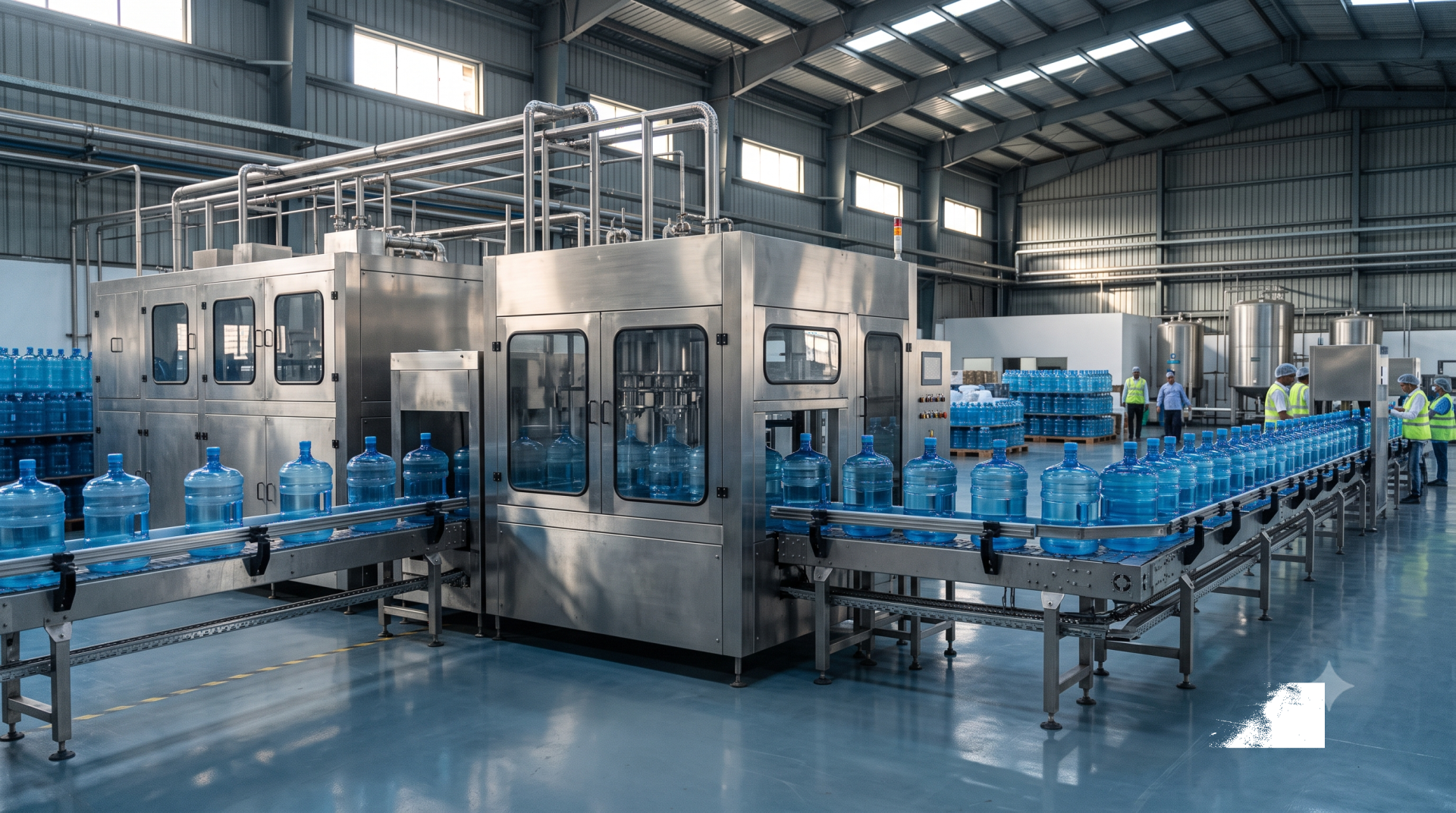
Automatic 20 Litre Jar Washing, Filling & Capping Machine (RFC) — Rs 4,90,000 (product page)
- Line speed: 100 to 150 jars per hour (JPH).
- Washing protocol: 3 discrete stations — tap-water spray (inside and outside), hot-water wash (inside), and pure product-water final rinse (inside).
- Filling mechanism: SS316 food-grade gravity valves with coarse and fine dual-stage dosing to prevent foaming and neck splash.
- Container standard: 53 mm neck PET jars.
- Controls: PLC paired with a touch-screen HMI for cycle timers and fault alarms.
- Utilities: 415V 3-phase, 4–20 kW total connected load; requires external shop air at 5–7 CFM at 90 PSI.
Evaluating the true mineral water plant project cost India requires separating capital equipment from daily operational realities. Raw water dictates your running margins. If your borewell water tests above 1,200 ppm TDS, membrane recovery drops toward 50%: for every 1,000 litres pumped into finished jars, another 1,000 litres drains away as reject concentrate. Wasted water burns electricity and fouls membranes faster. Sizing membrane surface area and media depth correctly keeps cost per litre in check. As an engineering-first RO plant manufacturer in Indore, New Vision Machines builds the RO train and RFC block to work together on the shop floor without third-party integration panels. (See also our RO plant selection guide.)
What else does the packaged drinking water plant setup cost?
Non-machinery capital requirements add roughly Rs 12 lakh to Rs 19 lakh to the budget, covering civil construction, laboratory equipment, statutory clearances, and container inventory. Machinery accounts for roughly a quarter to a third of the total packaged drinking water plant setup cost; the remainder finances civil infrastructure, testing equipment, and working inventory before commercial dispatches begin.
The figures below represent prevailing packaging industry averages across India — distinct from New Vision Machines equipment billing:
Swipe or scroll horizontally to view all columns
| Cost head | Typical range (INR) | Notes |
|---|---|---|
| Core machinery line (RO + RFC) | Rs 6,09,000 | New Vision Machines ex-works pricing (1000 LPH RO + 100–150 JPH RFC) |
| Civil shed & plant flooring | Rs 3,00,000 – Rs 6,00,000 | 1,200–2,000 sq. ft. industrial shed with coved epoxy or vitrified tile flooring, drainage channels, partition walls |
| Borewell & water extraction | Rs 1,00,000 – Rs 2,50,000 | Deep borewell drilling, casing pipe, raw water plumbing, 3–5 HP submersible pump |
| BIS/ISI lab & testing setup | Rs 2,50,000 – Rs 4,50,000 | Laminar flow bench, autoclave, incubator, analytical balance, chemical reagents mandated under IS 14543 |
| Regulatory clearances & fees | Rs 1,50,000 – Rs 3,00,000 | BIS application and inspection fees, FSSAI state license, State Pollution Control Board NOC |
| Electricals, air & plumbing | Rs 1,50,000 – Rs 3,00,000 | 3-phase cabling, servo stabilizer, 5–7 CFM compressor, food-grade SS304/UPVC piping |
| Jar & cap initial inventory | Rs 1,50,000 – Rs 3,50,000 | Initial working float of 1,500–2,500 20-litre PET jars (53 mm neck), printed caps, heat-shrink sleeves |
| Storage tanks (raw & pure) | Rs 80,000 – Rs 1,50,000 | Food-grade SS304 or multi-layer commercial plastic buffer tanks (5,000L raw buffer, 3,000L permeate buffer) |
| Estimated total project cost | Rs 17,89,000 – Rs 25,09,000 | Turnkey estimate from prevailing commercial vendor averages across India |
How does a 20 litre jar water plant cost recover its investment?
A plant bottling 120 jars per hour recovers its Rs 6,09,000 core machinery investment within roughly 77 to 153 production days, depending on route volume and distribution margins. Shop-floor economics rest on uptime — never budget around theoretical machine speeds. Use Overall Equipment Effectiveness (OEE) to account for bottle loading, cap jams, and shift changeovers:
Jars per day = Rated JPH × Operating Hours × 0.75 OEE
Running a 120 JPH line across a 12-hour shift at a realistic 0.75 OEE delivers: 120 × 12 × 0.75 = 1,080 jars per day.
Delivered 20-litre jars fetch Rs 25 to Rs 40 wholesale at local depots and corporate accounts. Assume variable costs — grid power, raw water pumping, caps, heat-shrink sleeves, two line operators, delivery diesel, antiscalant chemicals — run about Rs 18 to Rs 25 per jar in your market (illustrative; your numbers will vary). That leaves an illustrative operating margin of Rs 5 to Rs 8 per jar to pay down equipment debt. Applied to the 20 litre jar water plant cost, two scenarios emerge:
- Scenario A — conservative run (500 jars/day): at Rs 8/jar net, Rs 4,000/day → Rs 6,09,000 ÷ Rs 4,000 ≈ 153 working days. At Rs 5/jar, payback stretches to about 244 working days.
- Scenario B — target single shift (1,000 jars/day): at Rs 8/jar net, Rs 8,000/day → Rs 6,09,000 ÷ Rs 8,000 ≈ 77 working days. At Rs 5/jar, about 122 working days.
Once daily delivery routes cross 800 jars, the core machinery pays for itself in under four months of steady operation.
What can go wrong during daily plant operation?
Four mechanical and chemical failure points can cut plant output by 15% to 40% if operators neglect daily log sheets and pressure differentials:
- High-TDS breakthrough in permeate water — Symptom: permeate TDS climbs while raw feed TDS stays unchanged. Root cause: scaling on the polyamide membranes, cracked O-ring interconnectors inside the 8040 FRP vessel end caps, or an empty antiscalant reservoir letting calcium carbonate blind the feed spacer channels. Fix: inspect the antiscalant pump stroke frequency; if scale has settled, isolate the RO unit and run a low-pH citric acid clean-in-place (CIP) cycle at 2.5–3.0 bar. If TDS stays elevated after flushing, pull the 8040 elements and inspect interconnector seals for bypass leaks.
- Neck leaks and cap slippage — Symptom: stacked jars leak around the 53 mm neck ring during transport. Root cause: line pressure dropping below pneumatic thresholds at the press head, or misaligned chute guide plates seating caps off-center. Fix: verify the machine regulator holds 85–90 PSI during the press stroke; adjust cylinder stroke depth and replace worn polyurethane press pads so force spreads evenly across the tamper band.
- Low water recovery (excessive drain loss) — Symptom: permeate delivery drops below 1,000 LPH while reject discharge surges past 50% of inlet flow. Root cause: clogged media in the sand or carbon columns choking feed pressure, or borewell TDS surging past 1,500 ppm without adjusting the concentrate valve. Fix: run a 15-minute backwash on both media columns; check the inlet pressure gauge on the 3 HP pump and service the upstream 5-micron cartridge filters if suction starves.
- Underfill and volumetric drift — Symptom: fill levels fluctuate in the neck zone and fail visual checks at dispatch. Root cause: grit in the SS316 gravity valve seals, fluctuating head pressure in the overhead permeate tank, or drift in the PLC fill timer. Fix: recalibrate coarse and fine filling timers on the HMI, strip and clean the valve diaphragms, and fit the overhead tank with automated level floats so gravity feed pressure never drops mid-run.
Plan your bottling facility with New Vision Machines — direct engineering, transparent machine pricing, and rugged packaging systems built for Indian industrial environments. Call +91-9981604279 or visit the manufacturing facility at New Vision Machines, Lasudia Mori, Indore, Madhya Pradesh 452010.