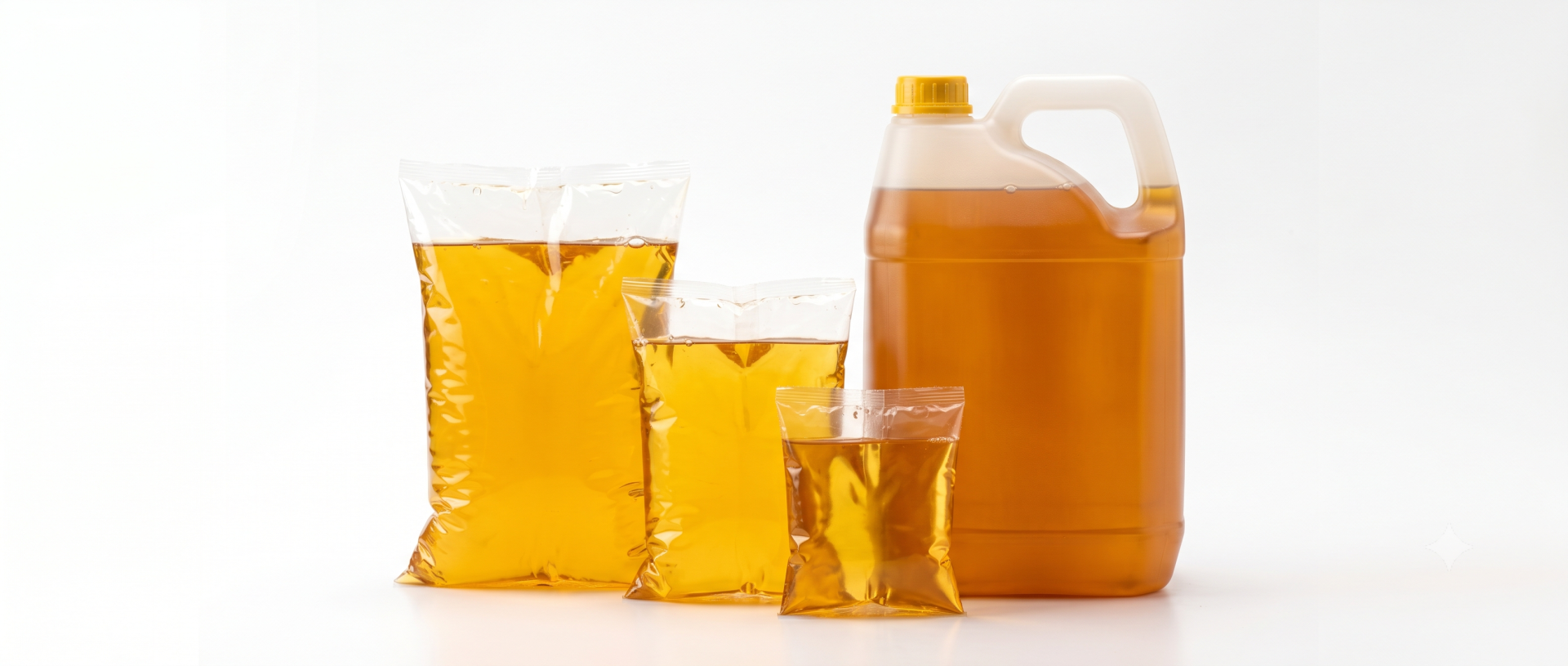
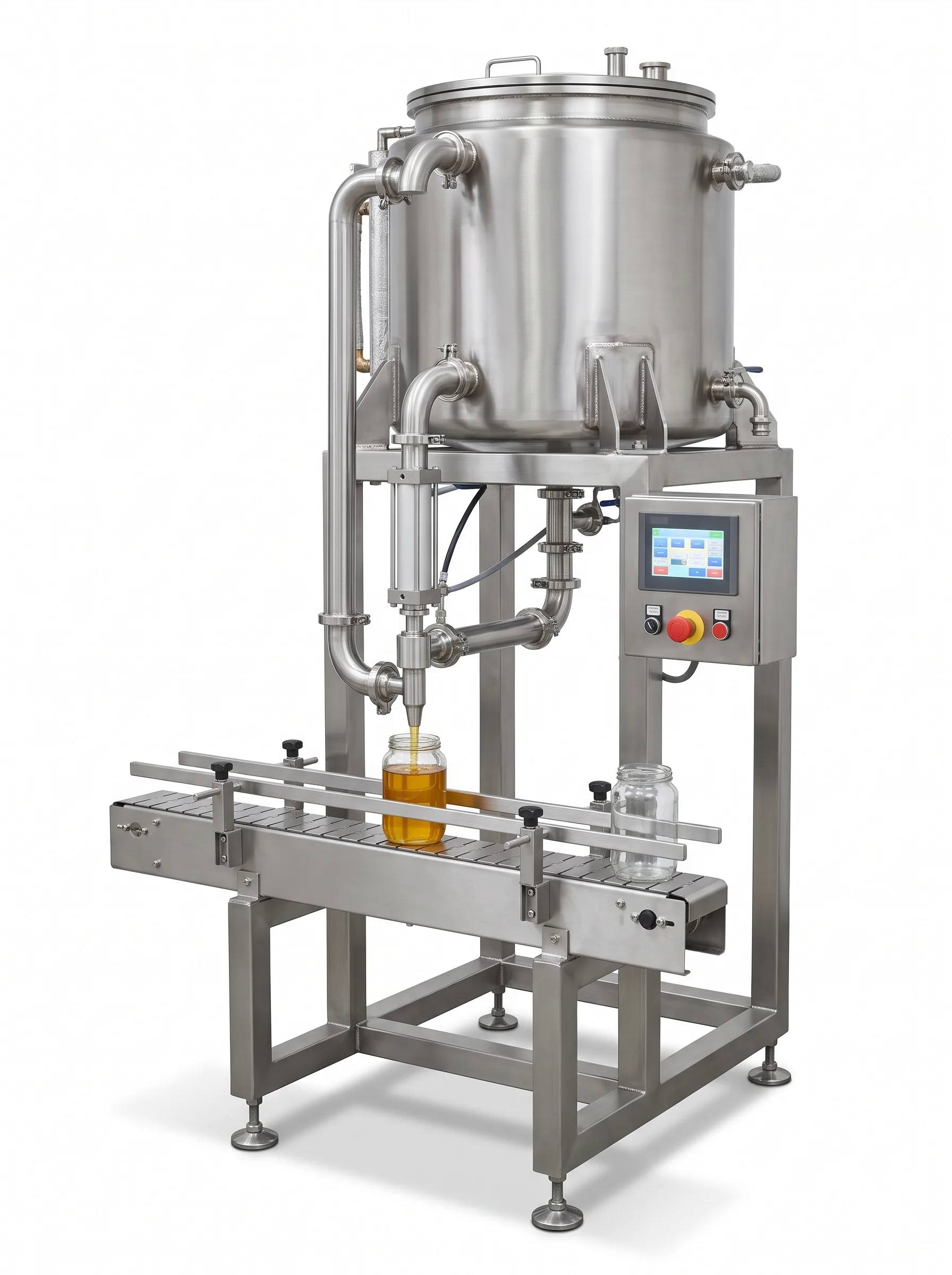
For 1-litre edible oil lines, the pouch-vs-bottle choice comes down to unit packaging economics: pouches convert single-source rollstock in one pass, while bottles need a five-part consumable stack and a multi-station line.
When evaluating an edible oil pouch packing machine vs bottle filling line, the plant owner's choice hinges on primary packaging unit economics and secondary shipping footprint.
- 1-litre pouches yield roughly 136 packs per kg of 100-micron 5-layer co-extruded film, minimizing consumable spend per litre.
- PET bottling lines require a 5-part inventory stack: preforms, screw caps, labels, blow-moulding air compression, and outer cartons.
- New Vision Machines lists an entry automatic liquid pouch VFFS at ₹91,000 (ex-works Indore, GST extra).
- Legal Metrology requires dual net volume (ml/L) and mass (g/kg) markings across 9 mandatory container sizes.
Capex and Throughput: Edible Oil Pouch Packing Machine vs Bottle Filling Line
A VFFS pouch unit occupies a fraction of the floor space of a multi-station bottling line, which strings together five separate mechanical stations.
Setting up dedicated oil filling machines involves balancing mechanical complexity against floor space and labor overhead. VFFS systems draw rollstock film through a forming collar, seal the back seam, dispense measured oil, and cross-seal the pouch in one continuous cycle. A PET bottling line introduces mechanical handoffs between discrete stations: bottle blow-moulding or unscrambling, air rinsing, nozzle filling, chuck capping, and wrap-around labeling.
This mechanical split directly dictates equipment investment. New Vision Machines manufactures an entry-level automatic liquid pouch VFFS at ₹91,000 (ex-works Indore, GST extra). For broader commercial context: Single-seller IndiaMART listings observed 25 Oct 2026 put an edible-oil pouch machine at ₹3,45,000 (2000 pouches/hr, 1L) and a 1L soybean bottle filling line at ₹10,00,000 (4-head piston, 1000–2000 bph) — market listings, not NVM prices, GST scope as listed. Because rigid bottling requires automated unscramblers and multi-head cappers to achieve balanced line speeds, the baseline edible oil packaging cost per litre India remains noticeably lower on pouch-making lines.
How Does 1-Litre Packaging Film Yield Compare to Rigid Containers?
A standard 1-litre edible oil pouch measuring 160 mm by 250 mm yields approximately 136 packs per kilogram of 100-micron 5-layer co-extruded film before trim allowance.
Determining your exact 1 litre edible oil pouch film cost per kg requires precise calculation of film surface area, polymer density, and extrusion tolerance. Our packaging yield model applies three operational baselines:
- Low-density polyethylene (LDPE) density of 0.92 g/cm³.
- Nominal 5-layer co-extruded LDPE film thickness for 1L oil between 90 and 110 microns (100 microns nominal).
- Pouch surface area calculated as 2 × width × length, measured prior to seal trim and scrap.
Swipe or scroll horizontally to view all columns
| Nominal Pack Size | Pouch Dimensions (W × L) | Film Area per Pouch (2×W×L) | Indicative Yield at 100 Micron |
|---|---|---|---|
| 200 ml | 110 mm × 160 mm | 0.0352 m² | ~309 pouches/kg |
| 500 ml | 140 mm × 210 mm | 0.0588 m² | ~185 pouches/kg |
| 1 Litre | 160 mm × 250 mm | 0.0800 m² | ~136 pouches/kg |
Note: Indicative engineering estimates based on 5-layer co-extruded film with 0.92 g/cm³ LDPE density at 100-micron nominal gauge, calculated before trim waste and jaw bite margins. Applicable to Indian edible oil packaging plants (October 2026).
An illustrative yield of 136 packs per kilogram of film is achieved with 100-micron 5-layer co-extruded LDPE film on a 1-litre pouch line (indicative engineering yield calculation, October 2026). Packaging supervisors should note that the frequently cited industry figure of 280 to 310 pouches per kilogram applies to 200 ml pouches, not 1-litre formats.
Rigid PET containers bypass rollstock yield math but introduce a five-part consumable stack. Every packed bottle requires an injection-moulded PET preform, an HDPE screw closure with tamper ring, a BOPP or paper label, continuous compressor power for high-pressure blow-moulding, and heavy corrugated outer cartons to prevent pallet crush.
How Do Impulse and Constant-Heat Jaws Handle Cross-Seal Integrity?
Cross-seal integrity fails when liquid oil splashes across the sealing face, weakening the seal if the jaw cannot squeeze oil out before thermal fusion.
Flexible oil packaging lines use either impulse sealing bands or continuous constant-heat jaws. Impulse systems use a NiChrome ribbon that receives a brief electrical surge while clamped against the film, cooling down under mechanical pressure. Constant-heat jaws use internal cartridge heaters and solid brass or steel profiles to transfer continuous heat through heavy 90 to 110 micron multi-layer films. While impulse sealing works well for thin single-layer films, heavy co-extruded barrier rolls perform best with constant-heat serrated jaws that physically displace surface liquid. Combining constant-heat tooling with positive shut-off filling nozzles prevents liquid dripping across the film web during film advance. For details on selecting positive shut-off pumps, review our piston vs gear pump vs flow meter guide.
How Do Seasonal Temperature Swings and Legal Metrology Rules Affect Packaging?
Uncontrolled ambient temperature shifts change vegetable oil density enough to throw off volumetric dosing accuracy and swell summer pouches.
In northern and central Indian winters, ambient room temperatures drop fluid temperatures, raising oil viscosity. This slows liquid discharge through filling nozzles, creating systematic under-filling on timed pneumatic piston valves. In peak summer, high warehouse temperatures trigger thermal fluid expansion, raising internal pouch pressure and stressing hot seals during palletizing. Packing lines manage this thermal swing by maintaining a small gaseous headspace inside each pouch.
Packaging lines must also comply with statutory packaging mandates. The Department of Consumer Affairs established 9 mandatory edible-oil standard pack sizes under a dual volume and mass declaration framework enforced from 6 September 2026 (PIB Delhi, 6 June 2026). The Legal Metrology 9 standard edible oil pack sizes 2026 schedule covers 200 ml/g, 500 ml/g, 1 L/kg, 2 L/kg, 3 L/kg, 4 L/kg, 5 L/kg, 15 L/kg, and 20 L/kg, requiring clear dual markings (millilitres and net grams) on outer facings. For layout compliance across pack variations, consult our edible oil standard pack sizes guide. Flexible lines accommodate dual weight printing and mandatory plastic Extended Producer Responsibility (EPR) recycling logos via thermal inkjet (TIJ) units mounted on the unwind film carriage.
Limits and Assumptions
This operational comparison focuses on standard edible vegetable oils, including mustard, refined soybean, sunflower, and palmolein oils.
- Yield figures assume a baseline virgin LDPE polymer density of 0.92 g/cm³; incorporating high-density barrier polymers like nylon or EVOH alters net yield per kilogram.
- Calculations do not include roll changeover wastage, manual web-splice scrap, or lateral former edge trimming.
- Rigid bottling plant comparisons omit custom bottle mould tooling, secondary carton packing machines, and industrial water chillers.
Oil Pouch Leakage Troubleshooting: Four Common Plant Defects and Fixes
Systematic oil pouch leakage troubleshooting requires isolating whether seal breakdown originates from thermal imbalance, film carriage alignment, or liquid nozzle shut-off failure.
Horizontal Cross-Seal Channel Leaks
Mechanism: Stray oil drops splash across the sealing zone, preventing inner polymer plies from fusing.
Remedy: Replace worn silicone nozzle O-rings and advance the pneumatic liquid shut-off timing slightly ahead of jaw closure.
Vertical Fin-Seal Burn-Through
Mechanism: Excessive heater bar temperature or prolonged jaw dwell melts through the outer protective polyester layer.
Remedy: Lower the vertical PID temperature controller setting by 5°C to 10°C and verify draw-down belt traction speed.
Pouch Bursting During Secondary Transport
Mechanism: Insufficient gaseous headspace transfers hydraulic liquid shock directly against end-seals when shipping crates are stacked.
Remedy: Raise dosing nozzle height slightly and increase total bag length cutoff by a few millimetres to maintain a headspace buffer.
Film Web Drift and Asymmetric Fin Seams
Mechanism: Oil residue on the forming shoulder or uneven unwind reel brake tension causes film to slide laterally.
Remedy: Degrease forming shoulder surfaces with an industrial isopropyl solvent wipe and readjust the mechanical friction brake.
Keep oil out of the seal zone: positive shut-off nozzles plus constant-heat serrated jaws are the single highest-leverage fix for oil-pouch leaks — most channel leaks trace to nozzle drip, not jaw temperature.
How many 1-litre oil pouches per kg of film can an oil repacker expect?
A standard 1-litre pouch (160 mm by 250 mm) yields roughly 136 packs per kilogram using 100-micron 5-layer co-extruded LDPE film at 0.92 g/cm³ density. Final production figures vary with trim allowance, but claims of 280 to 310 pouches per kilogram apply strictly to 200 ml packs.
How to stop cross-seal leakage on continuous oil pouch packing lines?
Preventing cross-seal leaks requires keeping oil drops entirely clear of the sealing zone. Install positive shut-off anti-drip nozzles and synchronize pump deceleration so liquid flow cuts off before jaws meet. Use constant-heat serrated jaws to displace micro-droplets and fuse inner polymer layers under steady mechanical pressure.
What is the pouch vs bottle cost difference per litre for edible oil?
Pouches reduce packaging expenditure significantly compared to rigid PET bottles by converting single-source rollstock in one continuous process. Bottling lines require purchasing preforms, injection-moulded caps, labels, corrugated cartons, and running heavy blow-moulding compressors, substantially raising capital investment and consumable costs per packed litre.
Why is 5-layer co-extruded LDPE film thickness for 1L oil specified at 90 to 110 microns?
The 90 to 110 micron band gives the puncture resistance and barrier strength a 1L oil pouch needs to survive distribution without bursting. Thinner gauges risk pinholing in transit, while heavier gauges waste film and need longer jaw dwell times, slowing the line.
Contact New Vision Machines at +91-9981604279 or visit our engineering works at SDA Compound, Lasudia Mori, Dewas Naka, Indore, Madhya Pradesh to inspect running liquid VFFS machinery and evaluate unit packaging costs for your edible oil line.