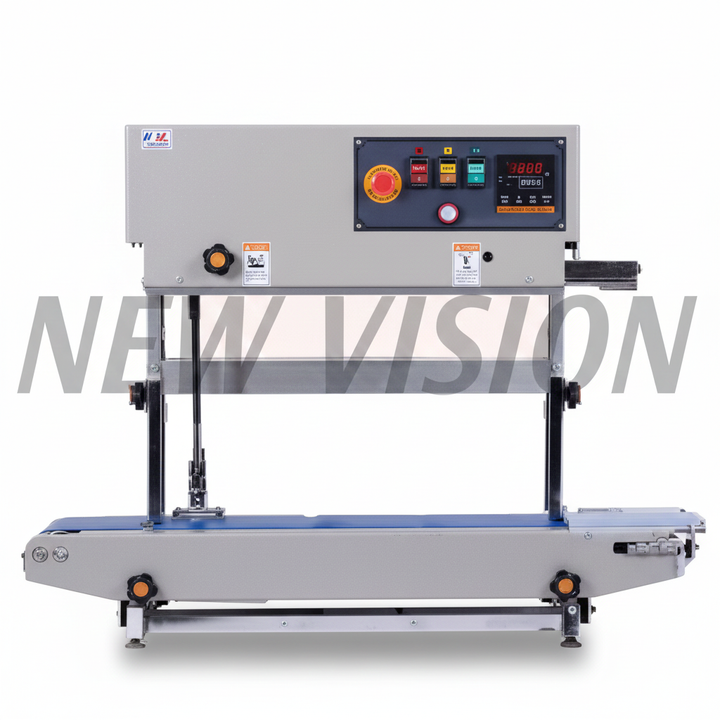
In many Indian packaging units, sealing becomes the main bottleneck once filling is stable—especially when pouches must look professional, stay leak-proof, and run continuously for long batches. A stainless steel vertical band sealer with digital control is designed for exactly this: consistent sealing quality with less manual effort, better hygiene, and faster output than impulse sealers.
What is a vertical band sealer?
A vertical band sealer is a continuous pouch sealing machine where the pouch travels on a conveyor and the top open edge passes through heated moving bands (belts) that create a sealed seam. In a vertical model, the pouch stays upright during sealing, which is especially helpful when the product inside is free-flowing or can spill if the pouch tilts.
Most vertical band sealers used in India come with adjustable temperature and conveyor speed, and many models also support optional batch/date coding for compliance and traceability.
How a band sealer works (simple flow)
Understanding the working cycle helps buyers choose the right model and helps operators get better seal quality with fewer trials. A typical continuous band sealer process looks like this:
- Feed: Place the filled pouch with the open mouth aligned on the conveyor so it enters the sealing zone smoothly.
- Heat + pressure: Heated sealing bands apply controlled heat while rollers apply pressure, melting the inner layer and bonding the pouch mouth into a single seam.
- Cooling: A cooling section helps the seal solidify quickly so the seam stays flat, strong, and presentable.
- Discharge: The sealed pouch exits continuously, ready for inspection, secondary packing, or dispatch.
Why stainless steel + digital control matters
If the packaging area deals with food, pharma, chemicals, coastal humidity, or frequent wash-down, stainless steel construction is a practical upgrade because it is more corrosion-resistant and easier to keep hygienic than painted/mild steel bodies.
Digital temperature control helps operators set and maintain stable sealing heat for different laminates, reducing common issues like under-sealing (peel-open seals) or over-heating (burnt, wrinkled seams).
In many vertical band sealer designs, the upright pouch movement also reduces product contamination at the sealing area when compared to setups where product dust or liquid tends to spread near the mouth during handling.
Best-fit applications in India
A stainless steel vertical band sealer is usually chosen when the product needs upright handling, continuous sealing, and a clean machine surface for daily operations. Common applications include:
- Food & FMCG: Spice powders, flour mixes, tea, coffee, dry fruits, mouth fresheners, namkeen (with proper pouch structure), and ready-to-pack mixes.
- Powders & granules: Detergent powder, seeds, nutraceutical powders, premixes, and small-part pouches where upright movement helps stability.
- Liquid & semi-liquid pouches: Liquids and semi-liquids often benefit from vertical orientation so the pouch remains upright while sealing.
- Pharma & chemicals: Where a clean surface and consistent sealing are important for process discipline and packaging finish.
Buying checklist (avoid wrong selection)
When buyers search for “best band sealer machine” or “vertical band sealer price”, the bigger risk is not overpaying—it is purchasing a model that cannot handle the pouch format, throughput, or shop-floor conditions. Use this checklist before finalizing:
1) Pouch material and laminate structure
Confirm the pouch structure (inner sealing layer) because different laminates need different heat windows. If multiple pouch types will run on the same machine, choose a model with stable digital temperature control and fine speed adjustment to reduce changeover trials.
2) Product type (dry vs dusty vs liquid)
Vertical band sealers are typically selected when pouches must remain upright during sealing, which suits many granular and liquid/semi-liquid packs.
If the product creates dust near the mouth, plan for operator SOPs (wipe the mouth area, control spillage) so the seal remains clean and consistent.
3) Required output and batch size
Match the machine duty to your daily workload. If your business runs long batches (same pouch size and material), continuous band sealers improve productivity because feeding and sealing happen in a steady flow rather than in cycles.
4) Seal consistency features
- Digital temperature control: Helps repeatability across operators and shifts.
- Stable pressure path: Smooth belt tracking and consistent pressure rollers reduce “one-side open” issues.
- Cooling support: Helps keep seals neat and reduces rework.
5) Conveyor and pouch handling
Check whether your pouch height range, gusset type, and fill level can pass without rubbing or tilting. Also confirm whether you need adjustable conveyor height for different pouch sizes (common in mixed-SKU businesses).
6) Optional add-ons (only if truly needed)
- Batch/date coding: Useful for retail and compliance-driven supply chains.
- Nitrogen flushing: Relevant for oxidation-sensitive products (snacks, some powders), but only if your overall packing system supports it.
- Embossing/printing support: Only if your pouch film and QA requirement justify it.
How to get better seal quality (operator tips)
- Run a short “seal trial” at start-up: Adjust temperature and speed together; fast speed often needs higher heat, while slow speed often needs lower heat.
- Keep the pouch mouth clean and flat: Powder, oil, or product particles on the seal area are a major reason for leaking seals in real shop-floor conditions.
- Do peel tests periodically: Check the seam strength every set interval (especially after material change or shift change) to catch drift early.
- Allow proper cooling: Do not stack hot-sealed pouches immediately if the laminate is prone to deformation; cooling improves seam stability.
Common problems and quick troubleshooting
Weak seal / seal opens on pressing
- Increase temperature slightly or reduce conveyor speed.
- Ensure the pouch mouth is free from dust/oil and is properly aligned.
- Check belt condition and pressure roller contact.
Burnt, wrinkled, or melted seam
- Reduce temperature or increase conveyor speed.
- Confirm laminate suitability; some films deform quickly if overheated.
- Check cooling airflow/section (if applicable).
Seal not straight / pouch drifting
- Align the pouch on the conveyor consistently (use guides if available).
- Check conveyor belt tracking and machine level on the floor.
Why this machine is a strong fit for growing units
If your business is moving from manual sealing to consistent, semi-automatic pouch sealing, a stainless steel vertical band sealer with digital control is a practical step-up: it supports continuous flow, cleaner operation in demanding environments, and more consistent sealing parameters across shifts.
For Indian MSMEs, the biggest ROI usually comes from reduced seal failures (rework/returns), faster dispatch readiness, and a more uniform pack finish that improves buyer confidence in the product.
Explore the New Vision Machines product: Stainless Steel Vertical Band Sealer (Digital Control). If you share your pouch type and approximate daily output, the correct configuration (temperature range, coding option, conveyor setup) can be recommended for your use-case.