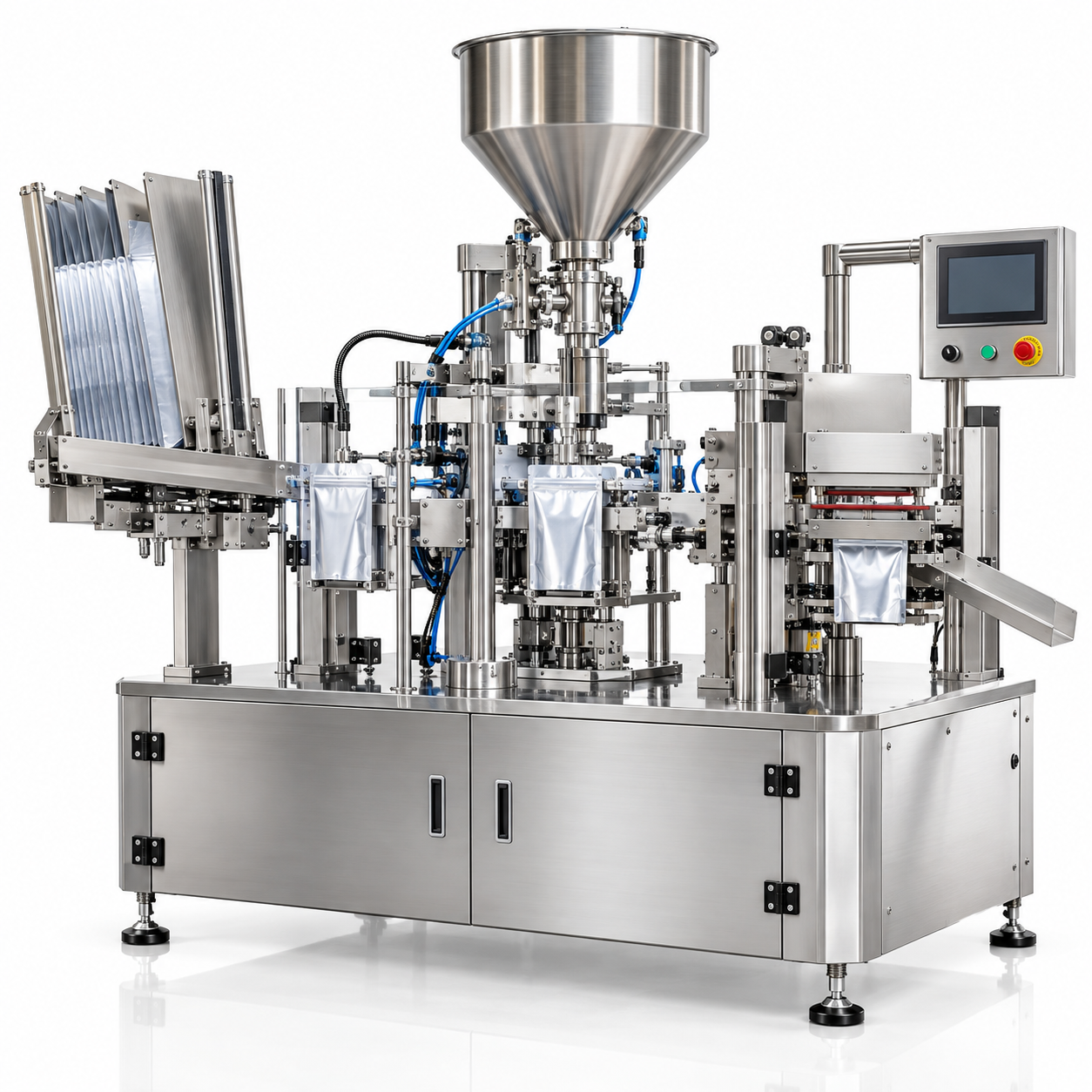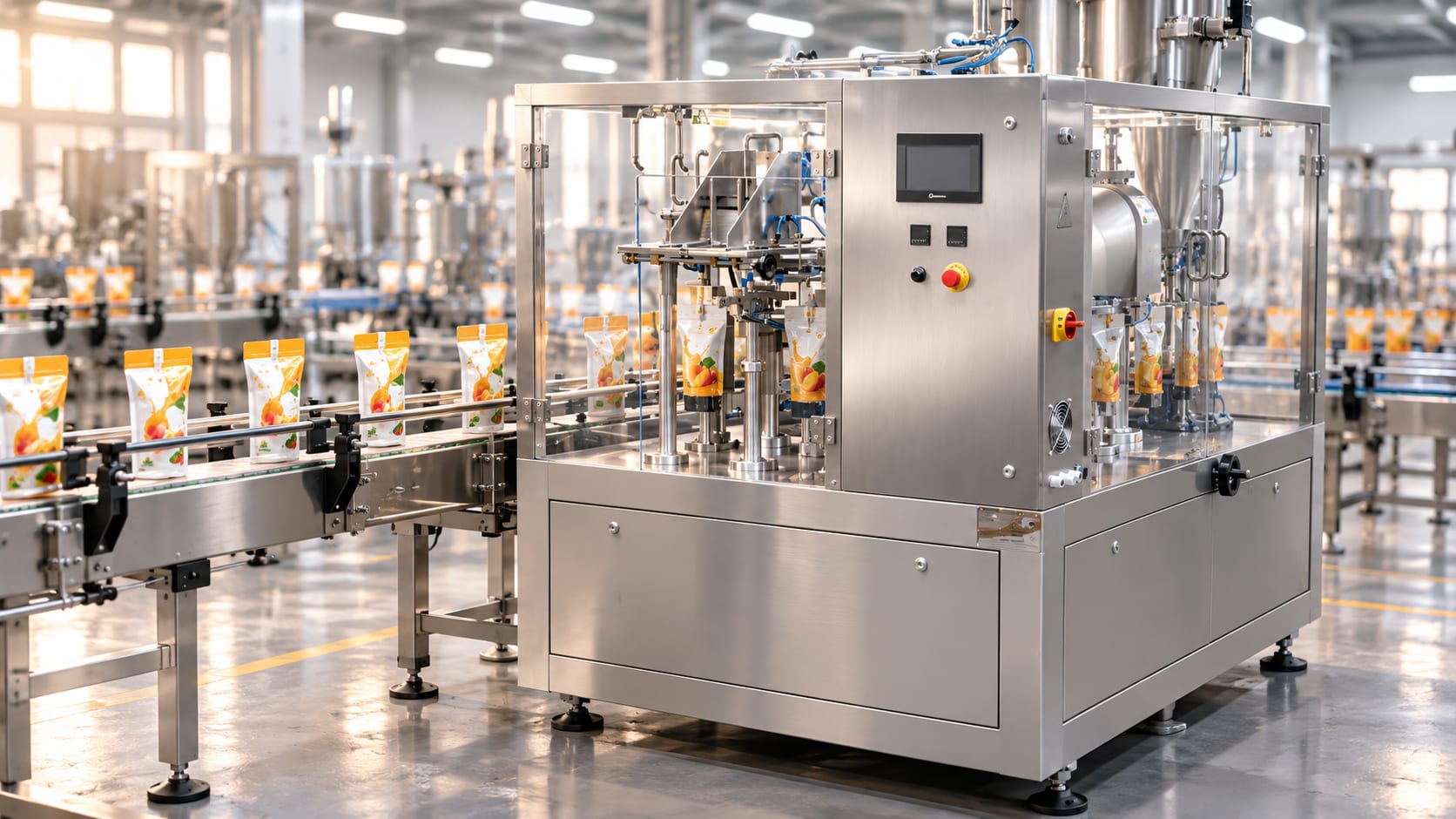
A premade pouch filling machine costs ₹5 lakh–₹7.5 lakh for entry automatic single-station systems, ₹10–12 lakh for higher-speed single/dual-station machines, and ₹18 lakh+ for multi-head rotary lines.
Premade pouch filling machine: India price bands by machine class
Entry automatic single-station machines typically cost ₹5,00,000–₹7,50,000, while higher-speed single/dual-station machines cost ₹10,00,000–₹12,00,000 and multi-head rotary lines start at ₹18,00,000+.
Swipe or scroll horizontally to view all columns
| Machine class | Speed / pouches per minute | Maintenance | Running cost | Pricing INR |
|---|---|---|---|---|
| Entry automatic single-station pick-fill-seal | 10–20 | Lower mechanical complexity | Moderate | ₹5,00,000–₹7,50,000 |
| Higher-speed single/dual-station | Higher than entry class | Higher mechanical complexity | Moderate | ₹10,00,000–₹12,00,000 |
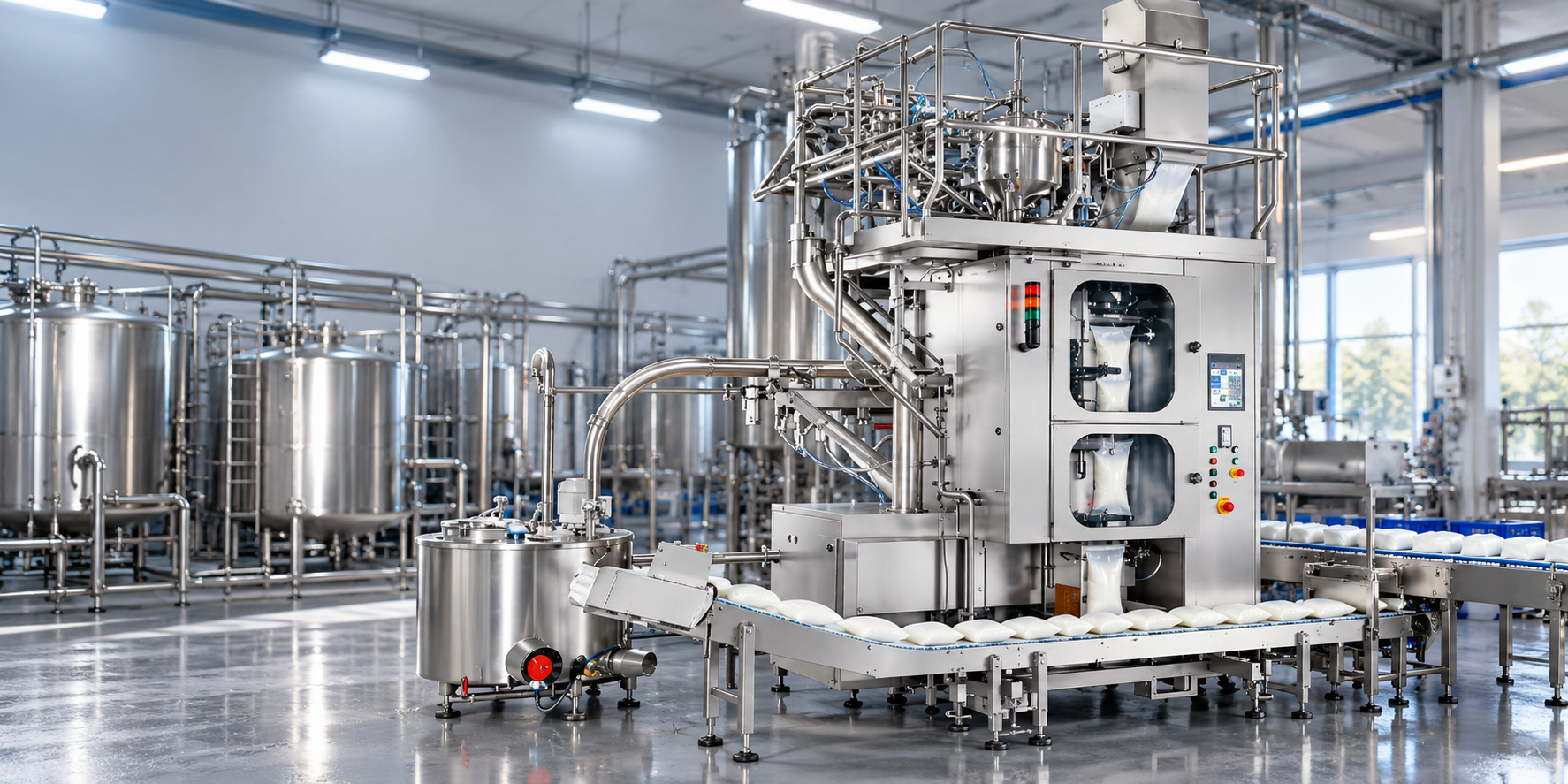
| Multi-head rotary premade pouch line | Multi-head rotary class | Higher system complexity | Higher | ₹18,00,000+ |
The listed market examples span ₹5,00,000, ₹5,52,552, ₹7,00,000, ₹7,50,000, ₹12,00,000 and ₹26,00,000. Taken together, they give a useful reference range when checking a quotation. The machine class and actual specification, however, are more important than the headline price.
New Vision Machines offers an entry-level automatic single-station pick-fill-seal machine at ₹5,40,000. Its stated configuration is 10–20 pouches/min, a 50 g–1000 g fill range, impulse sealing, single-phase power and a stainless-steel body. It is intended for powder, granule and solid products.
premade pouch filling and sealing machine at Rs 5,40,000
When comparing a premade pouch packing machine, it is worth looking beyond the number on the quotation. The useful question is whether the machine class actually fits the required output, pouch format and filling application.
premade vs FFS chooser
Premade pick-fill-seal makes more sense for premium printed stand-up pouches and minimal changeover, while FFS uses roll film to form pouches at higher speed and can reduce per-pouch cost.
Choose premade pouches when:
- The pouch is already printed and supplied ready for filling.
- Stand-up pouch presentation is important.
- You want to avoid maintaining roll-film inventory.
- Product or pouch changes make minimal changeover valuable.
Choose FFS when:
- Higher production speed is the priority.
- Roll film is practical for the operation.
- Lower per-pouch packaging cost matters more than premade pouch flexibility.
- Longer changeovers are acceptable.
The doypack filling machine price in India should be considered alongside the complete packaging process. Comparing it directly with an FFS machine can be misleading if film handling, pouch forming and changeover requirements are different.
What drives a quote up or down
A quote for a premade pouch filling machine generally moves with the machine class, station configuration, filling requirement, pouch handling and sealing arrangement.
Station configuration
A single-station pick-fill-seal arrangement is mechanically simpler than a dual-station or multi-head rotary system. Additional stations can increase throughput, but they also bring more mechanical and control complexity.
Filling range and product
A machine filling 50 g–1000 g across powders, granules and solids has different requirements from one designed around a narrow filling range. Product behaviour at the filling stage also affects the suitable configuration.
Sealing system
Impulse sealing is part of the entry-level New Vision Machines configuration. The sealing requirement should be checked against the actual laminated pouch construction rather than assumed from the machine category.
Pouch handling
Pick accuracy, pouch opening and magazine handling all affect whether the quoted output can be maintained on the factory floor. A nominal machine speed means little if feeding and filling are inconsistent.
Spec checklist before approving a quote
A premade pouch filling machine quote should be approved only after station count, pouch dimensions, seal type, required speed, fill range, product type and power requirements are clearly written down.
Before issuing a purchase order, record:
- Station count: single, dual or rotary
- Pouch format: pouch dimensions and stand-up/doypack format
- Fill range: required minimum and maximum weight
- Product: powder, granule or solid
- Seal type: impulse or the specified sealing arrangement
- Speed: required pouches/minute
- Power: single-phase requirement where applicable
- Construction: stainless-steel body where required
- Pouch supply: magazine/loading arrangement
- Changeover: products and pouch sizes that will actually be changed
QUOTE-APPROVAL CHECKLIST
Use this calculation before selecting the machine class: Required daily output = pouches/min × 60 × operating hours × 0.75 OEE For example: 15 pouches/min × 60 × 8 hours × 0.75 = 5,400 pouches/day That figure can then be compared with the appropriate machine class and its stated operating range. The point of the calculation is simple: do not select a machine only from its maximum advertised speed. For example, an entry single-station machine operating at 10–20 pouches/min has a theoretical eight-hour output of: 10 × 60 × 8 = 4,800 pouches/day 20 × 60 × 8 = 9,600 pouches/day Applying the 0.75 OEE factor gives an operational planning range of: 3,600–7,200 pouches/day That is the kind of plant-level calculation a purchase manager can use when checking whether a quoted machine is suitable for the actual requirement.
Field troubleshooting
1. Weak impulse seals on laminated pouches — Check sealing temperature/setting; check whether the pouch layers are correctly positioned; check pressure and contact across the seal; confirm the pouch material is suitable for the specified impulse-sealing arrangement. 2. Pouches not opening at the pick station — Check pouch alignment in the magazine; inspect whether pouches are sticking together; check the pick-and-open mechanism for consistent contact; verify pouch dimensions against the machine's intended handling range. 3. Inconsistent fill weights across the shift — Check product flow consistency; inspect the filling mechanism for buildup; verify the machine setting has not drifted; compare weights at intervals rather than relying on a single sample. 4. Film/pouch magazine jams at changeover — Check the new pouch dimensions against the previous setting; reset magazine guides and pouch alignment; remove misfed or overlapping pouches before restarting; record the changeover settings that produced stable feeding.