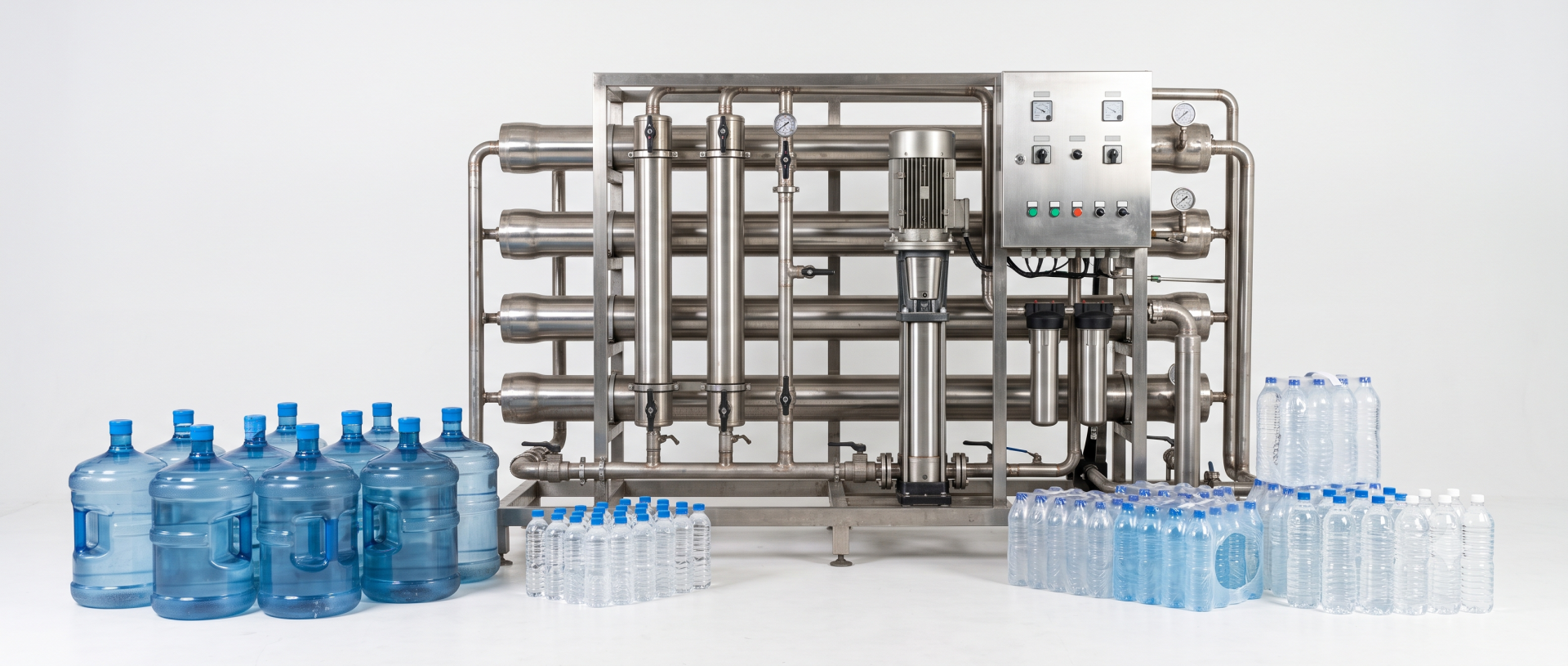
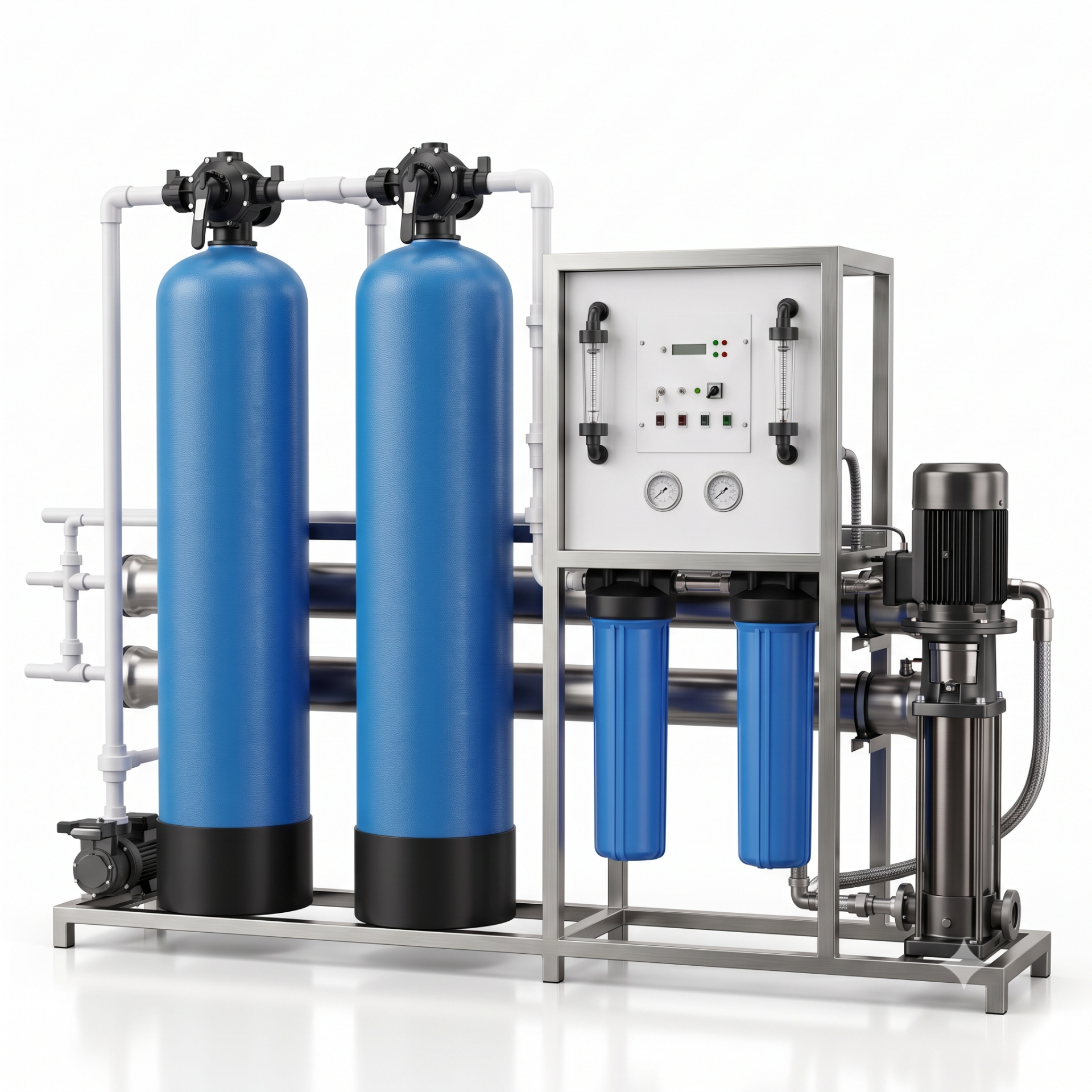
A 1000 LPH RO plant at 55% recovery needs 5.5–9.1 ml/hr of neat antiscalant (3–5 ppm). Run CIP when normalized permeate falls 10–15% or differential pressure rises 10–15%.
Miss chemical targets by even 2 ppm on hard groundwater, and final-stage elements choke within weeks. Getting your ro antiscalant dosing calculation 1000 lph plant right from day one is what keeps commercial RO plants producing clean water instead of eating through replacement membrane budgets.
- Feed flow baseline: at 55% recovery, a 1000 LPH permeate system demands 1,818 LPH feed flow (1000 ÷ 0.55).
- Chemical dosing rate: neat antiscalant consumption spans 5.5 ml/hr (3 ppm) to 9.1 ml/hr (5 ppm), injected ahead of cartridge filters.
- Membrane CIP trigger: clean when normalized permeate falls 10–15% or differential pressure rises 10–15%.
- Cleaning sequence rule: alkaline recirculation must always precede acid washing, or acid sets organic foulants permanently.
- Capital cost baseline: commercial skids from Rs 1,10,000 (500 LPH) to Rs 2,70,000 (2000 LPH), ex-works Indore, GST extra.
Normalize your log data before reaching for cleaning chemicals: permeate flow drops roughly 3% for every 1°C fall in feed-water temperature with zero fouling involved. Most "emergency CIPs" in winter are instrumentation or temperature artifacts, not scaled membranes.
Operating a properly dosed, scale-free membrane skid directly determines whether a bottling unit stays compliant or faces shutdown. Under the Food Safety and Standards Authority of India (FSSAI) Order dated 17 December 2025, a revamped testing scheme for packaged drinking water and mineral water took effect on 1 January 2026. The government withdrew the mandatory BIS certification mark in October 2024 and reclassified both packaged drinking water and mineral water as high-risk food categories. Plants must now run mandatory monthly microbiological tests at FSSAI-notified NABL laboratories covering coliforms, Escherichia coli, faecal streptococci, Pseudomonas aeruginosa, Staphylococcus aureus, Salmonella, Shigella, Vibrio, and yeast and mold.
Physical and chemical parameters — pH, turbidity, TDS, heavy metals, fluoride, nitrate, arsenic, and pesticide residues — demand quarterly lab reports. Packaging materials require testing every six months, and source water must be verified at FSSAI-notified NABL labs. Keeping membranes free of biological slime and scale buildup helps meet these statutory purity thresholds consistently.
How Hardness, Silica, and Iron Choke 8040 TFC Membranes
Dissolved calcium, magnesium, silica, and iron in Indian borewell water precipitate onto thin-film composite (TFC) membranes whenever local recovery pushes mineral concentrations past solubility limits — specifically when the Langelier Saturation Index exceeds 0 or reactive silica surpasses 120 mg/L.
Borewell water across India's industrial corridors routinely clocks total hardness well over 400 mg/L as CaCO3, with reactive silica between 30 and 80 mg/L. Stopping silica and calcium scaling in commercial ro plant arrays takes steady chemical threshold inhibition, not guesswork. Calcium carbonate scale forms fastest on tail elements, where mineral concentration peaks in the final vessel.
Silica is far nastier. Once monomeric silica concentrates past its solubility ceiling (120–150 mg/L at 25°C), it polymerizes into an amorphous, glass-hard glaze across the polyamide sheet and feed spacer. Standard field acids will not touch it. Once it sets, the element is scrap.
Balancing your ro plant recovery rate vs tds borewell water salinity dictates whether calcium sulfate or silica drops out in the final stage. Soluble ferrous iron (Fe2+) creates its own headaches: if raw water sits exposed to air in an open break tank, iron oxidizes into insoluble ferric hydroxide, a red-brown slime that blankets lead 8040 elements and spikes inlet pressure within days. Sizing element diameter and vessel staging properly — as laid out in our 4040 vs 8040 RO membrane sizing guide — must be backed by precise chemical dosing to keep these salts dissolved.
RO Antiscalant Dosing Calculation 1000 LPH Plant: Worked Formulas
The formula for hourly neat antiscalant consumption is:
Hourly antiscalant (mg/hr) = feed flow rate (LPH) × target dose (mg/L)
Neat injection rate (ml/hr) = [feed flow (LPH) × target dose (ppm)] ÷ [specific gravity of chemical × 1,000]
Feed flow rate (LPH) = permeate flow (LPH) ÷ fractional recovery
When running a ro antiscalant dosing calculation 1000 lph plant managers must pull the neat chemical's specific gravity from the supplier's technical datasheet (most fall between 1.05 and 1.15 g/ml; the math below uses 1.0 as the baseline). Most commercial antiscalants dose between 2 and 6 ppm depending on feed TDS, silica levels, and recovery setpoint. Always verify the exact dose against your chemical manufacturer's recommendations — never run the worked example below as a universal prescription.
Worked Calculation for a 1000 LPH Plant at 55% Recovery
Permeate output: 1,000 LPH
System recovery: 55% (0.55)
Required feed water flow: 1,000 ÷ 0.55 = 1,818 LPH
At a 3 ppm target dose: 1,818 × 3 = 5,455 mg/hr ≈ 5.5 ml/hr of neat antiscalant.
At a 5 ppm target dose: 1,818 × 5 = 9,091 mg/hr ≈ 9.1 ml/hr of neat antiscalant.
Sizing Feed Flow and Dosing Across Standard Skids (55% Recovery)
500 LPH skid: feed flow 909 LPH (500 ÷ 0.55). At 3 ppm the pump injects 2.7 ml/hr; at 5 ppm, 4.5 ml/hr.
2000 LPH skid: feed flow 3,636 LPH (2,000 ÷ 0.55). At 3 ppm the demand is 10.9 ml/hr; at 5 ppm, 18.2 ml/hr.
New Vision Machines builds FRP and SS commercial skids priced at Rs 1,10,000 for 500 LPH, Rs 1,70,000 for 1000 LPH, and Rs 2,70,000 for 2000 LPH (2×8040 TFC membrane configuration on the 2000 LPH skid), ex-works Indore, GST extra, October 2026.
Calibrating the Dosing Pump: Dilution Tank Ratios and Stroke Rates
Dosing pump calibration means diluting neat antiscalant in a 50 to 100-litre chemical tank so the electronic diaphragm pump operates inside its reliable 30% to 80% stroke range.
Electronic metering pumps cannot consistently meter 5.5 ml/hr neat against 3 to 4 bar of line pressure — check valves stick, stroke volume drifts, and membranes run dry. Dilute the chemical with pure RO permeate in a dedicated day tank.
Dilution and Calibration Sequence for a 1000 LPH Skid
Calculate daily consumption: at 10 hours daily and a 3 ppm dose (5.5 ml/hr neat), the plant burns 55 ml of neat chemical per shift.
Batch the dosing tank: take a 50-litre chemical tank, pour in 550 ml of neat antiscalant, and top up to the 50-litre mark with chlorine-free RO permeate. That yields 10 days of chemical at 5 litres per day — 500 ml/hr (0.5 LPH) of diluted solution.
Calibrate with a drawdown cylinder: plumb a 100 ml graduated cylinder into the pump suction via a three-way valve. Isolate the main tank, let the pump pull from the cylinder under full operating pressure, and time the drop over 5 minutes:
5-minute drawdown target = 500 ml/hr ÷ 60 × 5 = 41.7 ml
Adjust pump frequency until the meniscus drops exactly 41.7 ml in 5 minutes.
Tap the injection quill into the pipe run directly ahead of the 5-micron cartridge pre-filter — the turbulence across the pleats keeps scale from nucleating on filter fibres. Adding this 5-minute drawdown check to your monthly 500 to 2000 lph ro plant maintenance schedule stops chemical drift before membranes pay for it.
When to Trigger CIP: Differential Pressure and Permeate Thresholds
Trigger membrane Clean-In-Place immediately when normalized permeate flow decreases by 10% to 15%, feed-to-concentrate differential pressure increases by 10% to 15%, or normalized salt passage increases by 5% to 10% versus clean baseline values.
The FilmTec Technical Manual (Revision 19, February 2026) sets these as the CIP evaluation triggers against a normalized baseline. Do not wait until output drops 30% or the pressure gauge pegs red — by then the foulant layer is compressed solid, feed channels are blocked, and cleaning chemicals cannot reach the active layer.
Swipe or scroll horizontally to view all columns
| CIP trigger metric | Trigger threshold | Check before cleaning | What it means |
|---|---|---|---|
| Normalized permeate flow | 10–15% decrease | Calibrate flow sensor; verify temperature compensation | Fouling layer blocks water transport |
| Differential pressure (ΔP) | 10–15% increase | Inspect 5-micron pre-filter; verify gauge calibration | Feed spacer blockage; telescoping risk |
| Normalized salt passage | 5–10% increase | Inspect interconnector O-rings; calibrate TDS probe | Scale damages the polyamide layer |
Always normalize daily log data before reaching for cleaning chemicals. Check for plugged 5-micron cartridges, verify pressure gauge zeros, and inspect pre-treatment media beds before committing to a full CIP.
Step-by-Step 8040 RO Membrane CIP Cleaning Procedure India
A standard CIP sequence on commercial skids uses low-pressure recirculation below 60 psi (4 bar): alkaline cleaner (pH 11–12) first for organics and biofilms, then acidic flushing (pH 2–3) for mineral scale.
A repeatable 8040 ro membrane cip cleaning procedure india operators can execute on site keeps plants running without premature membrane replacements.
1. Low-Pressure Recirculation Rules
CIP relies on scrubbing velocity across spacer channels, not feed pressure. Above 60 psi (4 bar) you force foulants deep into the membrane support and generate permeate from dirty cleaning chemicals. Keep pressure low and flow volume high.
2. Alkaline Stage (Organic and Biofouling Removal)
Fill the CIP tank with pure RO permeate. Mix in sodium hydroxide or a proprietary alkaline cleaner to pH 11.0–12.0. Check the membrane datasheet's temperature and pH limits before circulating. Recirculate at low pressure for 15 minutes, soak 30–60 minutes with the pump off, recirculate another 15 minutes, then dump and flush to drain with fresh chlorine-free permeate until discharge reads neutral pH.
3. Acid Stage (Inorganic Scale and Metal Hydroxide Removal)
Refill with permeate and add technical-grade citric acid (1–2% by weight) to pH 2.0–3.0. Recirculate at low pressure for 15 minutes, soak 1–2 hours (up to 4 hours for heavy calcium carbonate on tail elements), then flush thoroughly to drain with fresh permeate before restarting the high-pressure pump.
A properly pretreated skid on clean borewell water needs CIP only once or twice a year. If the team mixes chemicals every two to three months, the real problem is upstream — inadequate antiscalant dosing, poor pre-filtration, recovery set too high, or biological growth in the feed.
Limits and Assumptions
Standard dosing and CIP projections assume pretreated feed water with silt density index below 5.0, turbidity under 1.0 NTU, total iron below 0.05 ppm, and zero free chlorine.
Every borewell is different, and field math must adapt:
- Membrane limits: standard TFC membranes handle pH 2–11 in daily runs and pH 1–12 during short CIP windows. Always check the manufacturer's sheet before mixing concentrated solutions.
- Feed chemistry: above ~25 ppm reactive silica, or with elevated barium and strontium, generic polyacrylic antiscalants fail — dedicated phosphonate or dendrimer formulations are needed.
- Chemical strength: commercial antiscalant barrels carry 15–40% active polymer. Check specific gravity and active solids on the batch Certificate of Analysis before setting pump dials.
- Seasonal swings: monsoons dilute TDS but drag colloidal clays down the casing; summer drawdown concentrates calcium, sulfate, and silica.
Field Troubleshooting: High Pressure Pump Pressure Drops and Scaling Defects
Diagnose RO failures by isolating feed pretreatment hydraulics, high-pressure pump suction, and inter-stage differential pressures in that order.
Start your high pressure pump pressure drop troubleshooting at the 5-micron filter housing and feed manifold before touching vessel clamps.
1. High Pressure Pump Cavitation and Pressure Loss
Root cause: starved pump suction — choked 5-micron cartridges, an empty break tank, or air pulled through an unseated antiscalant injection fitting.
Fix: check pressure drop across the cartridge housing; swap 5-micron spun polypropylene filters at 0.8 kg/cm² differential; bleed trapped air from the multi-stage pump head.
2. Rapid Differential Pressure Spike Across Stage 1
Root cause: silt breakthrough or bacterial slime on lead-membrane feed spacers — channeled sand media or stagnant raw-water tanks.
Fix: backwash dual-media and carbon filters until discharge runs clear; sanitize raw-water tanks; circulate an alkaline CIP wash (pH 11) with a compatible non-oxidizing biocide.
3. Rising Permeate Conductivity with Normal Differential Pressure
Root cause: blown interconnector O-rings, cracked end-cap adapters, or mechanical damage to membrane leaves from pressure shocks.
Fix: probe down the central permeate tube to find the leaking joint; replace pinched O-rings, seating them with food-grade silicone grease (never petroleum jelly).
4. Rapid Flux Drop in the Final Vessel with High ΔP
Root cause: heavy silica and calcium scaling in commercial ro plant tail housings — dosing set without accounting for feed TDS drift, or recovery pushed toward 70% on high-TDS borewell water.
Fix: immediate low-pH citric acid CIP; recalibrate the dosing pump with a drawdown cylinder; test raw-water TDS; open the concentrate valve to drop recovery 5–10%.
Frequently Asked Questions
How often should an RO antiscalant dosing pump be recalibrated?
Recalibrate the dosing pump every four weeks and after mixing each new chemical batch. Measure the drawdown from a graduated cylinder across five minutes under normal operating pressure. Diaphragm fatigue, worn seat valves, and temperature-driven viscosity shifts change delivery rates over time, causing under-dosing that lets scale form unchecked.
Why must alkaline cleaning precede acid cleaning during membrane CIP?
Alkaline cleaning must always precede acid washing because acidic solutions coagulate organic foulants and biological films into dense, insoluble deposits. Running alkaline cleaner (pH 11–12) first hydrolyzes the organic matrix and lifts colloidal silt. Once organics are flushed out, the acid stage (pH 2–3) cleanly dissolves mineral scale.
Can increasing antiscalant dosing allow a higher plant recovery rate?
Increasing antiscalant beyond 6 ppm cannot overcome physical saturation boundaries and often causes polymer fouling. While antiscalant delays mineral precipitation, excessive recovery concentrates silica and calcium beyond threshold kinetics. Operating above 60% recovery on high-TDS Indian borewell water accelerates scaling regardless of chemical dosage.
What testing is mandatory for packaged drinking water plants in India?
Under the FSSAI order effective 1 January 2026, packaged water manufacturers must perform monthly microbiological testing for nine pathogen groups at NABL-accredited labs. Quarterly testing covers physical and chemical parameters including heavy metals, fluoride, and pesticides. Packaging materials require biannual testing, and source water must undergo accredited verification.
How do I choose between 500, 1000, and 2000 LPH commercial RO plants?
Select plant capacity based on daily operating hours and bottling fill rates. Running an undersized 500 LPH unit continuously accelerates wear, whereas a 1000 or 2000 LPH skid provides production headroom. New Vision Machines manufactures FRP and SS skids priced from Rs 1,10,000 to Rs 2,70,000 ex-works Indore, GST extra.
For water treatment operators and bottling plant owners on high-mineral groundwater, New Vision Machines builds commercial FRP and stainless-steel RO skids for heavy industrial use. Systems are priced at Rs 1,10,000 for 500 LPH, Rs 1,70,000 for 1000 LPH, and Rs 2,70,000 for 2000 LPH (2×8040 TFC membranes on the 2000 LPH skid) — ex-works Indore, GST extra, October 2026 — fitted with precision chemical dosing assemblies and industrial high-pressure pumps. Call +91-9981604279 or visit our works at Lasudia Mori, Indore, MP 452010 to spec the right skid for your borewell report.